Category Archives: bicycles

Mobility in Moldova

2002 InGear

Following the disintegration of the USSR and the collapse of the Eastern Bloc economy, communities like Stefan Voda, in the former Soviet republic of Moldova, have seen incomes shrink, the cost of imported goods such as petroleum skyrocket, and their modest standards of living plummet. Personal mobility and productivity have suffered. As bus fares rose, the inhabitants of Stefan Voda could not afford to take public transport, the system collapsed, and a town once inter-connected via a bus system was left without transportation. Private cars are few. Moldovans are fond of bicycles, yet quality and price is a challenge for those on limited incomes. Nobody will sell a used bike, and new expensive imported bikes are the only ones available.

Local farmers on average walk 10–12 miles daily, to and from their fields. This takes two or more hours away from work. The average commute to work and school for teachers, students and others living outside the center of town is 30–45 minutes or more, exacerbated by the local tradition of returning home for lunch.

Peace Corps volunteer Marc Skelton, who works in a local non-governmental organization, Rural 21, coordinated with Stefan Voda. Marc teaches health to 6th and 7th graders, and facilitates HIV/AIDS seminars with local doctors and other medical professionals, to address the spread of this affliction resulting from the conversion of Moldova in general into a gateway for trafficking in women and drugs. Marc immediately saw that bicycles could contribute to better public health and the accomplishment of work and daily chores. Rural 21 agreed. The result is an initial request to P4P for 500 bicycles to establish a vocational educational program repairing and selling bicycles for local distribution.

P4P is presently seeking the $5,000 in funding necessary to finance an initial shipment and effectively capitalize a new project. If you would like to support Marc’s efforts, and those of Rural 21 and the people of Stefan Voda, send a check with the notation “Moldova” to Pedals for Progress, Box 312, High Bridge NJ 08829-0312.
Haitian Immigrants in the Dominican Republic

Winter 2001 InGear
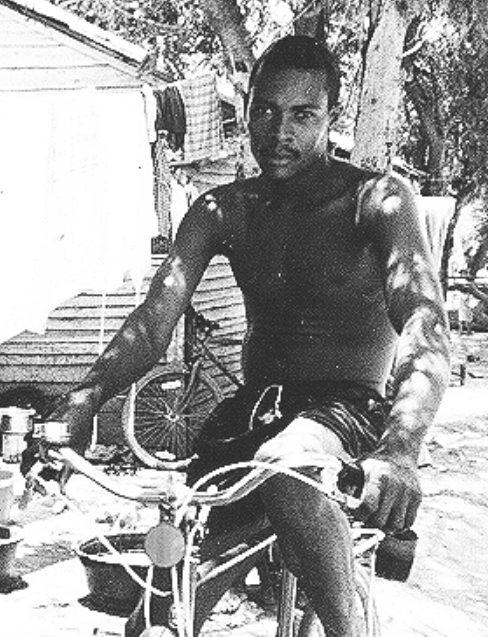
2001winterHaitiDominicanRepublicBiemboBiembo Olivé is a twenty-five-year-old Haitian immigrant who works as a day laborer on local rice plantations. He lives in the part of Boca de Mao called El Batey; the name comes from the time when it housed the Haitian workers who cut sugar cane in the state-owned plantations. Rice, bananas, yuccas and plantains have replaced sugar in this region of the Dominican Republic, but immigrants like Biembo still supply much of the labor.

As a day laborer harvesting rice, Biembo usually earns 100 pesos ($6 US) a day. Paying car fare out of that would cost him 20 pesos daily, and given that option before having the bike, he usually walked.

He came to the Dominican Republic from Cape Haitian, his birthplace, two years ago. He came “Buscando la vida” as the expression here goes, “Looking for a living”. What money he can save from his earnings, he sends to his family in Haiti, toward the construction of a better house there.

2001winterHaitiDominicanRepublicRosa

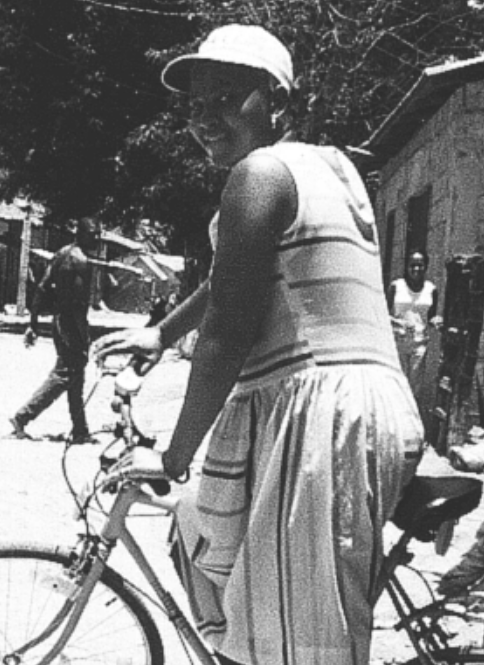
Rosa Pye is a twenty-two-year-old Haitian immigrant who works washing clothes by hand, and also as a field laborer on local rice or tobacco farms. Her husband is twenty-one, Haitian, and works as a day laborer as well.

“I use the bicycle to take meals to my husband in the fields and also for me to get to work”, she says. The trip to the rice fields takes from 30 minutes to an hour on foot. Riding the bike, she arrives in 10 to 20 minutes. Before owning the bike, on days when she didn’t walk to the fields, she paid 20 pesos for car fare. A day in the fields has recently been netting them 80 pesos daily.

Rosa comes from a family of eight children in a small town in northern Haiti near the Haitian–Dominican border. She has been traveling to and from the Dominican Republic to work for the past five years. She met her husband in the D.R. on one of her first trips when she came to work bundling tobacco and picking tomatoes. She says that life here is a little easier.

Afribike: Improving School Attendance through Bicycles

Fall 2001 InGear

In rural South Africa, it is not uncommon for primary and secondary school students to live many miles from their school, and to spend precious hours walking between home and academics. Few South African schools can afford to offer bus service, or board students. Given the distances to cover on foot, many promising students have little time to complete assignments and help their families. Unsurprisingly, many rural youths cannot attend school, or drop out as they get older.

2001fallAfribikeIn an effort to improve school attendance in rural areas, the South African government has initiated a pilot program to distribute affordable bicycles to outstanding students, especially girls. Working with Afribike, a South African-based non-governmental organization (NGO), the National Roads Agency, and provincial transport departments, the National Department of Transportation (NDOT) has launched “Learners-on-Bikes”, with the initial goal of placing 10,000 students on bicycles by mid-2002. Pedals for Progress is the major source of bicycles for this new program, while NDOT will provide $300,000 in funding to cover a portion of shipping, training, and administrative costs.

Learners-on-Bikes will enable primary and secondary school students to purchase inexpensive refurbished bicycles through a combination of cash/credit (minimum contribution of US$12) and sweat equity (assisting the refurbishment and assembly of each bicycle). While the program will exclude no academically qualifying student, it will give preference to students traveling the greatest distances to school. Afribike will offer qualifying students a training course covering the benefits and opportunities of cycling, safety and maintenance/repair issues, and environmental and health impact of cycling.

Afribike will also oversee the establishment of the local “franchises”, or bicycle sales and service businesses that will refurbish the bikes. These community-owned businesses will be capitalized by bicycles and parts donated by Pedals for Progress and, in the future, other foreign sources. Each franchise receives the necessary tools and training that will see the retail operation turn into a sustainable micro-enterprise after an initial twelve-month start-up phase. Wherever possible, local women will be trained and set up as mechanics and shop managers.

Afribike will recover its initial setup investment costs, and subsequent (12-month subsidy phase) establishment cost, together with the shipping and import costs of the bicycles, from projected sales income. Each outlet/franchise will undergo periodic three-month assessments to establish its commercial viability. Close monitoring of the program will allow for strategic adjustment in the approach and also yield valuable lessons for scaling up the initiative. If successful, Afribike, in partnership with Pedals for Progress, will expand the program in 2002–2003, to a network of 80 microenterprise franchises distributing 100,000 bicycles.

For further information on the Learners-on-Wheels Program, or on Afribike in general, visit Afribike.org.

COMWELF: Doing Well in Bawku District, Ghana

Fall 2001 InGear

As Pedals for Progress crosses the 10,000 bicycle per year production mark, Africa is receiving more and more bikes, both in total numbers and as a share of overall production. Over the last decade, seven countries in Africa—most significantly South Africa, Ghana, and Eritrea—have received 6,600 bikes, over half of them in the last 18 months since the beginning of the millennium.

2001fallGhanaBikeWsacks

In our summer 2000 issue of InGear, we featured one of our most promising partners, the Community Welfare Foundation (COMWELF) in Bawku, Ghana, and the process leading to an initial shipment taking place as we went to press. This shipment was sponsored by the Friends of Ghana, a Returned Peace Corp Volunteer group.

Because we feel it important to avoid leaving our readers the impression that our partners are temporary or that the glowing hopes reported beforehand are unfulfilled, here is a summary, and a few excerpts, from a subsequent letter and report dated April 15, 2001, received from COMWELF’s director, John Atibila.

Mr. Atibila began providing some basic statistics and the results of a beneficiary survey. The bikes were popular; of 458 bikes received, 420 were sold within six months. The survey revealed that of 25 interviewed, 21 were male, four female. Respondents indicated multiple use; 80% used bikes to go to work on their farms, 72% in going to markets for selling or shopping, 24% in going to school, 20% going to church, 16% going for medical treatment, and 12% for recreation. According to the report, traders earned 70–100% more income by getting to markets easily and early.

2001fallGhanaBikeWcans

Still others saved money by doing without the local bus. Of those surveyed, 85% claimed having a bike raised their social status and 100% reported that the bikes were “very important.”

Mr. Atibila further stated: “We would like to continue with the bikes project. We now have sufficient funds to order container #2. In addition, we have surplus funds of [$1,000] for our poverty alleviation fund, which provides microcredit to rural women… Thank you for your donation.”

Specifically, COMWELF is seeking two containers of 450 bicycles apiece per year, with which it will train 10 additional bike mechanics and hold the Bawku Zone First Annual Cycling Competition, scheduled December 2001. The objectives will be to make COMWELF the leading bicycle distributor in Northern Ghana, support community development and employment in the region, and generate increasing revenue from the project, “which can support rural micro-enterprise development to alleviate poverty and ensure food security.” So far, so good! Stay tuned!

A Note from GoodWill in Panama

by Tom Ford, board member, Asociación Panamena de Industrias de Buena Voluntad
Fall 2001 InGear

We are anxiously awaiting the arrival of our third container. Despite the fact that we cannot meet the demand for mountain bikes, the public has reacted very favorably to our super prices as a great transportation alternative.

Distribution has included almost all sectors of the Panamanian economy and geography. P4P bikes can be found along small rural roads as well as on wide city streets. Many of the users are first-time owners who have found the bikes to be satisfying both emotionally and economically. A typical case is that of Jose Luis Bethancourt.

2001fallPanamaSeventeen-year-old Jose is the youngest of four brothers born to parents of scant economic means. Since his early childhood Jose worked at sundry jobs ranging from fisherman to car-washer to help make ends meet at home. His desire to go back to school was so great that he struggled, successfully, to obtain a grant and was able to begin his studies anew. But the time required in attending school reduced his ability to contribute to the family income, and he was considering dropping out of school again.

P4P came to the rescue when Jose obtained his first-ever bike. He saved money by not paying bus fares and was able to work longer because the easily maneuverable bike makes the trip to school through Panama’s traffic jams in half the time. Back at work while remaining a student, Jose has once again become an important provider for the family. He boasts about his new-found luxury so much that his friends tease him about his newly gained mobility in his P4P “automobile”. Definitely a satisfied customer!

A Case Study in Monitoring and Evaluation: Guatemala

Fall 2001 InGear

In November, 1999, P4P began shipping to FIDESMA (Fundación Integral de Desarrollo y Medio Ambiente). The first container of 438 bicycles was sponsored by the Golden Rule Foundation; a second shipment of 519 bikes was paid for in part by FIDESMA and partially by the Koinonia Foundation.

FIDESMA serves the highland indigenous community of San Andrés Itzapa, Chimaltenango, providing agricultural extension and other education services, small enterprise assistance, and other community development services. P4P shipped the first container based on a brief proposal from the Guatemalan organization. Due to the isolation of the community and the limited financial capacity of FIDESMA, as well as the linguistic and cultural gulf between the two partners, subsequent communication was sparse, and PfP had little idea of the impact of the first shipment other than that FIDESMA desired another shipment – generally a good indicator!

2001fallGuatemala

Finally, in March 2001, FIDESMA submitted a substantive report. For P4P, it was worth the wait, as the information presented was extensive and appears to justify the investment. Included in the report was a detailed inventory breaking down bikes by category, whether or not they had been sold, etc., per container. The information enabled P4P to better assess its own effectiveness and characteristics in collecting, selecting, and packing, as well as to assess the impact of the bicycles overseas and the potential for sustainability of the relationship.

FIDESMA reported that the project was able to cover its costs, and hence appeared likely to be sustainable. The reported commercial value of the contents of each container ranged from slightly over $12,000 to almost $15,000 (since that time, improvements in packing and the addition of large quantities of valuable new parts donated by the US bike industry has augmented the value of shipments). The reported costs—including not just recurring operating and shipping expenses but also a value-added tax to be rebated and one-time investments in facilities and tools—were under $10,000 per container. We found out more about beneficiaries. FIDESMA reported that 40% of the purchasers were farmers, 25% students, 30% laborers and tradesmen, and 5% working women. Shop employment comprised a mechanic/shop administrator and mechanic’s assistant, supplemented by three full-time apprentices and two part-time apprentices. FIDESMA is seeking a training institute to certify a six-month bike mechanic’s apprenticeship course.

FIDESMA interviewed half a dozen recipients of bicycles and shared the notes with P4P. All were positive, citing the savings in time getting to work, doing errands for the family, and getting to school. Edwin Paulich Velázquez, for example, reported spending as much as four hours daily on his bike, using it principally to cover the five kilometers to work. Not everyone uses the bike solely for work however. Another respondent — Carlos Arnoldo Bueno, who also uses his bike to get to work — specifically mentioned his newfound ability to engage in competitive racing.

José Siquinajay is the local mail carrier. Twenty-nine-years-old and married, José has for several years managed San Andres Itzapa’s mail and telegraph services. Each day he opens the post office and attends to the communication needs of the town. Twice weekly, he goes by bus to nearby Chimaltenango, the provincial seat, to pick up the mail. On his return, he utilizes his bike, obtained through FIDESMA, to deliver the mail throughout the town, covering distances up to two kilometers and up and down steep inclines. According to José, he saves time, gets the mail faster and sooner to customers, and is getting in good physical shape.

Finally, FIDESMA cited the long-term institutional benefits. Not only did the project benefit the community and raise the local group’s profile, the non-profit institution’s skills also strengthened it in business and project management, dealing with government institutions such as Customs and the Ministry of Finance, and generating income for institutional overhead.

Creating Hope in Ada, Ghana

by Lomo Tanihu
Fall 2001 InGear

I am Lomo Tanihu, now 19. I left school ten years ago when my parents could no longer afford to send me. I cannot read or write. In spite of this setback, I decided then that even if I did not go to school, I would still be somebody. But instead of achieving through learning, I would do it through bike-riding.

Bikes are expensive in Ghana, and my parents were too poor to buy one. One member of my family, my Uncle Tetteh, did own a bike, which he used to get to work and to market. From early on, I dreamed of owning one. During my teenage years, I would wake up at 4am so that I could ride my uncle’s bike before he departed for work.

Then one day late last year, I heard on the radio that the NekoTech Center was having a bicycle race and ride for HIV/AIDS awareness. I knew little about NekoTech and little about HIV/AIDS, but a lot about bike racing. The best part was that for 2000 cedis (20 cents) every village kid who did not own a bike could ride for the day…and you could choose your own bike!

Princess Asie, the director of NekoTech, explained to us that Pedals for Progress and Johnson & Johnson helped to bring this chance to Ada. We were also told that the first prize for the race was one million cedis. ($150!) I had never ever held that kind of money before! Most people in the village earn 100,000 to 400,000 cedis per month ($15–$60).

I can never forget that day. The whole village came to life; over 1000 kids came to the center. Only the first 250, registering on a first come-first serve basis, could qualify; many were turned away.

I was there first, four hours before the opening of the center. I had the chance to choose the first bike. Over the years, I had learned how to repair bikes. I had taught myself everything I could about bikes. I chose a red and white Schwinn racer, and serviced it. When I signed up, I even received a PfP t-shirt. I took this as a good sign!

I had promised myself that I would win the first prize and buy this very bike! I could feel so much closer to my dream. We had two weeks to prepare. I woke up every morning at 3am to practice for speed and endurance. On January 26, 2001, the biggest day of my life arrived. I did not ride my uncle’s bike to NekoTech—rather, I walked—because I was determined to win the race and purchase and bring home my Schwinn. Perhaps you will not be surprised I won the race and one million cedis ($150), and immediately bought my Schwinn! I did not know whether to ride the Schwinn or to carry it. I have never experienced such joy in all my 19 years. I had now understood the meaning of having a dream come true!

Since that day, my life has changed in many ways. The local radio mentioned my accomplishment almost ten times. I was shown on national TV!! Best yet, I reconciled with my parents. My father asked me to move back into his house. I am treated like royalty now in my father’s house. I gave part of my winnings to my uncle, whose bike I had borrowed to become a champion.

NekoTech now employs me to repair bikes and to teach other young school dropouts bicycle repair. I was also elected President of the NekoTech Winners Club, a bike club with a mission to educate Ghanaian youth about HIV/AIDS.

The NekoTech “Save a Million Lives” program has brought hope to many in Ada. Beyond HIV/AIDS education and recreation, bikes are used to produce income. Farmers are taught how to carry produce by bike; women and mothers have been taught to ride for the first time. Children ride to school sometimes over six miles instead of walking. The program has given many families a chance to own a bike for the first time. We are all happy about the program and pray for more bikes to come to Ada. The program has also brought hope to me. I am now determined to learn how to read and write. I know that with NekoTech’s assistance, I can do it!

P4P and Rotary in Senegal!

Summer/Fall 1999 InGear

1999summerFallSenegalIn early 1999, P4P made its first shipment—440 bikes—to the West African coastal nation of Senegal. The recipient—the Association des Bacheliers pour L’Emploi et le Developpement (ABACED)—is a non-profit agency, established in 1985 by 20 young Senegalese professionals, which manages programs in savings mobilization and credit, environmental protection, and education, particularly with disadvantaged women and youth. ABACED’s new project reconditions P4P-donated bicycles, generating local employment, and provides them at low cost to urban street vendors, rural farmers producing vegetables for urban markets, and other disadvantaged microentrepreneurs.

First P4P Partner in Mexico!

Summer/Fall 1999 InGear

Desarrollo Rural de Guanajuato (DRG), a 22-year-old affiliate of the Mexican Rural Development Foundation, is P4P’s first partner in this important U.S. neighbor, the hemisphere’s most populous Spanish-speaking country.

In June, 1999, P4P loaded a single-container record of 553 bicycles—collected in New Jersey, Pennsylvania, and Massachusetts—and shipped them to DRG, donating shipping as well as the contents.

DRG works in rural communities throughout Guanajuato, an impoverished and arid state in the central highlands northwest of Mexico City. By project’s end, DRG will establish seven bicycle reconditioning and repair centers providing stable employment for bicycle mechanics and managers, while offering reliable and economical transportation to more than 1,000 low-income workers, students, health and education personnel. Guanajuato, which in the 17th century was the world’s largest producer of silver and a prosperous region, has since been in economic decline.

It’s Better on a Bike! The CELA Bicycle Workshop-School

Summer/Fall 1999 InGear

As Latin America grapples with the inter-linked challenges of poverty, urbanization, and environmental deterioration, a new generation of citizen activists is arising within the market economies overseen by still-fragile democracies. A good example is the Centro de Asistencia Legal Ambiental (Center for Environmental Legal Aid—CELA), based in Cali, Colombia’s third-largest city, which in November 1998 received a grant from Pedals for Progress, Mediterranean Shipping Company, and the Friends of Colombia, of a 40-foot container of 392 used bikes, plus parts.

CELA, through the affiliate Asociación de Cicloamigos “Mi Bicicleta”, has long sponsored the “It’s Better on a Bike” campaign. As a logical and concrete extension of this public education and advocacy program in favor of bicycle transportation, CELA established a Bicycle Workshop-School, adjacent to its offices in Cali, to train youth apprentices in bicycle mechanics, repair, and assembly, and to offer bicycle sales, repair, and maintenance services to the public.

The sale of P4P-donated bicycles and parts generates funds to operate the training program, including salaries of the administrator/trainer and stipends for the apprentices, as well as a reserve fund to pay for subsequent P4P shipments, including international freight, customs duty, and inland transportation costs. Discounts on purchases are provided to members of the Asociación de Cicloamigos, and preference is given to those demonstrating use of the bicycle for daily transport and as a means for generating income.

Through the summer of 1999, CELA has sold the bulk of the P4P-donated bicycles and trained three apprentices, who will shortly return to their communities to set up their own independent businesses. CELA is engaged in discussions with other civic groups and municipalities to identify joint initiatives to build cycling infrastructure and otherwise advance the use of the bicycle as a means of transportation.

Unfortunately, Colombian customs authorities have not been as supportive of the CELA bicycle initiative as local elected officials, interpreting Colombian law to require payment by the group of upwards of $8,000 in import duties, value-added tax, storage charges, and in-country freight from the port inland to Cali. Given the unanticipated financial burden, CELA is uncertain as InGear goes to press whether it will be able to pay future international shipping charges and continue receiving support from Pedals for Progress. For P4P and its partners to succeed, governments must do their part and remove those trade restrictions, which often protect monopoly importers and are biased against the poor.