| Fiscal Year | Total Expense | Bikes Shipped | Sewing Machines Shipped | Total Units Shipped | Cost per Unit Shiped | Cost per Bike Shipped |
|---|---|---|---|---|---|---|
| 2017 | $357,230 | 2760 | 285 | 3045 | $117 | $129 |
| 2018 | $192,013 | 3644 | 469 | 4113 | $47 | $53 |
| 2019 | $184,993 | 2935 | 456 | 3391 | $55 | $63 |
| 2020 | $167,672 | 2806 | 565 | 3371 | $50 | $60 |
| 2021 | $228,873 | 1827 | 356 | 2183 | $105 | $125 |
| 2022 | $259,584 | 2814 | 408 | 3222 | $81 | $92 |
| 2023 | $182,526 | 2322 | 514 | 2836 | $64 | $79 |
| 2024 | $181,585 | 2171 | 417 | 2588 | $70 | $84 |
| 2025 | $238,340 | 2265 | 406 | 2671 | $89 | $105 |
| 2026 | $186,485 | 2643 | 359 | 3002 | $62 | $71 |
All posts by Michael Sabrio
Sewing Machines Shipped
| 1999 | 2000 | 2001 | 2002 | 2003 | 2004 | 2005 | 2006 | 2007 | 2008 | 2009 | 2010 | 2011 | 2012 | 2013 | 2014 | 2015 | 2016 | 2017 | 2018 | 2019 | 2020 | 2021 | 2022 | 2023 | 2024 | 2025 | 2026 | Country Totals | |
|---|---|---|---|---|---|---|---|---|---|---|---|---|---|---|---|---|---|---|---|---|---|---|---|---|---|---|---|---|---|
| Albania | 30 | 39 | 52 | 59 | 25 | 70 | 46 | 93 | 50 | 50 | 70 | 40 | 624 | ||||||||||||||||
| Belize | 100 | 120 | 25 | 90 | 45 | 380 | |||||||||||||||||||||||
| Cameroon | 15 | 100 | 72 | 72 | 259 | ||||||||||||||||||||||||
| Costa Rica | 18 | 19 | 100 | 137 | |||||||||||||||||||||||||
| Dominican Republic | 17 | 13 | 30 | ||||||||||||||||||||||||||
| El Salvador | 5 | 15 | 58 | 7 | 67 | 51 | 62 | 78 | 43 | 156 | 542 | ||||||||||||||||||
| Ethiopia | 72 | 72 | |||||||||||||||||||||||||||
| Fiji | 68 | 68 | |||||||||||||||||||||||||||
| Ghana | 10 | 31 | 39 | 130 | 49 | 27 | 132 | 69 | 74 | 561 | |||||||||||||||||||
| Guatemala | 3 | 10 | 9 | 19 | 20 | 11 | 18 | 15 | 102 | 60 | 36 | 20 | 40 | 28 | 15 | 35 | 55 | 15 | 511 | ||||||||||
| Honduras | 39 | 7 | 46 | ||||||||||||||||||||||||||
| Jamaica | 6 | 6 | |||||||||||||||||||||||||||
| Kenya | 34 | 72 | 106 | ||||||||||||||||||||||||||
| Kosovo | 50 | 50 | |||||||||||||||||||||||||||
| Kyrgyzstan | 25 | 30 | 55 | ||||||||||||||||||||||||||
| Liberia | 70 | 72 | 142 | ||||||||||||||||||||||||||
| Mexico | 72 | 72 | |||||||||||||||||||||||||||
| Moldova | 15 | 15 | 72 | 53 | 155 | ||||||||||||||||||||||||
| Nicaragua | 18 | 36 | 26 | 39 | 72 | 24 | 34 | 15 | 25 | 20 | 10 | 11 | 6 | 2 | 12 | 350 | |||||||||||||
| Nigeria | 145 | 145 | |||||||||||||||||||||||||||
| Panama | 14 | 14 | |||||||||||||||||||||||||||
| Perú | 65 | 65 | |||||||||||||||||||||||||||
| Philippines | 35 | 35 | |||||||||||||||||||||||||||
| Rwanda | 43 | 60 | 101 | 204 | |||||||||||||||||||||||||
| Sierra Leone | 30 | 72 | 95 | 197 | |||||||||||||||||||||||||
| Somalia | 72 | 72 | |||||||||||||||||||||||||||
| South Africa | 71 | 71 | |||||||||||||||||||||||||||
| St. Vincent | 20 | 20 | |||||||||||||||||||||||||||
| Tanzania | 101 | 74 | 143 | 119 | 57 | 43 | 72 | 72 | 72 | 753 | |||||||||||||||||||
| Togo | 72 | 100 | 100 | 123 | 100 | 20 | 515 | ||||||||||||||||||||||
| Uganda | 34 | 56 | 11 | 36 | 51 | 82 | 73 | 69 | 72 | 72 | 90 | 144 | 144 | 934 | |||||||||||||||
| USA | 3 | 3 | |||||||||||||||||||||||||||
| Vietnam | 30 | 30 | |||||||||||||||||||||||||||
| Yemen | 60 | 60 | |||||||||||||||||||||||||||
| Zambia | 71 | 71 | |||||||||||||||||||||||||||
| Year Totals | 17 | 75 | 58 | 94 | 55 | 172 | 109 | 203 | 160 | 182 | 311 | 246 | 139 | 113 | 185 | 274 | 310 | 285 | 469 | 456 | 565 | 356 | 408 | 514 | 417 | 406 | 359 | 417 | 7355 |
Bikes Shipped
| 1991 | 1992 | 1993 | 1994 | 1995 | 1996 | 1997 | 1998 | 1999 | 2000 | 2001 | 2002 | 2003 | 2004 | 2005 | 2006 | 2007 | 2008 | 2009 | 2010 | 2011 | 2012 | 2013 | 2014 | 2015 | 2016 | 2017 | 2018 | 2019 | 2020 | 2021 | 2022 | 2023 | 2024 | 2025 | 2026 | Country Totals | |
|---|---|---|---|---|---|---|---|---|---|---|---|---|---|---|---|---|---|---|---|---|---|---|---|---|---|---|---|---|---|---|---|---|---|---|---|---|---|
| Albania | 463 | 523 | 479 | 1022 | 912 | 1003 | 1006 | 1016 | 949 | 453 | 474 | 450 | 871 | 870 | 10491 | ||||||||||||||||||||||
| Barbados | 750 | 822 | 823 | 866 | 855 | 441 | 1001 | 953 | 887 | 465 | 7863 | ||||||||||||||||||||||||||
| Belize | 473 | 867 | 404 | 905 | 432 | 3081 | |||||||||||||||||||||||||||||||
| Cameroon | 462 | 462 | |||||||||||||||||||||||||||||||||||
| Colombia | 392 | 444 | 470 | 387 | 1693 | ||||||||||||||||||||||||||||||||
| Costa Rica | 589 | 438 | 1027 | ||||||||||||||||||||||||||||||||||
| Dominican Republic | 657 | 350 | 768 | 388 | 1397 | 3560 | |||||||||||||||||||||||||||||||
| Ecuador | 350 | 722 | 433 | 50 | 1555 | ||||||||||||||||||||||||||||||||
| El Salvador | 457 | 434 | 447 | 879 | 432 | 1015 | 1759 | 2907 | 2396 | 2584 | 3081 | 3143 | 1102 | 1092 | 1664 | 576 | 23968 | ||||||||||||||||||||
| Eritrea | 785 | 729 | 834 | 413 | 2761 | ||||||||||||||||||||||||||||||||
| Fiji | 213 | 122 | 270 | 2 | 405 | 440 | 1452 | ||||||||||||||||||||||||||||||
| Ghana | 369 | 878 | 816 | 1571 | 1213 | 882 | 481 | 1617 | 470 | 2270 | 963 | 928 | 458 | 864 | 0 | 460 | 1581 | 479 | 16300 | ||||||||||||||||||
| Guadalcanal | 310 | 313 | 623 | ||||||||||||||||||||||||||||||||||
| Guatemala | 424 | 527 | 1107 | 530 | 517 | 430 | 577 | 535 | 523 | 580 | 558 | 545 | 1022 | 488 | 1317 | 524 | 943 | 417 | 470 | 913 | 460 | 431 | 419 | 14257 | |||||||||||||
| Haiti | 87 | 436 | 523 | ||||||||||||||||||||||||||||||||||
| Honduras | 1306 | 1334 | 1408 | 1924 | 1452 | 461 | 7885 | ||||||||||||||||||||||||||||||
| India | 18 | 18 | |||||||||||||||||||||||||||||||||||
| Jamaica | 600 | 600 | |||||||||||||||||||||||||||||||||||
| Kenya | 403 | 403 | |||||||||||||||||||||||||||||||||||
| Kosovo | 450 | 436 | 886 | ||||||||||||||||||||||||||||||||||
| Madagascar | 8 | 15 | 17 | 20 | 12 | 72 | |||||||||||||||||||||||||||||||
| Malawi | 5 | 5 | |||||||||||||||||||||||||||||||||||
| Mexico | 553 | 553 | |||||||||||||||||||||||||||||||||||
| Moldova | 452 | 417 | 467 | 479 | 477 | 478 | 475 | 439 | 3684 | ||||||||||||||||||||||||||||
| Mozambique | 425 | 375 | 800 | ||||||||||||||||||||||||||||||||||
| Namibia | 373 | 451 | 824 | ||||||||||||||||||||||||||||||||||
| Nicaragua | 129 | 684 | 294 | 1325 | 1245 | 2719 | 1567 | 1359 | 1411 | 997 | 1508 | 1025 | 2994 | 4048 | 3166 | 3760 | 2793 | 2670 | 2240 | 2286 | 1141 | 1141 | 565 | 1103 | 502 | 533 | 43205 | ||||||||||
| Nigeria | 463 | 463 | |||||||||||||||||||||||||||||||||||
| Pakistan | 400 | 400 | |||||||||||||||||||||||||||||||||||
| Panama | 948 | 1029 | 951 | 1511 | 2091 | 6530 | |||||||||||||||||||||||||||||||
| Papua New Guinea | 2 | 2 | |||||||||||||||||||||||||||||||||||
| Peru | 143 | 143 | |||||||||||||||||||||||||||||||||||
| Rwanda | 503 | 452 | 429 | 1384 | |||||||||||||||||||||||||||||||||
| Senegal | 440 | 450 | 890 | ||||||||||||||||||||||||||||||||||
| Sierra Leone | 21 | 938 | 455 | 1414 | |||||||||||||||||||||||||||||||||
| South Africa | 444 | 1736 | 2180 | ||||||||||||||||||||||||||||||||||
| Sri Lanka | 487 | 487 | |||||||||||||||||||||||||||||||||||
| Tanzania | 469 | 439 | 444 | 1352 | |||||||||||||||||||||||||||||||||
| Thailand | 472 | 472 | |||||||||||||||||||||||||||||||||||
| Togo | 463 | 976 | 927 | 391 | 496 | 3253 | |||||||||||||||||||||||||||||||
| U.S.A. | 39 | 27 | 24 | 30 | 50 | 45 | 215 | ||||||||||||||||||||||||||||||
| Uganda | 436 | 927 | 950 | 496 | 458 | 431 | 442 | 4140 | |||||||||||||||||||||||||||||
| Venezuela | 411 | 411 | |||||||||||||||||||||||||||||||||||
| Vietnam | 565 | 570 | 528 | 1663 | |||||||||||||||||||||||||||||||||
| Year Totals | 168 | 854 | 533 | 2449 | 4134 | 5402 | 5468 | 6287 | 7001 | 8970 | 9174 | 11576 | 11808 | 11832 | 8536 | 8961 | 7622 | 6628 | 6652 | 4723 | 4157 | 3769 | 2018 | 3634 | 3239 | 2760 | 3644 | 2935 | 2824 | 1827 | 2814 | 2322 | 2171 | 2265 | 2643 | 2150 | 173950 |
P4P Profit and Loss, 2016 to 2025
| Oct '16 - Sep 17 | Oct '17 - Sep 18 | Oct '18 - Sep 19 | Oct '19 - Sep 20 | Oct '20 - Sep 21 | Oct '21 - Sep 22 | Oct '22 - Sep 23 | Oct '23 - Sep 24 | Oct '24 - Sep 25 | Oct '25 - Sep 26 | TOTALS | |
|---|---|---|---|---|---|---|---|---|---|---|---|
| Ordinary Income/Expense | |||||||||||
| Income | |||||||||||
| Contributions - Cash w/Bikes | $30,163 | $29,884 | $22,671 | $19,775 | $32,739 | $35,730 | $34,492 | $42,166 | $37,211 | $29,674 | $314,505 |
| Contributions - Civic Groups | $3,460 | $4,675 | $2,596 | $2,808 | $281 | $2,736 | $1,500 | $1,300 | $1,750 | $2,450 | $23,555 |
| Contributions - Corp/Foundation | $19,090 | $16,668 | $7,558 | $9,872 | $17,958 | $19,585 | $7,335 | $6,350 | $8,250 | $2,787 | $115,452 |
| Contributions - Individuals | $93,057 | $106,764 | $100,221 | $107,236 | $122,499 | $197,664 | $95,028 | $143,307 | $105,142 | $142,261 | $1,213,178 |
| Contributions - Religious Org. | $4,830 | $6,018 | $4,600 | $3,131 | $2,375 | $1,835 | $561 | $4,210 | $2,057 | $4,151 | $33,767 |
| Contributions - Sewing Machines | $6,312 | $5,985 | $7,925 | $2,920 | $8,260 | $5,469 | $6,880 | $9,484 | $8,798 | $5,204 | $67,237 |
| In Kind Contributions Received | $144,731 | $0 | $0 | $0 | $0 | $0 | $0 | $0 | $0 | $0 | $144,731 |
| Interest Income | $12 | $657 | $216 | $49 | $55 | $8 | $7 | $0 | $920 | $0 | $1,925 |
| Investment Income | $591 | $105 | $650 | $593 | $766 | $469 | $2,849 | $6,276 | $4,453 | $3,705 | $20,457 |
| Merchandise Sales | $40 | $150 | $0 | $0 | $0 | $0 | $0 | $0 | $0 | $0 | $190 |
| Miscellaneous Income | $0 | $6,728 | $0 | $0 | $0 | $0 | $0 | $0 | $0 | $0 | $6,728 |
| Revolving Funds | $51,971 | $30,610 | $27,837 | $13,378 | $35,890 | $19,560 | $33,500 | $31,315 | $49,300 | $40,685 | $334,045 |
| Total Income | $354,516 | $208,244 | $174,273 | $160,541 | $220,824 | $283,056 | $182,902 | $245,448 | $225,040 | $233,577 | $2,288,421 |
| Expense | |||||||||||
| travel expense | $0 | $0 | $0 | $580 | $2,772 | $8,601 | $2,658 | $223 | $2,368 | $0 | $17,201 |
| Reconciliation Discrepancies | $0 | $0 | $0 | -$0 | $0 | $14 | -$56 | $19 | -$1,468 | $0 | -$1,491 |
| *Payroll Expenses | $50 | $0 | $0 | $0 | $0 | $0 | $0 | $0 | $0 | $0 | $50 |
| Advertising | $0 | $0 | $0 | $80 | $135 | $850 | $1,220 | $2,014 | $1,453 | $1,135 | $6,888 |
| Automobile Expense | |||||||||||
| President Mileage | $0 | $0 | $0 | $0 | $0 | $0 | $591 | $960 | $0 | $0 | $1,552 |
| Automobile Expense - Other | $0 | $0 | $0 | $0 | $0 | $382 | $0 | $0 | $0 | $0 | $382 |
| Total Automobile Expense | $0 | $0 | $0 | $0 | $0 | $382 | $591 | $960 | $0 | $0 | $1,933 |
| Bank Service Charges | $319 | $458 | $514 | $356 | $605 | $401 | $803 | $1,320 | $1,535 | $1,289 | $7,600 |
| Collection Expense | $13,318 | $10,063 | $11,979 | $5,816 | $11,193 | $7,837 | $12,974 | $16,975 | $13,463 | $12,732 | $116,351 |
| Computer Equipment | $333 | $1,315 | $1,459 | $0 | $1,844 | $0 | $1,271 | $0 | $0 | $0 | $6,221 |
| Credit Card Fees | $990 | $1,265 | $1,070 | $1,192 | $1,359 | $1,529 | $804 | $410 | $993 | $940 | $10,551 |
| Dave's Mileage | $1,078 | $538 | $153 | $580 | $853 | $0 | $0 | $0 | $0 | $0 | $3,203 |
| Depreciation Expense | $931 | $0 | $0 | $0 | $0 | $0 | $0 | $0 | $0 | $0 | $931 |
| Dues and Subscriptions | $0 | $39 | $150 | $0 | $0 | $0 | $0 | $0 | $0 | $495 | $684 |
| Fund Raising | $375 | $0 | $0 | $0 | $0 | $0 | $80 | $0 | $0 | $0 | $455 |
| In Kind Contributions Shipped | $159,706 | $0 | $0 | $0 | $0 | $0 | $0 | $0 | $0 | $0 | $159,706 |
| Insurance | |||||||||||
| Business Owners | $0 | $2,867 | $1,777 | $4,224 | $2,519 | $2,259 | $5,406 | $0 | $2,269 | $0 | $21,321 |
| D&O Liability | $0 | $0 | $0 | $0 | $0 | $0 | $0 | $2,134 | $0 | $717 | $2,851 |
| Worker's Comp | $6,726 | $3,644 | $3,755 | -$4,020 | $2,731 | $1,688 | -$406 | $543 | $1,540 | $1,376 | $17,576 |
| Total Insurance | $6,726 | $6,511 | $5,532 | $204 | $5,250 | $3,947 | $5,000 | $2,677 | $3,808 | $2,093 | $41,749 |
| Interest Expense | $0 | -$94 | $0 | $0 | $0 | $0 | $209 | $0 | $17 | $48 | $179 |
| Licenses | |||||||||||
| Permits | $610 | $325 | $820 | $790 | $1,234 | $550 | $1,066 | $1,851 | $847 | $547 | $8,641 |
| State Fees | $311 | $370 | $276 | $277 | $231 | $381 | $25 | $31 | $206 | $0 | $2,105 |
| Licenses - Other | $0 | $0 | $0 | $0 | $0 | $0 | $0 | $0 | $0 | $0 | $0 |
| Total Licenses | $921 | $695 | $1,096 | $1,067 | $1,464 | $931 | $1,091 | $1,882 | $1,053 | $547 | $10,746 |
| Merchandise Cost | $998 | $0 | $904 | $420 | $994 | $907 | $0 | $375 | $509 | $250 | $5,357 |
| Miscellaneous | $0 | $127 | $0 | $0 | $0 | $0 | $0 | $0 | $0 | $254 | $381 |
| Office Supplies | $1,464 | $511 | $977 | $1,559 | $1,665 | $1,611 | $729 | $1,867 | $1,390 | $720 | $12,493 |
| Parts & Tools | $120 | $0 | $0 | $0 | $0 | $0 | $0 | $0 | $0 | $0 | $120 |
| Payroll Expenses | |||||||||||
| Labor Assessment | $0 | $33 | $0 | $0 | $0 | $0 | $0 | $0 | $0 | $0 | $33 |
| Salaries | $15,852 | $17,651 | $16,440 | $17,924 | $30,206 | $50,451 | $70,016 | $76,617 | $103,097 | $67,448 | $465,702 |
| Officers' Salaries | $64,822 | $65,715 | $62,273 | $66,830 | $73,079 | $80,000 | $0 | $0 | $0 | $0 | $412,719 |
| Outside Services | |||||||||||
| Payroll Preparation Fee | $497 | $496 | $507 | $549 | $581 | $512 | $355 | $401 | $316 | $372 | $4,585 |
| Total Outside Services | $497 | $496 | $507 | $549 | $581 | $512 | $355 | $401 | $316 | $372 | $4,585 |
| Payroll Taxes | |||||||||||
| Taxes - EE | $64 | $266 | $27 | $232 | $931 | $118 | -$0 | $249 | $426 | $184 | $2,497 |
| Taxes - ER | $6,723 | $6,803 | $6,381 | $6,926 | $8,351 | $10,659 | $6,663 | $7,173 | $8,890 | $5,932 | $74,502 |
| Total Payroll Taxes | $6,787 | $7,069 | $6,409 | $7,158 | $9,282 | $10,777 | $6,663 | $7,422 | $9,316 | $6,116 | $76,998 |
| Retirement Expense | $10,392 | $11,268 | $9,145 | $11,956 | $15,459 | $15,043 | $6,731 | $7,425 | $14,785 | $7,500 | $109,704 |
| Payroll Expenses - Other | $0 | $0 | $28 | $30 | $0 | $30 | $79 | $0 | $59 | $31 | $257 |
| Total Payroll Expenses | $98,350 | $102,231 | $94,801 | $104,447 | $128,608 | $156,813 | $83,845 | $91,864 | $127,572 | $81,468 | $1,069,998 |
| Postage and Delivery | $3,138 | $2,888 | $2,747 | $2,745 | $3,140 | $3,506 | $3,416 | $2,341 | $2,447 | $2,281 | $28,649 |
| Printing and Reproduction | $5,215 | $5,252 | $6,423 | $6,018 | $9,114 | $7,385 | $7,554 | $7,198 | $15,287 | $11,447 | $80,893 |
| Professional Fees | |||||||||||
| Bookkeeper | $1,513 | $1,195 | $1,198 | $1,193 | $1,368 | $1,388 | $1,620 | $1,105 | $1,724 | $1,408 | $13,709 |
| Accounting | $7,070 | $11,917 | $2,895 | $2,845 | $2,845 | $2,800 | $2,925 | $3,000 | $6,450 | $0 | $42,747 |
| Website Authoring | $0 | $0 | $228 | $0 | $228 | $238 | $0 | $0 | $0 | $0 | $694 |
| Professional Fees - Other | $0 | -$6,700 | $0 | $0 | $0 | $0 | $0 | $0 | $0 | $0 | -$6,700 |
| Total Professional Fees | $8,583 | $6,412 | $4,321 | $4,038 | $4,441 | $4,426 | $4,545 | $4,105 | $8,174 | $1,408 | $50,450 |
| Realized Loss | $0 | $0 | $0 | $0 | $0 | $0 | $0 | $0 | $0 | $0 | $0 |
| Rent | $15,300 | $16,200 | $16,050 | $16,200 | $16,350 | $16,050 | $17,000 | $18,000 | $18,495 | $18,540 | $168,185 |
| Shipping & Packing | $36,064 | $33,710 | $30,506 | $19,649 | $36,824 | $42,280 | $36,187 | $26,880 | $38,564 | $48,406 | $349,069 |
| Telephone & Internet | |||||||||||
| Telephone & Internet | $2,321 | $2,094 | $2,967 | $2,622 | $2,091 | $1,961 | $0 | $0 | $0 | $0 | $14,055 |
| Telephone & Internet - Other | $37 | $1,005 | $0 | $154 | $0 | $0 | $2,304 | $1,905 | $2,228 | $2,431 | $10,064 |
| Total Telephone & Internet | $2,358 | $3,098 | $2,967 | $2,776 | $2,091 | $1,961 | $2,304 | $1,905 | $2,228 | $2,431 | $24,119 |
| Travel | |||||||||||
| Travel Expenses | $598 | $559 | $3,149 | $0 | $0 | $0 | $0 | $0 | $0 | $0 | $4,306 |
| Travel - Other | $8 | $180 | $0 | $0 | $0 | $0 | $0 | $0 | $0 | $0 | $188 |
| Total Travel | $606 | $739 | $3,149 | $0 | $0 | $0 | $0 | $0 | $0 | $0 | $4,494 |
| Utilities | $287 | $54 | $197 | -$53 | $171 | $156 | $298 | $570 | $454 | $0 | $2,134 |
| Total Expense | $357,230 | $192,013 | $184,993 | $167,672 | $228,873 | $259,584 | $182,526 | $181,585 | $238,340 | $186,485 | $2,179,300 |
| Net Ordinary Income | -$2,714 | $16,231 | -$10,720 | -$7,130 | -$8,050 | $23,472 | $377 | $63,863 | -$13,300 | $47,092 | $109,121 |
| Other Income/Expense | |||||||||||
| Other Income | |||||||||||
| Other Income | $0 | $0 | $565 | $0 | $19,700 | $0 | $0 | $0 | $0 | $0 | $20,265 |
| Unrealized Gain/Loss | $1,551 | $2,759 | $614 | $3,781 | $9,058 | -$2,940 | $171 | $1,154 | $782 | $1,009 | $17,938 |
| Total Other Income | $1,551 | $2,759 | $1,179 | $3,781 | $28,758 | -$2,940 | $171 | $1,154 | $782 | $1,009 | $38,203 |
| Other Expense | |||||||||||
| Total Other Expense | $0 | $0 | $0 | $0 | $0 | $0 | $0 | $0 | $0 | $0 | $0 |
| Net Other Income | $1,551 | $2,759 | $1,179 | $3,781 | $28,758 | -$2,940 | $171 | $1,154 | $782 | $1,009 | $38,203 |
| Net Income | -$1,163 | $18,990 | -$9,541 | -$3,349 | $20,708 | $20,532 | $547 | $65,017 | -$12,518 | $48,100 | $147,324 |
Report from the Rwanda Wildlife Conservation Association, October 2026
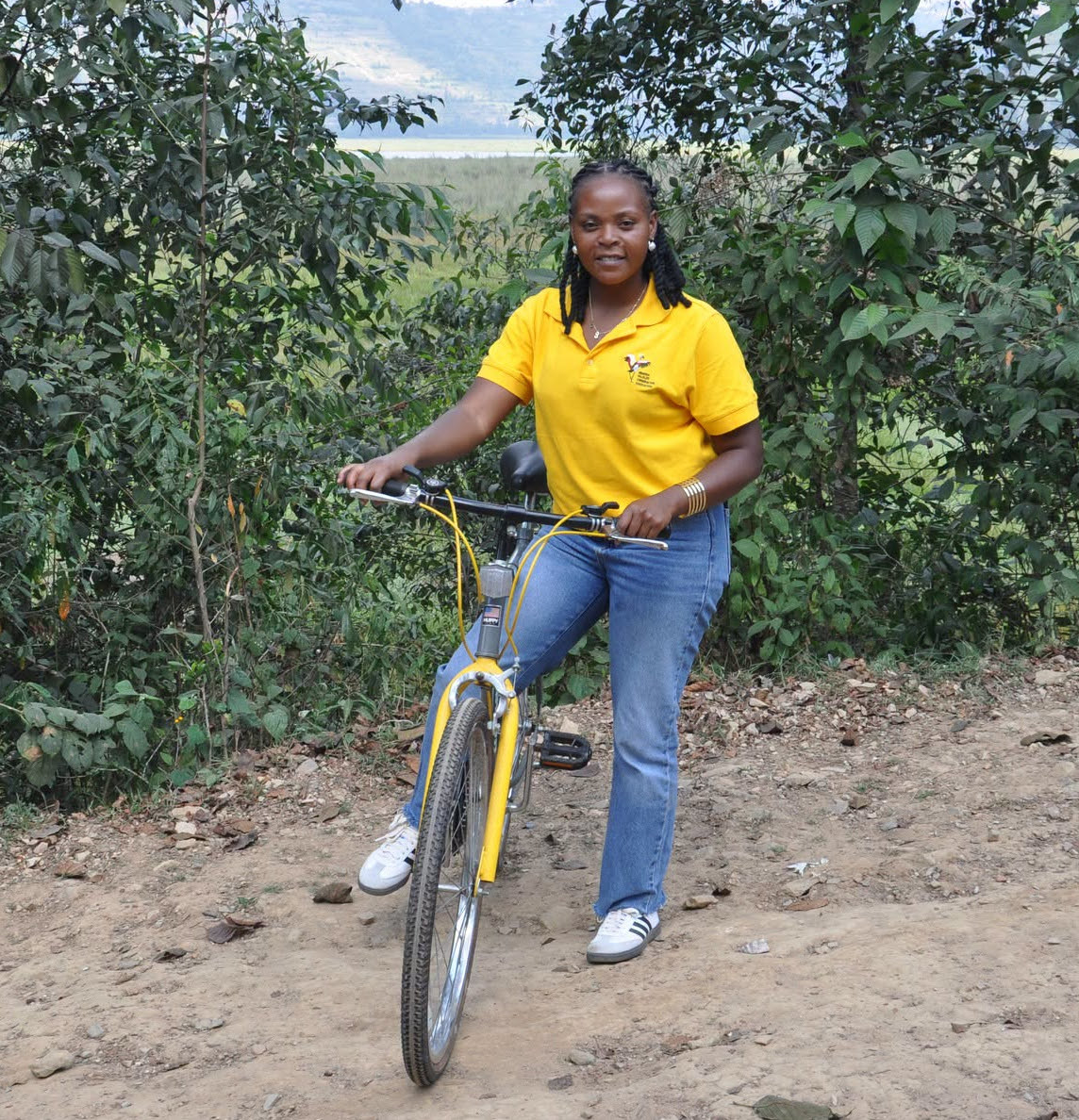 For our field teams, getting to the places where they work can take time. This means less time for patrols, responding slower to conservation emergencies, and challenges for those who have families waiting for them at home.
That is why we are so grateful to have received 400 bicycles from Pedals for Progress to support our conservation work across Rwanda.
“Before receiving my bicycle, I had to prepare my children in the morning and then walk for hours to reach some patrol areas. I often arrived late and worried about getting home late and missing time with my children. Now, with my bicycle, I can reach patrol areas faster, respond to my duties on time, and still return home to be with my family. This bicycle will make a big difference in my life, helping me balance my responsibilities as a Ranger and a mother while continuing to protect the marsh.”
A big thank you to Pedals for Progress for helping our teams go further in protecting Rwanda’s wildlife and natural habitats.
P4P Greatest Hits
P4P Greatest Hits
P4P has published more than 500 posts. It’s tough to pick favorites, but here are a few that stand out.
- Summer 1940: Neal Oussoren’s bike in World War II (from the Summer 2021 Newsletter)
- 1998 Fall Newsletter: Baton Rouge Beth: an 8-year-old organizes a collection that gets 398 bikes.
- 2001 Fall Newsletter: Guatemala Case Study: early FIDESMA report and grinding corn with a bike
- 2002 Spring Newsletter: Cycle Wheelchair in Ghana: Akrofi uses a wheelchair with a hand crank.
- 2004 Summer Newsletter: Refurbishing Bikes in the Ellsworth Correctional Facility, Ellsworth, Kansas
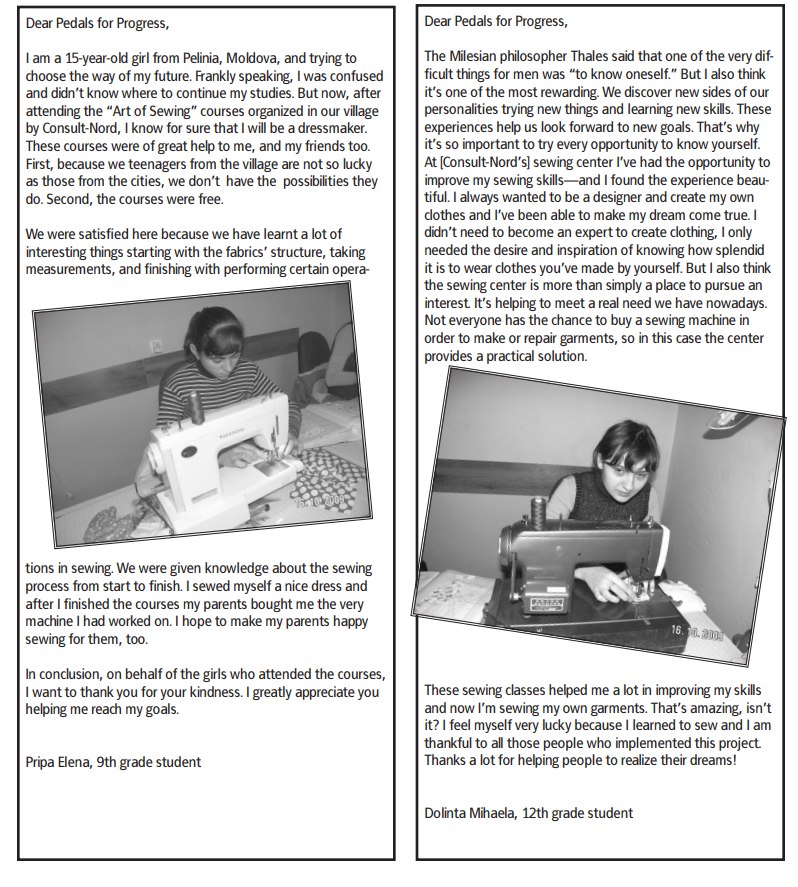
- 2010 Fall Newsletter: Pripa and Dolinta, high-school girls sewing in Moldova
- Blood feuds in Albania
- 2015 Fall Newsletter: Klodi, new bike owner
- 2019 Spring Newsletter: Sewing machines in Northern Albania
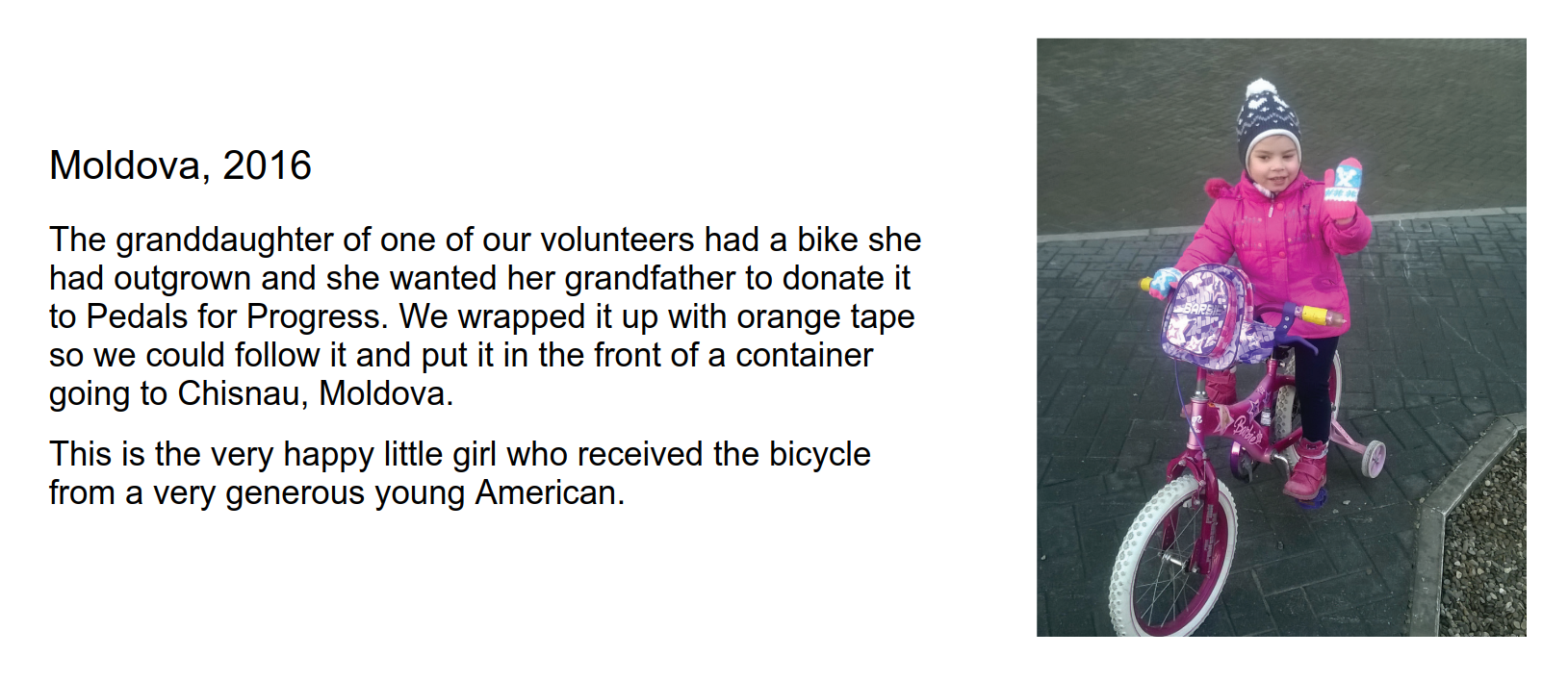
- 2016 Spring Newsletter: Barbie Bike in Moldova
- 2017 Fall Newsletter: Ghana: Using a bike to carry 300+ pounds of water to sell
- 2018 Spring Newsletter: Sewing in Cameroon
- 2020 Spring Newsletter, Tanzania:
- 2020 Fall Newsletter: P4P gets a bike for David Loveland’s 12,000-mile bike ride
-
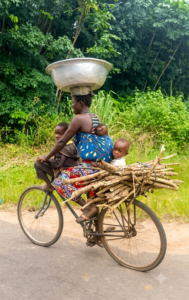
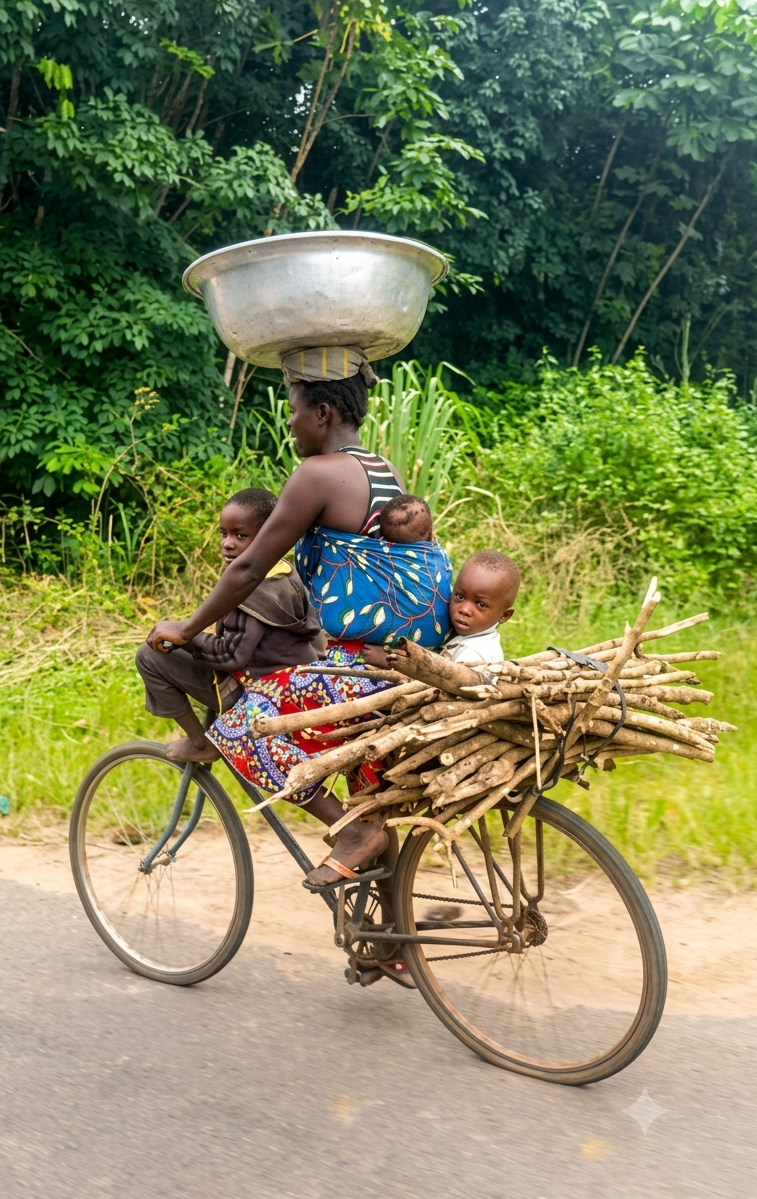
Cargo bike in Togo, Summer 2021 2021 Summer Newsletter: Report from Togo: Women use bikes to carry all kinds of cargo.
- 2021 Summer Newsletter: Trafficking in Sierra Leone
- 2022 Spring Newsletter: Bikes and Sewing Machines in Togo
- 2022 Fall Newsletter: Collections in Oneonta, New York: 2007 and 2022
- 2024 Fall Newsletter: Bikes in Sierra Leone
High productivity and professional quality from Ellsworth, Kansas
By Sam Cline, Warden
Summer 2004 Newsletter
The Ellsworth Correctional Facility (ECF) located in North Central Kansas, houses 830 medium security inmates. Dedicated in 1988, the ECF is located on 60 acres of ground on the northwest corner of the City of Ellsworth, Kansas.
In 2001, a bicycle program was created at ECF, where donated bicycles are refurbished by inmates for distribution to less fortunate children. The distribution of these bicycles is carried out by civic organizations during the holidays. Any bicycles that don’t go to the children are designated for shipment to developing countries. And that’s where Pedals for Progress steps in.
The most recent shipment of ECF bicycles was in March 2004, when 446 bikes were sent to Kumasi, Ghana. This was helped along by a generous charitable donation from the Post Rock JayCees chapter, which is made up of inmates at the Ellsworth Correctional Facility. By conducting numerous fundraising events within the prison they raised enough money to subsidize the shipment.
The ECF bicycle program employs 15 inmates and provides valuable work for these men throughout the day. Their pay is provided by the State of Kansas and is not part of donated funds for the bicycle repairs. Additional supporting funds for this project come from the Ellsworth Kiwanis Club, which serves as the program’s sponsoring civic group. Through the Kiwanis, necessary funds for the purchase of supplies, parts, tubes and tires are provided.
Bikes leaving ECF are among the best bikes Pedals for Progress collects. After all, these bikes receive special treatment far beyond the usual P4P bike processing. To begin with, the shop area for the ECF Bicycle program is as well organized as a professional bike shop. And the work done to each bike is very thorough. They are cleaned, lubed and tuned up, and even receive some disassembly in order to grease bearings and thoroughly clean the drive components. Worn tubes and tires are replaced with new ones. And when needed, the ECF inmates even go so far as to repaint the bikes. The bikes are made new again.
Inspired by doing something that benefits others, the productivity of the inmates in this program is very high. In addition to learning new skills, this work is very heartening to the men, especially when they receive news about how the bikes are being used wherever they’ve been shipped.
Both ECF and Pedals for Progress are very proud of the relationship that has been created through bicycles and good will. As with all P4P programs, ECF helps to prevent a valuable resource – used bikes – from becoming part the vast waste stream of America and gets these bikes to very deserving people across the world. And as an added benefit, the ECF/P4P program provides meaningful work for men seeking to improve their own lives while incarcerated.
Baton Rouge Beth, Collector “Extraordinaire”
Fall 1998 Newsletter
At eight years of age, Beth accompanied her mother Robbie McHardy on a business trip to Philadelphia to attend a national conference on Service Learning. As Beth sat through (in her words) “another boring meeting,” she flipped through the conference program, looking for something – anything! – that sounded more interesting. At the first opportunity Beth guided her mother through the conference center to where Dave Schweidenback was demonstrating how bikes are processed for overseas shipment.
“This is so easy to do. I’ve even had 6 years old Brownies processing bikes,” Dave said. When someone in the audience snickered at the idea, Dave looked around the room for proof! He spotted Beth, and quickly called her to the front of the room to learn how to remove pedals and turn handle bars. She accepted the challenge.
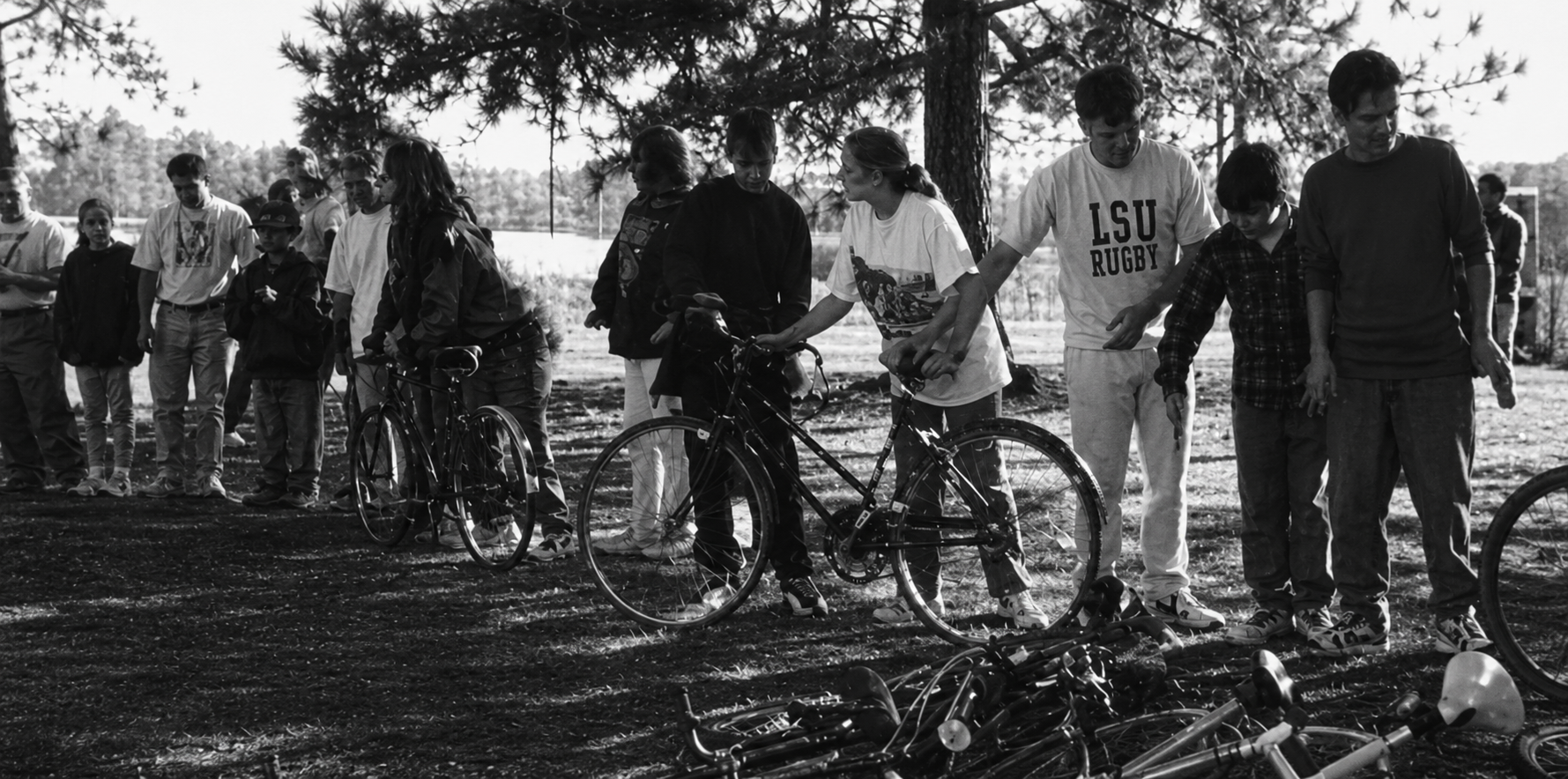
Beth begged her mother to help her organize a collection in Baton Rouge. Three years later in March 1997, Baton Rouge held its first Pedals for Progress collection. Mother and daughter contacted friends in five middle schools and convinced them to hold collections at their schools, all on the same Saturday morning. The 350 bicycles collected that morning were all processed the way Beth had learned in Philadelphia and brought to a central location on the Louisiana State University campus. There Beth and her parents and fellow volunteers were joined by ten players from the LSU football team to pack the bikes into an 18-wheeler for shipment to Rivas, Nicaragua. The afternoon’s work was topped off with pizza and sodas (through the generosity of the Baton Rouge Coca-Cola Bottling Co.).
The most remarkable thing about that first year was the fun that these sixth and seventh graders had getting to know each other. In 1998 they decided to build on that feeling of working together by inviting ALL of the middle schools in Baton Rouge to participate. Beth wrote letters and her mother met with principals from 36 public, private, and parochial schools throughout the city. Twenty schools agreed to participate, providing a cross section of Baton Rouge middle schoolers in terms of types of schools and neighborhood makeup.
All told, 207 volunteers worked during the 1998 Baton Rouge collection, which yielded 398 bikes and $1,445 in donations. Beth’s dad, Gaylord James, who received a grant from Exxon for $1000 toward shipping costs and led the truck packing effort for CESTA in El Salvador, with the aid of all 25 members of the L.S.U. Rugby Team. Beth, her parents, and her eight-year old brother Robert would like to draw in the remaining 16 schools and thus create a citywide effort in a charitable project on which they work together for the benefit of others, rather than in competition.
A Cycle-wheelchair in Ada, Ghana
Spring 2002 Newsletter
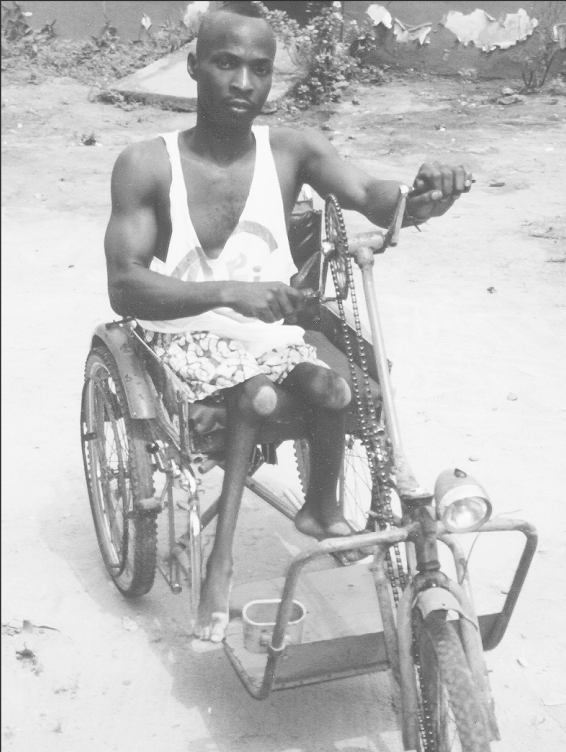 From the floor, the sitting host extended a muscled arm to meet my lanky reach. His brilliant smile in the dense shade of the entrance to his home echoed the bright outside sun of a hot West African midday. Self-conscious at how I towered over him, I placed myself on the ground opposite. Equally discomfited in return, and always a concerned host, he quickly had a friend bring in chairs for his visitors.
I had come searching for Akrofi Augustine while visiting the Volta River Estuary community of Ada, home to the Nene Ocansey | Technical Center (NEKOTECH), one of two Pedals for Progress partners in Ghana. Pedals for Progress has shipped four containers of bicycles and parts to NEKOTECH beginning in late 2000, and already there are more than 1,000 PfP-provided bicycles circulating in Ada district.
Akrofi (“first-born”) lives in Amlakpo, a small village of the Ada district. Amlakpo is four kilometers out of Kasseh, the commercially-active crossroads where traffic parts, continuing eastward across the Volta River towards neighboring Togo, or turning south a few miles down river to Ada proper. Akrofi’s family owned their modest home, and rented the other half of the simple concrete-block duplex to a Peace Corps volunteer. Through this contact we had heard of this energetic young man, who had established a reputation locally for exceptional initiative.
Akrofi, now 29, told me his story. He had suffered polio at age 2, crippling his legs and leaving them emaciated and useless. Through first grade, he lived with his grandmother, attending school nearby. Crawling to school and elsewhere, Akrofi developed exceptionally strong arm and chest muscles. However, after returning to live with his father, the one-mile distance to the new school eventually compelled him to drop out.
For many years, he stayed close to home, for a while feeling depressed and useless. On reaching his teens and hoping to make a financial contribution to the family, he began to work as a barber. For a while, he persevered, but waiting for people to come to his home to sit for a haircut was frustrating and didn’t generate much income.
His break came when the clinic in Batton, at the behest of his father who worked there, gave him a bicycle-wheelchair put together by a local workshop. The customized contraption, with the drive chain fixed high in front, permitted Akrofi to efficiently apply his brawny arms to moving around independently.
With the freedom provided, he was able to break out of home-bound isolation. Unable to make a living cutting hair at home, Akrofi set about to realize a long-held dream of learning to repair radios and televisions.
A childhood friend was a store owner and established electronics repairman in Kasseh. Akrofi, when not barbering, hung out there, and soon came to think that electronics repair was far more interesting than barbering. It was a career where his disability was not an impediment. When he barbered, it was difficult to cut people’s hair because he couldn’t readily circle around his customer like standing barbers do. With electronics repair, Akrofi could focus on his work at a table, relying on his hands alone.
In the months preceding our January 2002 visit, Akrofi apprenticed himself to the electronics repair shop. In exchange for the proprietor’s time and knowledge, Akrofi works for nothing, slowly acquiring the varied skills to run such a business. In spite of the five-kilometer distance, the young man is a regular sight on the road, outpacing pedestrians and greeting a growing number of acquaintances. Soon, he will be able to leave and begin his own business.
Akrofi is satisfied; he enjoys the challenges and variety of repair work, knows he will earn more money once he is on his own, and looks forward to becoming independent and his own boss. Once he has mastered the trade, he plans on moving near his father in Batton. And all because of a bicycle wheelchair.
A Case Study in Monitoring and Evaluation: Guatemala
Fall 2001 Newsletter
PfP began shipping to Fundación Integral de Desarrollo y Medio Ambiente (FIDESMA), in November 1999. “The first container of 438 bicycles was sponsored by the Golden Rule Foundation; a second shipment of 519 bikes was paid for in part by FIDESMA and partially by the Koinonia Foundation.
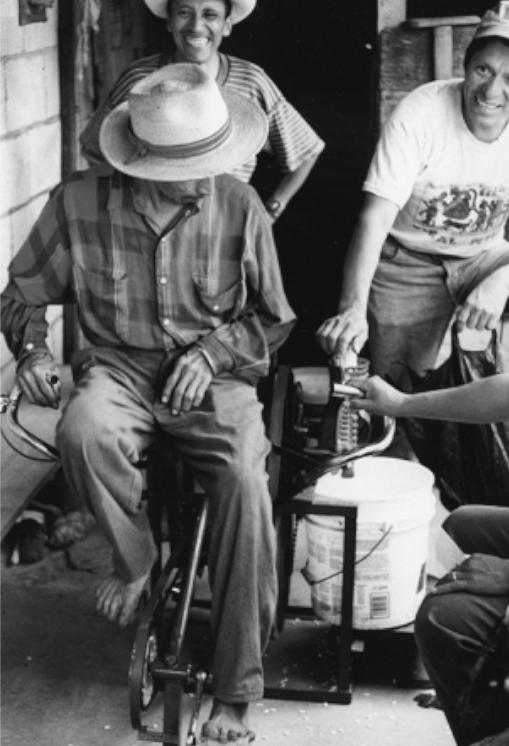
“FIDESMA serves the highland indigenous community of San Andrés Itzapa, Chimaltenango, providing agricultural extension and other education services, small enterprise assistance, and other community development services. PfP shipped the first container based on a brief proposal from the Guatemalan organization. Due to the isolation of the community and the limited financial capacity of FIDESMA, as well as the linguistic and cultural gulf between the two partners, subsequent communication was sparse, and PfP had little idea of the impact of the first shipment other than that FIDESMA desired another shipment – generally a good indicator!
“Finally, in March 2001, FIDESMA submitted a substantive report. For PfP, it was worth the wait, as the information presented was extensive and appears to justify the investment.” Included in the report was a detailed inventory breaking down bikes by category, whether or not they had been sold, etc., per container. The information enabled PfP to better assess its own effectiveness and characteristics in collecting, selecting, and packing, as well as to assess the impact of the bicycles overseas and the potential for sustainability of the relationship.
FIDESMA reported that the project was able to cover its costs, and hence appeared likely to be sustainable. The reported commercial value of the contents of each container ranged from slightly over $12,000 to almost $15,000 (since that time, improvements in packing and the addition of large quantities of valuable new parts donated by the US bike industry has augmented the value of shipments). The reported costs – including not just recurring operating and shipping expenses but also a value-added tax to be rebated and one-time investments in facilities and tools – were under $10,000 per container.
We found out more about beneficiaries. FIDESMA reported that 40% of the purchasers were farmers, 25% students, 30% laborers and tradesmen, and 5% working women. Shop employment comprised a mechanic/shop administrator and mechanic’s assistant, supplemented by three full-time apprentices and two part-time apprentices. FIDESMA is seeking a training institute to certify a six-month bike mechanic’s apprenticeship course.
FIDESMA interviewed half a dozen recipients of bicycles and shared the notes with PfP. All were positive, citing the savings in time getting to work, doing errands for the family, and getting to school. Edwin Paulich Velázquez, for example, reported spending as much as four hours daily on his bike, using it principally to cover the five kilometers to work. Not everyone uses the bike solely for work however. Another respondent – Carlos Arnoldo Bueno, who also uses his bike to get to work – specifically mentioned his newfound ability to engage in competitive racing.
José Siquinajay is the local mail carrier. Twenty-nine-years-old and married, José has for several years managed San Andres Itzapa’s mail and telegraph services. Each day he opens the post office and attends to the communication needs of the town. Twice weekly, he goes by bus to nearby Chimaltenango, the provincial seat, to pick up the mail. On his return, he utilizes his bike, obtained through FIDESMA, to deliver the mail throughout the town, covering distances up to two kilometers and up and down steep inclines. According to José, he saves time, gets the mail faster and sooner to customers, and is getting in good physical shape.
Finally, FIDESMA cited the long-term institutional benefits. Not only did the project benefit the community and raise the local group’s profile, the non-profit institution’s skills also strengthened it in business and project management, dealing with government institutions such as Customs and the Ministry of Finance, and generating income for institutional overhead.