Category Archives: bicycles

Chase Manhattan Bank Sponsors Simultaneous Fall 1999 P4P Collections in Four States

by Andra Stam–Taylor
Summer/Fall 1999 InGear

Chase Manhattan Bank is strongly committed to the communities which it serves. As part of a comprehensive corporate philanthropy initiative, one of the ways that Chase displays this commitment is through an annual October event called “Global Days of Service” (GDS). In 1998, 13,000 Chase employees, along with their friends and family, participated in 350 different projects worldwide. According to Chase Chairman Walter Shipley, “The commitment and dedication of our volunteers and their tireless energy to improve the communities in which they live and work inspires us and sets an example worth following.”
1999summerChaseDescreen

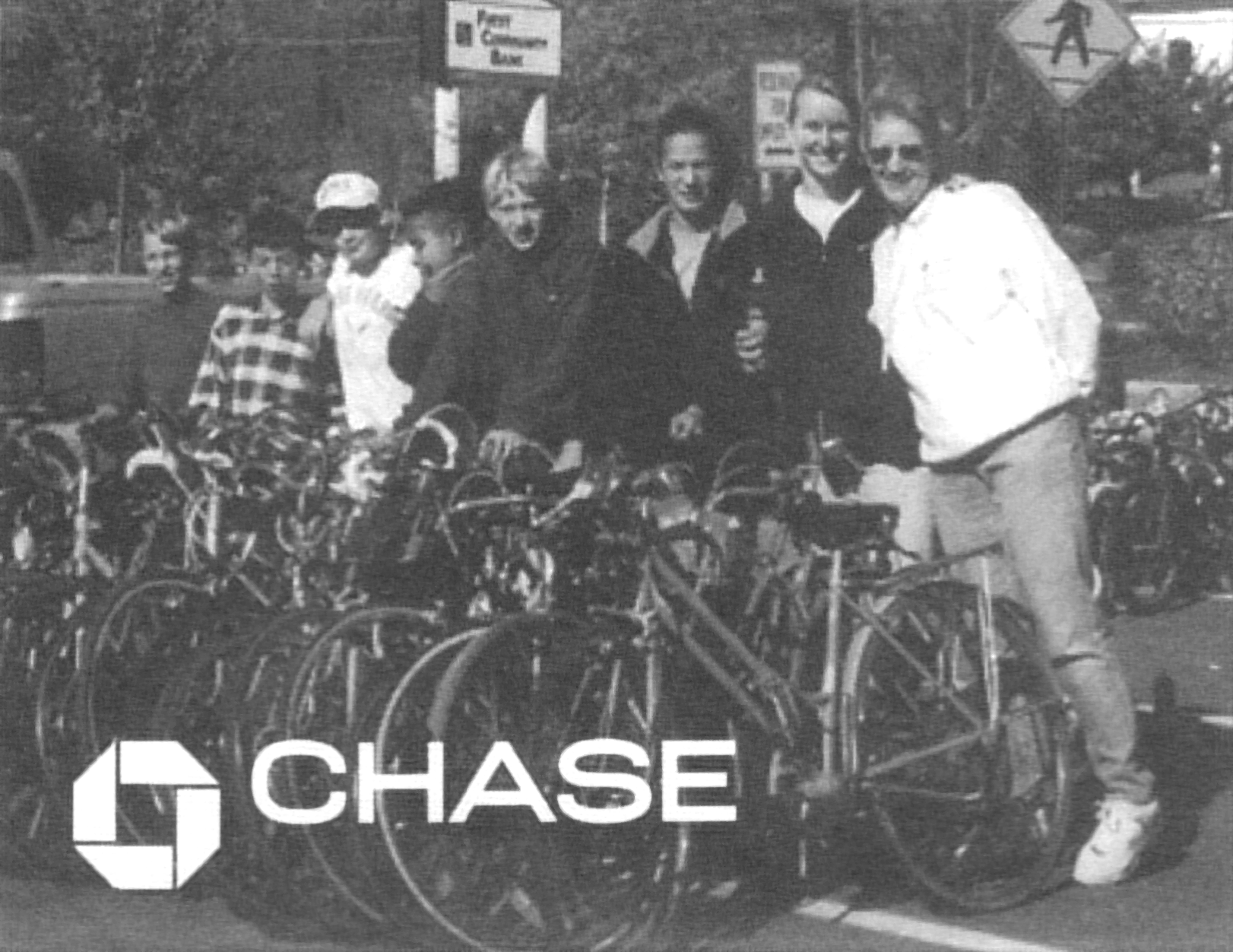
I had read about Pedals for Progress and as a Chase employee thought that a bicycle collection was an excellent tie-in with Global Days. Knowing that many GDS projects are done in conjunction with other organizations, I approached the leaders of my Church, the Church of the Holy Spirit, in Lebanon, New Jersey, regarding the possibility of adding this collection to their long list of community service projects. The Church leaders enthusiastically approved the idea, and we decided to make this the first fall project for the Rite-13 youth group, ages 13 and 14. The Youth group was shown the video stressing the mission of P4P and participated in the publicity by putting up posters and mailing posters to other churches. We received permission from Unity Bank in Clinton, New Jersey, to use their parking lot as the site for the collection.

On October 24th, 1998, 14 volunteers had a lot of fun with the project and collected 99 bicycles. Because of the excellent tie-in that P4P has with Chase’s Global Days, an idea was sparked for the 1999 Global Days: “What if Chase had simultaneous bicycle collections in multiple locations gathering used bicycles for P4P?”

Although final plans are still being made, as of press time Chase will be having 5–7 P4P collections during Global Days in at least four states: Delaware, Ohio, New Jersey, and New York. In each of the selected communities, Chase employees will organize, publicize, and staff the event—not to mention donate their used bikes!
Rural Health Care Delivery … and Bicycles??

Spring/Summer 1996 InGear

The Society Taking Active Responsibility for International Self-Help (STARFISH), an Ohio-based non-profit agency, and Pedals for Progress (P4P), a New Jersey non-profit specializing in mobilizing overseas development, have joined to more effectively deliver medical services to rural communities in an impoverished corner of the Indian Ocean island of Madagascar.

STARFISH and P4P are supporting the Malagasy medical assistance agency Action Sante Organization Secours (ASOS) to deliver regular immunization and other health services to rural communities located within the Andohahela Nature Preserve. Until now, these remote villages were accessible only by foot and have received few outside medical services. STARFISH is donating medical supplies valued at $5000 and the services of a volunteer public health nurse, while Pedals for Progress is donating eight new 18-speed Mongoose mountain bicycles distributed by Service Cycle, Inc., a well known American bicycle distributor, along with spare parts, tools, and a volunteer mechanic trainer.

ASOS physicians and nurses, accompanied by STARFISH and Pedals for Progress personnel, will travel through the region over a two week period in June 1996. The enhanced transportation capacity provided ASOS by mountain bikes will cut the valuable travel time of participating personnel by more than half, and will be made sustainable through the training of local support personnel and a continuing resupply of parts.

This innovative and technologically appropriate health services delivery effort complements an on-going World Wildlife Fund (WWF) biodiversity conservation project in the territory including and surrounding the Andohahela Nature preserve, a region containing a large number of threatened plant and animal species found nowhere else in the world. WWF will assist shipping and Customs and port clearances for the medicines and bikes.

Nicaragua’s Fifth Anniversary for Pedals for Progress

by John Griffin
Spring/Summer 1996 InGear

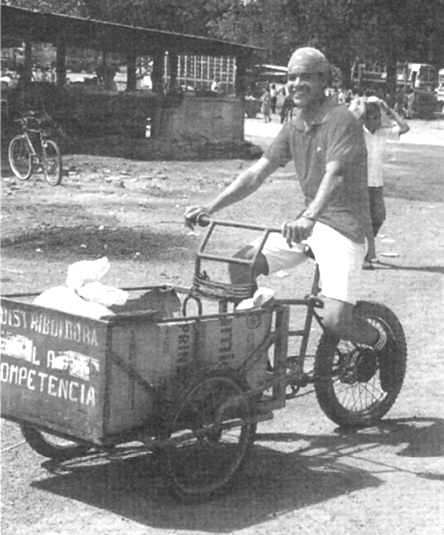
Produce delivery in Rivas, Nicaragua

1996 in Rivas, Nicaragua, signaled the fifth consecutive year that Pedals for Progress has been supplying bicycles and spare parts to the Asociación de Desarollo Comunitario, a small Nicaraguan cooperative. The impact of the project is tangible: Rivas has been transformed into a vibrant and bustling center of activity, made so in part because of the ubiquitous presence of bicycles. Whereas walking was once the leading mode of travel in Rivas, as it is in most Latin American towns and villages, the infusion of bicycles initiated by Pedals for Progress’s efforts has made cycling the number one mode of travel in Rivas.

By most estimates, between 60% and 80% of all Rivas households own at least one bicycle and demand for affordable bikes continues to be high. Containers of up to 425 bicycles from Pedals for Progress are usually distributed by the Rivas ADC within two weeks of arrival. Demand is high because for many individuals, the bicycle is either a direct or indirect means of employment. At the least, the bicycle saves hours of tedious transport time for families, as well as money that would otherwise be spent on bus or taxi fare.

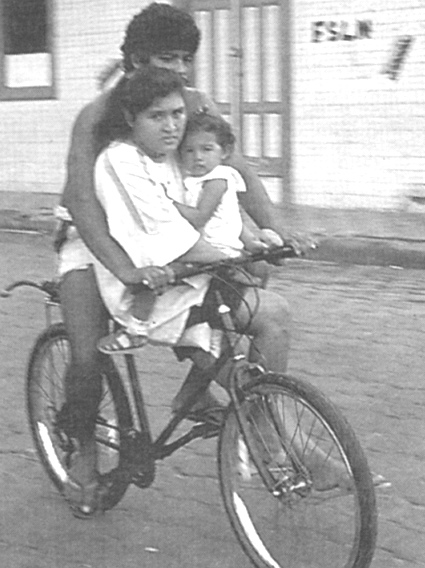
Family bicycling in Rivas

It is not uncommon in Rivas to see families of three on a bicycle, often transporting a child to school, an adult to a work place, while another adult uses the bicycle to do errands around town. A recent study by a City University of New York urban planning graduate student of the socio-economic impact of the bicycle in Rivas found that over one quarter of survey respondents reported using the bicycle regularly to earn income. For some this means that the bicycle is used to move goods for sale, while for others it means that the bicycle enables getting to a job which would otherwise be impossible or uneconomical to reach. When incomes were compared between this group and those who don’t use bikes to generate income, a 14% difference was noted, favoring those who use bicycles in their work.

It is common in Rivas for women to use the bicycle in numbers nearly equal to those of men, enabling far greater independence for woman than in many other places where women’s mobility is limited. This fact was borne out by results from the study, which showed greater parity of income between men and women who use bicycles in their work. These numbers are especially significant since income equality between the sexes is one of the most elusive goals for economic development experts.

Rivas is now a noticeably different town than it was prior to the introduction of the bicycle. Along with the backdrop of volcanoes and lush tropical growth, bicycles are now a permanent part of the Rivas landscape. Moreover, commercial activities appears to have increased in Rivas, perhaps due in part to the greater mobility of the inhabitants. One thing is certain: 1800 donated bicycles have found useful second lives as primary transport and means of employment for an equal number of people in Rivas.

*Proceeds from the sale of the cycles are used by the ADC to support projects in and around Rivas, including a tree nursery, an innovative roofing tile factory, construction of an elementary school, irrigation systems and an infant nutrition program and laying of potable-water lines.

Meals on Wheels in Rivas

by John Griffin
Spring/Summer 1996 InGear

Adan de Jesus Solís Vilchez and his wife Luz Maria start off their day even earlier than most Nicaraguans. Being up and working by 4 a.m. enables them a few hours free from the hot tropical sun and humid air.

Adan prepares for lunch delivery in Rivas

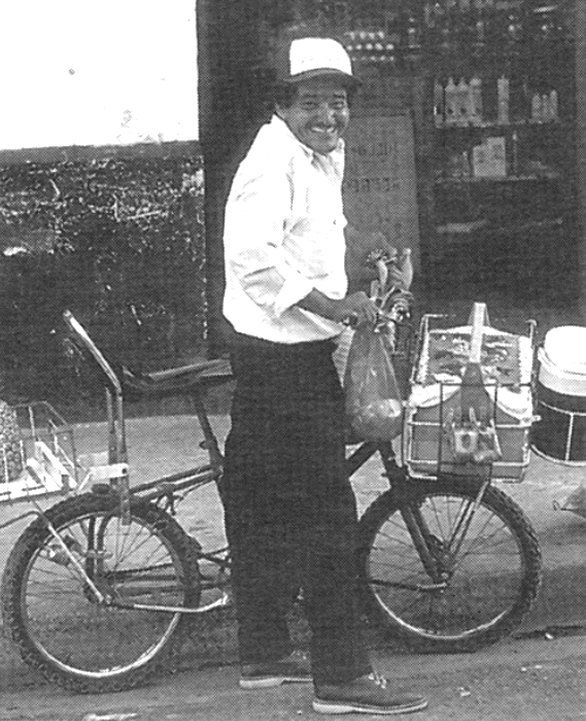
By 5 a.m. Luz Maria has finished making the last of the sandwiches, tortillas, fruit cups, and custard puddings that Adan will pack onto his modified Huffy BMX bicycle. The last item he loads onto his bicycle before leaving is a large thermos of sweet black coffee. By 5:30, when Luz Maria has already begun working on the day’s lunchtime special, Adan is plying his heavily laden cycle through the crowds at the Rivas bus depot where the first busloads of the day from Managua and Costa Rica have already begun to arrive. The adjacent marketplace is also in full swing and Adan competes for road space with swarms of other cyclists, small traders pushing carts piled high with vegetables and tropical fruits and the occasional loose pig.

Adan will proudly show any curious customers the clever modifications which have enabled him to convert his Huffy into a roving restaurant. By welding pieces of an old Harvard bed frame together, he has fashioned an extra-wide rear rack capable of carrying two medium-size coolers and a pair of burlap panniers at the sides. When not in use vending breakfast or lunch to Rivenses, Adan says there is ample room to carry his wife or one of his two children. In front, Adan has made good use of the heavy-gauge foot pegs that American kids use to do stunts with and attached another wide rack with room for yet another cooler. All told, Adan can serve up an ample meal, including beverages, to as many as 15 customers from just one bicycle load.

Before acquiring their bicycle two years ago from the Rivas Asocación Desarollo Comunitario (ADC), Adan and Luz Maria eked out a living by selling cold drinks from an unsteady wheeled cart pulled from the front. With it, they were limited to customers in a tight radius around their home. Now with the added mobility afforded by the bicycle, Adan is able to easily triple that radius. Extending his market area threefold means a similar increase in Adan and Luz Maria’s daily earnings. By his own estimates Adan says that the bicycle, together with all of the improvements he has put into it, has paid for itself in less than three months.

With demand for Luz Maria’s prepared foods seemingly unending, Adan has recently begun to look into ways to build a small trailer to tow from the rear of his BMX. When asked what the trailer would be used to carry, Adan responded that it would become Rivas’s first mobile barbecue.