All posts by Michael Sabrio

InGear Summer 2017


P4P Bike Number 150,000

Summer 2017 InGear

In April of 2017 Pedals for Progress collected and shipped its 150,000th bicycle.

P4P’s initial goal in 1991: ship 12 bicycles to Ecuador. This initial estimate is short, so far, by a factor of 12,500.

Our Partners

P4P has shipped to 36 countries, from Albania to Vietnam. We’ve shipped 2 bikes to Papua New Guinea and 42,672 bikes to Nicaragua. We’ve made one shipment each to India, Jamaica, Kenya, Malawi, Pakistan, Papua New Guinea, Sri Lanka, and Venezuela. We’ve made 82 shipments to Nicaragua, 40 to El Salvador, 32 to Ghana, 19 to Guatemala, and 18 to Barbados. As of June, 2017, we’ve made 378 bicycle shipments and 24 independent sewing machine shipments.

Programs end because of changes in our partner organizations, import laws and fees, bureaucracy, and sometimes outright corruption. But most countries are eager for the programs we support—the economics make sense for our partners and the bikes clearly improve the lives of the people in their communities. We always have more demand than we can fill.

As of June, 2017, our active partners with both a bicycle program and a sewing program are Albania, Ghana, Guatemala, and Nicaragua. Our active partners with sewing programs only are Ethiopia, Kenya, Kyrgyzstan, Liberia, Tanzania, and Uganda.

Choosing partners is not an exact science. Groups from around the world find us in several different ways, including the internet, magazine articles and other publications, and word of mouth. P4P has a formal procedure that potential partners use to request a shipment. They make a proposal that gives us basic information about their location, size, history, and business plan. In some cases P4P can find a way to fund a first shipment, but our business model is that the partner must pay for shipping; that payment is more evidence of their good faith.

Some of our partners we know only at a distance. Other partners we have met personally, in the U.S. and in their home countries. We have seen their kids grow up and join P4P partner businesses. We have taken terrifying auto rides with insane drivers, hiked and biked through spectacular countryside, visited their bike shops and their business, educational, and health programs. We are continuously impressed by the generosity, resourcefulness, and hard work of our partners and their communities around the world.

Bike Number 1: 1991

Nicaragua Produce Bike

For its first couple of years, P4P shipped bikes as part of shipments from other groups. We sent our very first bikes to Nicaragua, though to a partner we no longer have.

In 1992 we made our first shipment to Rivas, Nicaragua, where Wilfredo Santana had the business that became EcoBici, which is still our partner today. In 1993 P4P started filling its own containers, and Wilfredo and Dave worked out the revolving fund idea: P4P would pay for the collection of bikes in the U.S., our partner would pay shipping costs, and the partner would make enough profit selling the bikes to pay for the next shipment.

Bike Number 50,000: 2001

2001fallPanama

We can’t find any specific information about the 50,000th bike we shipped. Our records show that it must have been 2001. We shipped 20 containers that year, and we were nearing our peak production. In 2001 we shipped to South Africa, Honduras, Nicaragua, Barbados, Panama, El Salvador, Ecuador, and Ghana. Perhaps we were too busy collecting, prepping, and shipping bikes to notice the 50,000-bike milestone.

Let’s just pick one of our 2001 bikes and pretend that it is number 50,000. Here’s a typical happy story about how bikes improve lives: A note from Panama in our Fall 2001 InGear newsletter tells the story of seventeen-year-old Jose Luis Bethancourt, who was ready to drop out of school because of family finances. His commute to school by bus not only cost money, but took hours because of traffic, so Jose had no time for a job that would raise income for the family. He got his first-ever bike from P4P, which eliminated the bus fare and dramatically reduced his commute time. As a result, Jose had time for a job as well as for school.

Bike Number 100,000: 2006

fall2006mateoFamily

We got our 100,000th bike at a collection sponsored by the Somerset Hills Kiwanis on June 24th, 2006, at the Sunset Inn in Clinton, New Jersey. Leonard Lance, then a New Jersey State Senator, was on hand to thank the surprised donor. Now in 2017 Leonard Lance is the U.S. Congressional Representative of the New Jersey 7th District. So P4P can improve the lives of U.S. politicians as well as people in our partner countries!

We shipped the 100,000th bike to FIDESMA in Guatemala, one of our most long-standing partners. P4P’s Reykha Bonilla followed the bike to Guatemala, met our good friends and partners at FIDESMA, and met the owner of P4P bike 100,000, Mateo Patzan, a working father of 5 and amateur bike racer. The Fall 2006 InGear newsletter has the whole story of bike number 100,000.

Bike Number 150,000: 2017

Fast forward to 2017. On April 1, the Long Island Returned Peace Corps Volunteers collected P4P bike number 150,000. On April 22 we loaded the bike into a container bound for FIDESMA, the same destination as bike number 100,000. At midday, June 6th, the bike arrived at FIDESMA in San Andrés Itzapa, Guatemala. It’s fitting that these are the groups that collected and received our 150,000th bike.

The Long Island RPCVs have been one of our most successful collection partners. They rotate collections around Long Island to maximize their reach. Their first P4P collection was in 2003, their second in 2005, and they’ve held collections every year since. The Long Island RPCVs are featured in this article from Summer 2011.

We’ve already mentioned FIDESMA, our Guatemala partner, because they got our 100,000th bike in 2006. FIDESMA has been our partner since 1999. We are good friends as well as professional partners with the principals. For example, the summer 2012 InGear newsletter has this article about a visit to New Jersey from Señora Maria Margarita Caté de Catú, founder of FIDESMA.

What’s Next

In 2016 P4P had the first uptick in bicycle collections since 2001. Let’s hope bike collections continue to improve.

Even though we are celebrating a bicycle milestone, we should mention sewing machines. Since 1999, P4P has shipped sewing machines along with bikes. Like bikes, sewing machines give people a way to improve their economic circumstances. A sewing machine can be a job in a box. In 2015 we created the Sewing Peace brand as an option for carrying on our sewing machine activities separately from our bicycle activities. If only sewing machines are involved, we have multiple advantages: with collections, with shipping, and with partnering. For collections, we can target groups more likely to have sewing machines to donate. For shipping, we can send much smaller loads, loads that do not take a full container, and so are much cheaper to ship. And for partnering, we can find groups abroad that may not have the capacity or expertise to deal with 500 bikes at a time, or that may not even have a bicycle program.

So we are now the same single organization, but doing business both as Pedals for Progress and as Sewing Peace. It’s been a rewarding 26 years. We look forward to many more.


Nicaragua Success Story, 2017

Summer 2017 InGear

Alexander Mora was born in Tola, Nicaragua, eight miles west of the town of Rivas, home of our P4P partner EcoBici.

Alexander has been interested in bikes since he was 10. From a very young age he learned bike repair from Guadalupe, the former lead mechanic at the Ensembladora de Bicicletas, the EcoBici bike shop. Guadalupe taught Alexander everything about repair and maintenance of bicycles: lubrication, wheel alignment, cable replacement, …

When Alexander got his first 20-inch bike he became even more interested in bike repair.

When he was 23 an Atlas bicycle came into the shop from a Señor Miguel Ríos. Señor Rios used to deliver newspapers in Rivas on his Atlas. Señor Ríos passed away but his son gave the Atlas to Alexander. Alexander still has this bike.

After he got the Atlas, Alexander would ride it from Rivas to Tola. From Tola he would ride another five miles to the village of Gasper García to repair taxi trikes. Overall, Alexander maintains about 100 of these bike taxis.

After work he would ride a few more miles to the Pacific coast for fish and whatever else he could find. To survive he would carry a machete, a liter container of water, and a pump and patches for tire-repair.

In 2011, Alexander met Joaquino Bando and they met Carlos Santana at EcoBici. They began to assemble beach cruiser bikes.

Alexander seemed different from other workers. He worked closely with Carlos. Then when head mechanic Don Lorenzo retired, Alexander joined the EcoBici permanent staff, earning a fixed salary. He works on new and used bikes, and has become one of the best bike mechanics in the country.

Alexander now restores badly damaged used bikes, making them almost like new. Besides the Atlas, he has restored a classic 24-inch bike that he uses to run errands for EcoBici: making bank deposits or doing anything else we need him to do. Alexander has great skill as a bike mechanic and has been an excellent addition to the staff at EcoBici.


The Vendor

Summer 2017 InGear

Kwame is a young man around 22 years old and a student at Cape Coast Polytechnic in Ghana. Kwame is into the business of selling Phone Cards at wholesale prices. He does this when he has no lectures to attend. Considering the tough nature of this business, he sells them by either hiring a car or walking. This mode of selling makes the work somehow cumbersome and tedious.

Fortunately for Kwame, he came into contact with WEBike and he purchased one of the bikes at an affordable price. He uses the bicycle for his phone-card business and sometimes to go to lectures as well because he is a non-resident student. The use of the bicycle has made his business very efficient and his customer base has increased. This is how he is able to buy more books and other personal needs. Kwame also loves to use the bicycle because of the exercise he gets riding between the campus and town.


The Significance of the Bicycle to the Rural Teacher

Summer 2017 InGear

The teacher, as would be widely agreed, plays an invigorating role in the nurture of a human being. It is for this reason that teachers ought to be given apt remuneration and motivation for their services.

Teachers in rural areas like the Northern Region of Ghana have particular needs, and bicycles play a vital role in their lives.

A teacher who teaches up north and does not possess a bicycle is like a farmer going to the farm without a machete. Not to make a storm in a tea cup, but anyone who has lived in the rural northern part of Ghana could attest to the fact that living there can be very cumbersome.

In some places a teacher can get to school on time only by commercial bus. But in some areas the bus operates only once a day. Having a bicycle is a much more reliable means of transportation.

The bicycle is therefore invaluable in the life of the rural teacher.


Adongo the Bicycle Mechanic

Summer 2017 InGear


Adongo is a young energetic man who resides in the Northern Region of Ghana.

Life after secondary school was very vexatious. There were not enough funds for Adongo to continue school. Since time obviously waits for no man, he decided to use his time profitably. After much deliberation, he finally resolved to learn a trade.

Consequentially, he moved to the capital of the country, Accra, where he learned carpentry. Along the line, Adongo realized carpentry was not in his best interest. He resolved to find something else to do on the side; he met this man who was into bicycle repairs. Adongo then thought it wise to align himself with the bicycle repairer.

About a year and a half into bicycle repairs, he became a proficient bicycle mechanic. He handled both major and minor repairs with utmost case.

Adongo later decided to change his domicile. He went back to his roots.

He is now a big-time bicycle mechanic, with about five apprentices. He buys bicycles and gives those that are not in very good shape a decent overhaul.


Adongo is now a competent bike mechanic cum sales executive. He is able to cater for his family and other needs. Through this business has he put up a three-bedroom house in his home town. He is living comfortably with his wife and two children.

All thanks go to WEBike.


Liberia: New Partner, May 2017

Sewing Peace is proud to announce that we are adding an additional program. The Tailoring 4 Life Project of Education Care Africa, based in Monrovia, Liberia, is our new partner. The machines will be sailing out of Port Newark on the ACL Atlantic Star on the 6th of June, 2017. The shipment is scheduled to arrive in Monrovia via Antwerp on the 9th of August.

We used a new configuration in our packing. We had several treadle and hand-crank manual sewing machines that should be welcome in parts of the country with unreliable electricity, so we stacked the portable electric machines around the sides of the pallet and put the manuals inside. Liberia is getting four pre-1915 treadles, two lovely Singer hand-crank machines from around 1915, and 64 electrics.

The Tailoring 4 Life Project has three main goals:

  1. Hire experienced tailors to produce designer clothing for sale and to provide tailoring services to the community.
  2. For women who wish to learn tailoring, train them in a six-month program after which they can rent-to-buy a sewing machine.
  3. For women who do not wish to learn tailoring, train them in retail sales.

Welcome, Education Care Africa!

Albania Update, March, 2017

Dear David,

I wish you and your organization the best. We have been engaged in several important campaigns.

After four years, supported by money we earned by selling shopping bags we made with P4P sewing machines, we won an important battle against plastic garbage. YES! Now even people in Albania are paying a modest fee for plastic bags. This has created an even larger market for our bags. Another mission accomplished together: PASS & P4P!

Building bike frames in Albania

The project of the Albanian Bicycle is taking life. So far we have produced 50 bicycle frames, 100% Albanian.These bikes fill different roles than the excellent bicycles we get from P4P. The Albanian bikes we are building are cargo bikes, taxi bikes, coffee bikes, etc. For each bike sold we are still planting 10 trees. ☺

We are also very interested in solar panels. We are highly active in environmental issues and have implemented several projects involving solar energy. We would like to continue our mission to promote clean energies.

LibrAria

We opened a children’s library we call LibrAria in the Grand Park of Tirana. About 5000 children per month visit us there. With the generous help of a local publishing house, we offer children’s books for no charge. Besides books, we also offer musical instruments – guitars and percussion – that the kids can play in the park. On Mondays we have a flutist who gives free lessons.

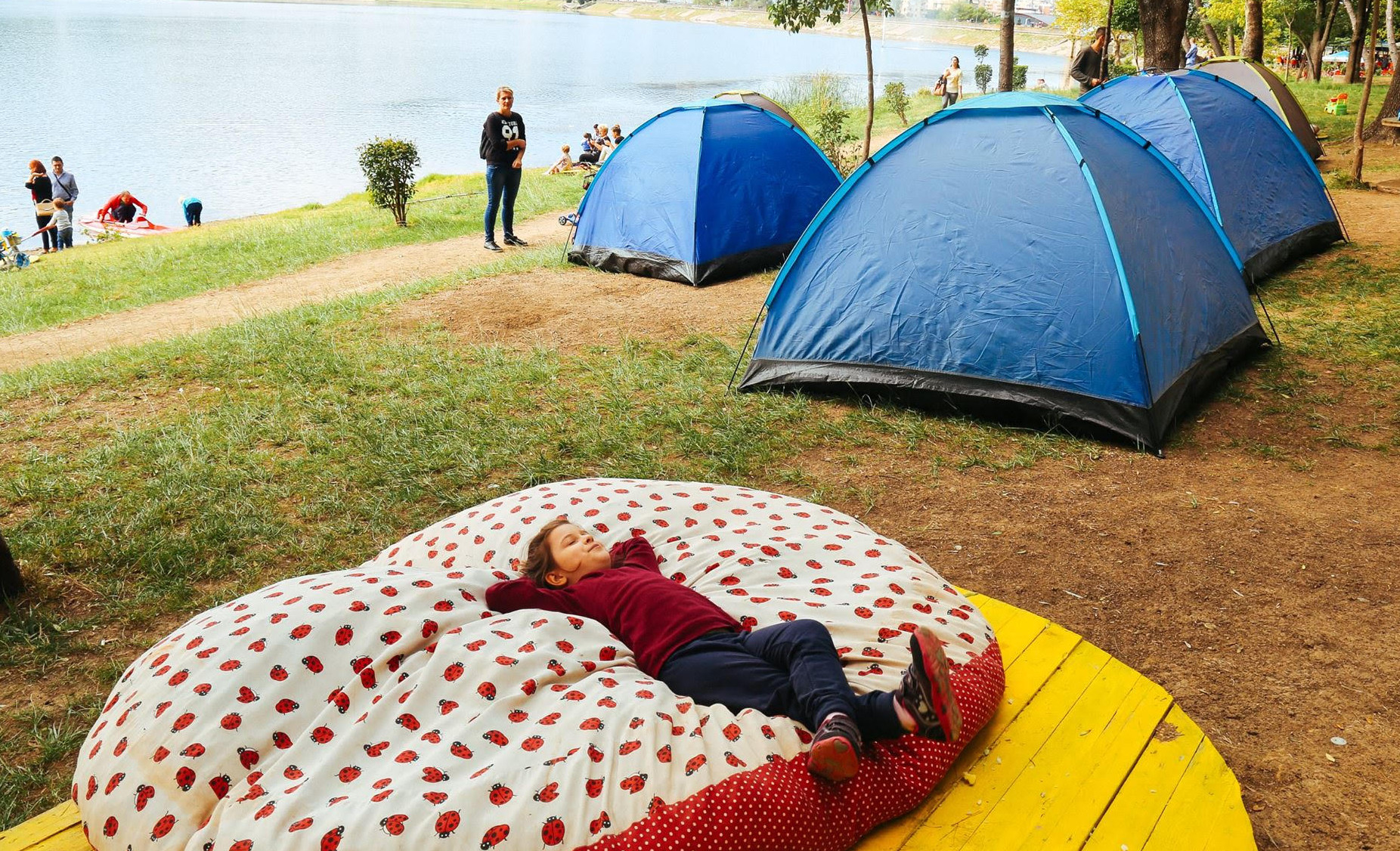
albania2017aprKidsBookstoreIMG_1888We invented games that give the kids a better appreciation of nature. For example, on the Island of Little Robinson Crusoe we asked the children to think about how they would survive, how they could sustain themselves, if they had to live outside. Another time we started the Odyssey island project and the children helped build a small boat to get to the island. A third time we created the Island of Indian Tents. We always have colors and paints that the kids use in the projects.

On Saturday evenings we bring in a piano and invite adults to listen to the music and enjoy a glass of wine. We’ve also had some fantastic music from Trio Bonae, who play classical music for violin, cello, and contrabass.

So we’re outside in the park with the children, their parents, and the lake, books, trees, tents, and games. We feel so good about this project.

THANK YOU for your hard work and for everything P4P has done for Albania and for our organization. We wish you only the best in the future!

Sincerely,

Ened Mato

[Check out this one-minute video of a dance party with PASS making fabric bags using P4P sewing machines.]

Ethiopia Shipment Number 1, March 2017

Depending on our inventory and funding, Pedals for Progress / Sewing Peace is always looking for new partners. A good place to look is at the Convention of Laureates of the European Environment Foundation (EEF) in Freiburg, Germany. As an EEF Laureate, Dave attended the 2nd International Convention of Environmental Laureates in 2013. It was there that Dave met Samson Tsegaye, Ethiopia Country Director for the Solar Energy Foundation, a German NGO that installs solar systems in rural areas in Africa.

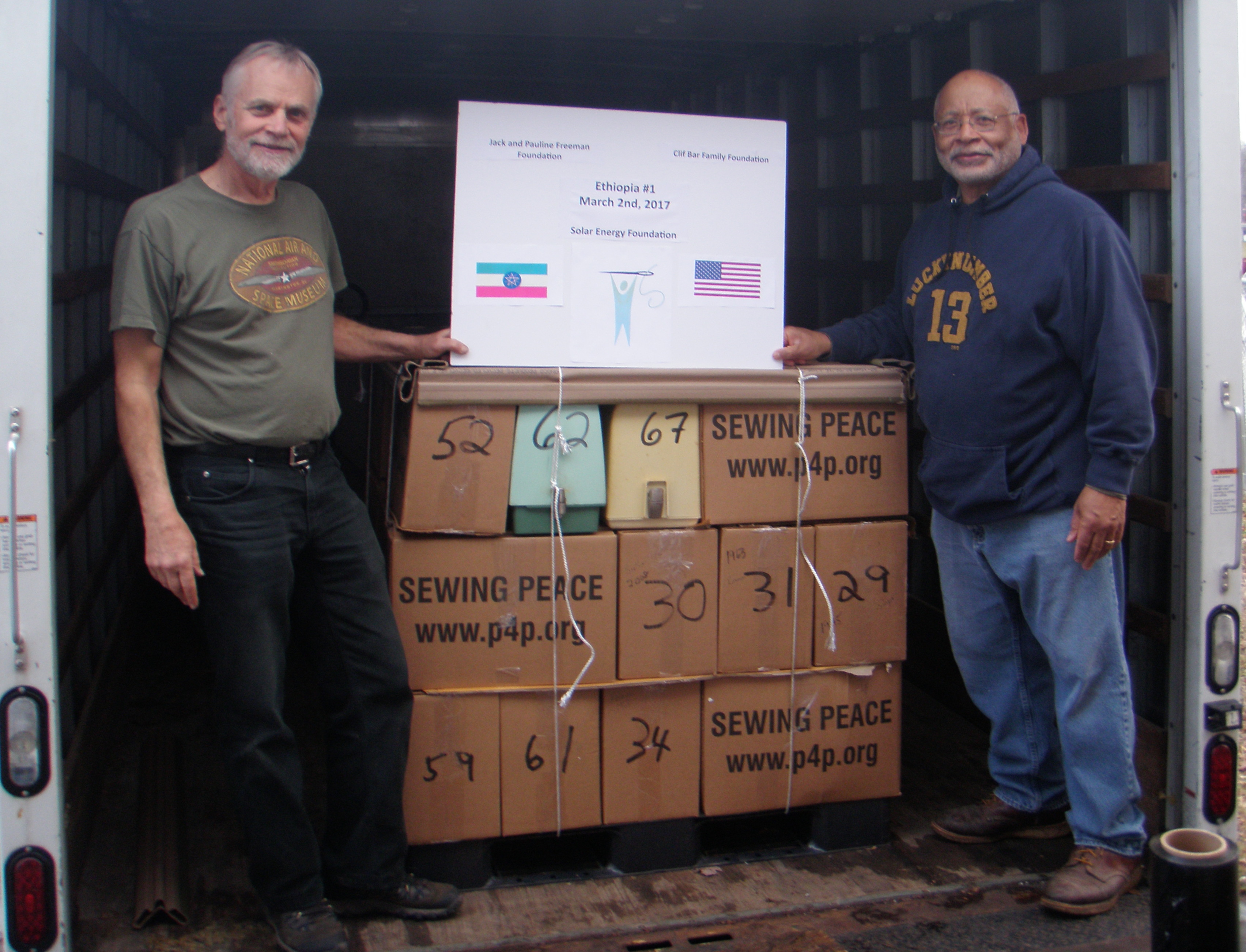
Robert, Ethiopia #1, March 2nd, 2017
Samson has made a proposal to the Solar Energy Foundation: with the help of Sewing Peace, he plans to train and equip 70 women to set up their own sewing businesses. The women to be chosen for the program are widows, orphans, single mothers, or from other at-risk groups. The women will get three months of training in sewing and tailoring. The program will pay travel costs plus provide food and housing during the training. Trainees who complete the program will get a sewing machine, with the understanding that they will use it to set up a sustainable small business.

Samson’s proposal sounds perfect for Sewing Peace, so we agreed to supply the sewing machines and accept a new program partner. We were able to help because of financial support from two of our generous donors: thanks so much to the Clif Bar Family Foundation and the Jack & Pauline Freeman Foundation.

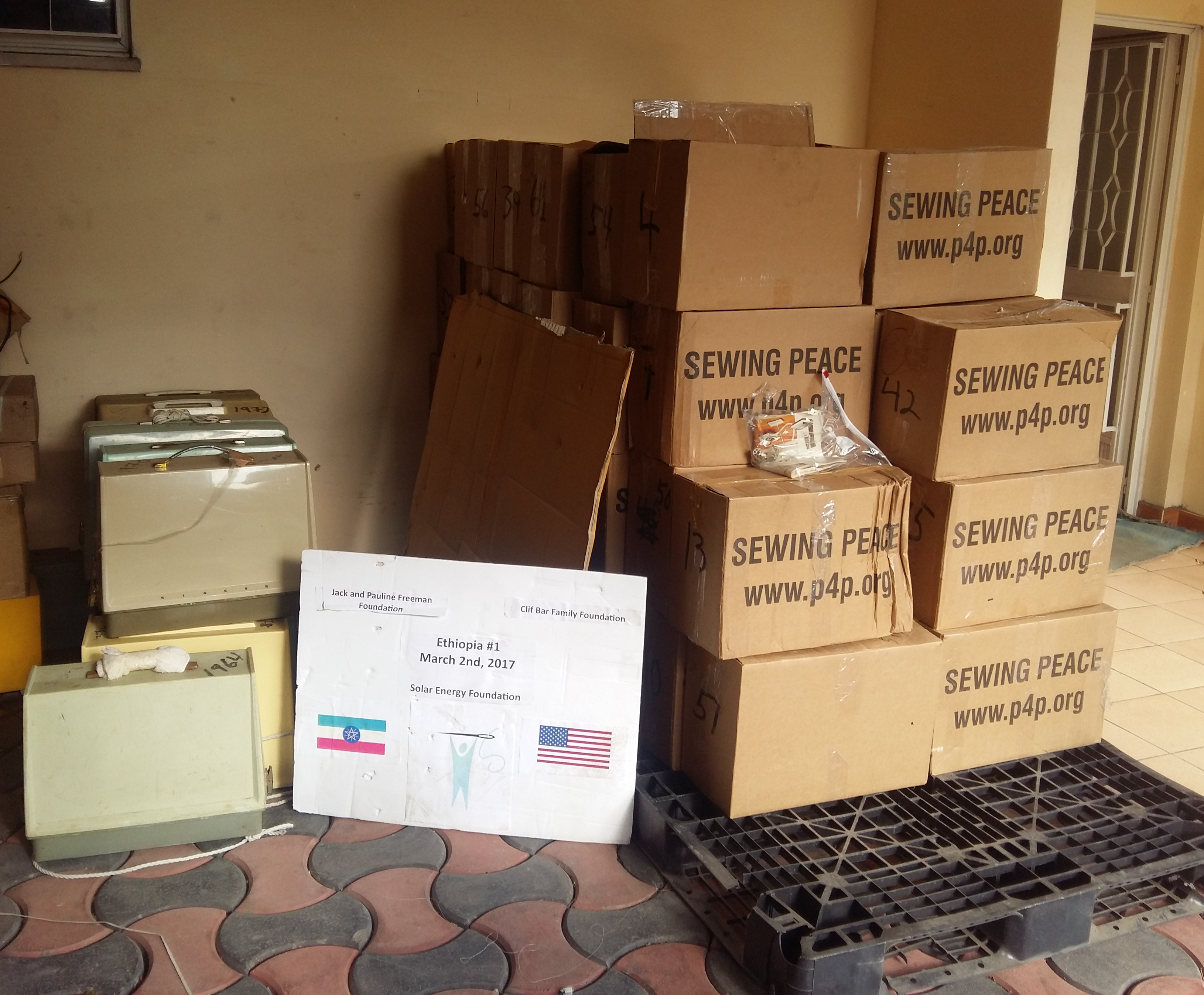
Robert and Dave, Ethiopia #1, March 2nd, 2017Because this is our first shipment to Ethiopia, we expected a learning experience, and we got one! Import laws vary wildly and inexplicably by country. The Ethiopian Revenues and Customs authority demanded information for each machine. So Robert and Dave opened 72 boxed machines, removed them from the boxes, recorded the make, model and serial numbers, and then repackaged them. Our new Tinkerer, Simon, went online with that information to find the dates of manufacture, also required. After we supplied that first batch of information, Ethiopian Customs decided that we also had to include country of manufacture. Simon signed up to refurbish sewing machines, not to deal with government red tape, but he went back online, beyond the call of duty, to get information on country of manufacture for each machine. Let’s hope that’s the last of the delays.

The 72 machines are now on their way to Ethiopia. When we get new information, we will report back.

Shipping Treadle Machines for Sewing Peace

treadleMachine
Pedals for Progress has shipped sewing machines since 1999. In 2015 we created the Sewing Peace brand as a way to carry on our sewing machine activities separately from our bicycle activities. Publicizing sewing machine collections separately can be more effective than always making them part of our bike collections. And shipping sewing machines separately can be more effective because we can ship them to groups that specifically want sewing machines and may not even have a bicycle program. Plus we can ship a few dozen machines on a pallet rather than shipping an entire container, which costs much more. So we’re adding a new emphasis on sewing machines to our ongoing bike programs.

Most of the sewing machines we collect are electric portables. They are relatively small, and, when we do ship them with bikes, they add no shipping cost because they fit nicely nestled among the bikes in our regular shipping containers. Most customers of our overseas partners have reliable electricity, so the portables offer a great way to earn a living.

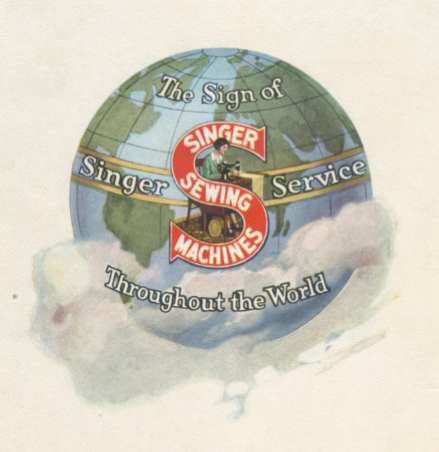
treadleMachinesDaveRobertBesides electric portables, we also get a few old-fashioned treadle sewing machines, almost all made by Singer, which do not use electricity. These are gorgeous, well-built machines: almost entirely metal and super reliable. With occasional lubrication and a new belt every few decades, they can last 100 years or more. They are beautiful: the machines themselves, the cast-iron structure with the treadle and band wheel, and the wooden cabinets.

If we have room in a container of bicycles, we sometimes ship an entire treadle machine without disassembling it, wooden cabinet and all. But it takes up a lot of space — about the same as 4 bikes — so it is a questionable tradeoff for our bike-shop partners.

But now as part of our Sewing Peace program we sometimes ship sewing machines separately from bikes, and we’re trying a new way of shipping treadle machines.

treadleMachineMetalParts
Over the past couple of years, we’ve accumulated about a dozen of these treadle machines, so we decided to disassemble them and ship everything except the wooden cabinets, which are just too big. We put the sewing machines themselves into our standard Sewing Peace cardboard shipping boxes. We zip-tie the metal support structure together with the treadle and band wheel. We can load up a pallet with four walls of boxed sewing machines, electric and manual; and then we put the metal stands inside the walls of boxes.

Our overseas customers are incredibly resourceful and creative. We feel certain that, even without the wooden tables and drawers, they will be able to build whatever they need to make the machines useful.

We believe that even our customers with electricity will appreciate these machines. And we do still occasionally get requests from partners where electricity is scarce or unreliable: from parts of Fiji and Africa, for example.

Here’s hoping that these wonderful old treadle machines find new lives abroad and offer another way for people in our partner countries to make a living.

New Partner in Tanzania: Tanzania Women and Youth Development Society

Fall 2016 InStitch

Pedals for Progress has a new partner in Tanzania: the Tanzania Women and Youth Development Society (TWYDS). The foundation is a non-governmental, non-profit organization founded in 1994 in Dar es Salaam, Tanzania, West Africa. TWYDS has programs in education, health, business, agriculture, natural resources, and policy advocacy.

tanzaniainstitchfall2016sewingmachine
In June 2016, with the generous support of the Jack & Pauline Freeman Foundation, we shipped 74 sewing machines to TWYDS. They will offer training in the use and maintenance of the sewing machines and then distribute the machines to the people they’ve trained with the goal of improving their standard of living.

P4P picks partners based not only on their sewing machine or bicycle programs, but also on their other projects in their communities. Our partners often focus, for example, on education, business, or the environment. TWYDS has programs in all these areas. But from TWYDS we hear stories we do not hear from our other partners. TWYDS founder Sophia Mwakagenda has more than once been called on to rescue girls from underage marriages. These marriages are illegal in Tanzania but still occur because of tradition and because of the poverty of the girls’ parents. In April 2016 Sophia was approached by the mother of an 11-year-old Masai girl who, for 16 goats, had been sold into marriage to a 75-year-old man. With the help of the police, Sophia had the girl released from the arrangement and brought back to school. (The Sunflower Foundation of Australia has programs for the education of Tanzanian girls.)

We welcome the Tanzania Women and Youth Development Society as a new P4P partner. Good luck with the Sewing Peace project and all your other excellent work.