“The bicycle is the most civilized conveyance known to man. Other forms of transport grow daily more nightmarish. Only the bicycle remains pure in heart.” – Iris Murdoch
At the Kola Nut Producers Association, our mission is rooted in creating meaningful impact in communities across Sierra Leone. We actively identify challenges within our communities and strive to address them. However, without a culture of adaptation, organizations like ours risk becoming irrelevant or, worse, missing valuable opportunities for transformative change.
Initially, we recognized a significant issue: the lack of access to transportation for local farmers in Sierra Leone. This challenge has deeply affected the fabric of their lives, causing substantial losses in agricultural produce due to their inability to access market centers. The distances involved and the poor condition of the roads have made it nearly impossible for farmers to transport their goods. We realized that bicycles could provide a vital solution to this transportation crisis.
As we delved deeper into this challenge, we discovered that the problem was much more complex than we had first perceived. We adapted our approach to better serve our members and the community, recognizing that the root issue lay in financial inclusion for smallholder farmers. Many farmers lacked the necessary tools to make proper investments in their farms, severely hindering their progress. They needed resources to help propel their families forward.
The Pedals for Progress journey began when we identified a substantial transportation void for local farmers living in Sierra Leone’s most rural areas. Thousands of farmers were situated in hard-to-reach locations, creating barriers to essential resources. This issue was not just a statistic; it was brought to life through personal stories from our national coordinator, Patrick Abu Mansaray, who grew up in rural Dalu Village, Kenema District.
Recognizing this urgent need, we reached out to Pedals for Progress in the United States for assistance. Their support in providing bicycles to local farmers, children, women, and the community as a whole is helping to bridge the transportation gap and empower livelihoods.
The agricultural value chain in Sub-Saharan Africa faces significant challenges. Although 25% of the world’s most arable land is in this region, it produces only 10% of the world’s agricultural outputs (International Fund for Agricultural Development). This gap presents an opportunity to address the needs of millions of people in Sierra Leone who are overlooked by conventional market solutions. We view this not merely as a problem but as an opportunity to close the efficiency gap.
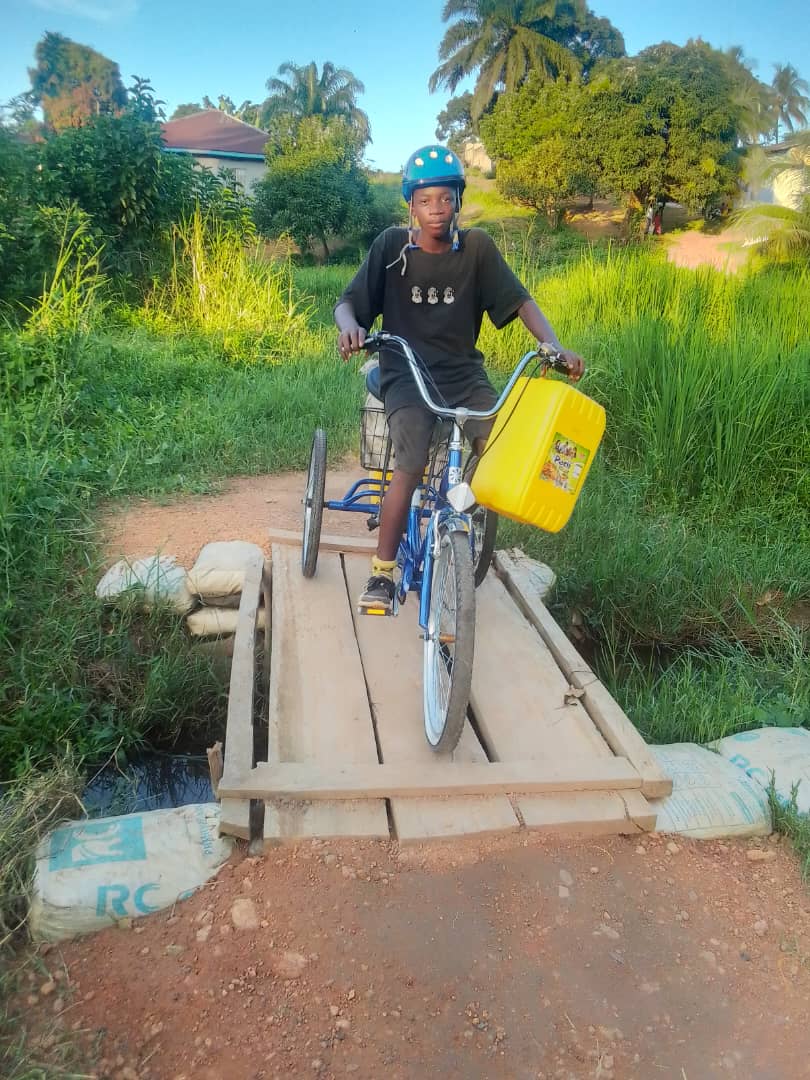 We witness this exclusion repeatedly among the farmers we serve. For example, Abu Turay can now transport his crops to the market using his tricycle. However, he asks us, “What next?” If this bicycle has helped Abu reach this point, how else can we assist him in realizing his fullest potential?
Abu Turay grows crops such as cassava, sweet potatoes, okra, palm oil, and rice. He has been an active member of the Slow Food 10,000 Gardens Project in Africa and has been involved with Slow Food Sierra Leone for over five years. Recently, he received a brand-new tricycle to transport his agricultural produce to the central market in Kono District.
 Abu is thrilled with this new direction in his agricultural business and has expressed his gratitude to Duke Farm and Pedals for Progress for this wonderful gift, which uplifts both his business and family livelihood. “With this, I can now have more money to pay my children’s school fees,” he shared.
The challenges we face are vast, but they ultimately consist of millions of farmers like Abu, each with the potential to improve how they cultivate their land, plant their crops, harvest their goods, store them, and transport them to market.
With Pedals for Progress, a bicycle becomes a valuable asset for trade, employment, transportation, and community engagement. In countries like Sierra Leone, where P4P has established partner programs, the most successful entrepreneurs are those who use bicycles to reach work and deliver their agricultural goods and services where they are needed most. This empowers them to expand their businesses and increase their personal incomes and productivity.
The Pedals for Progress bicycle program has always been good, clean, and fair for everyone. Here is a photo of Abu Turay riding his tricycle to carry his palm oil to the central market in Kono District. This image embodies our hope that we will continue to collaborate with Pedals for Progress at the heart of these impactful initiatives.