Category Archives: Sewing Partners

Sewing Machine Success in Ghana


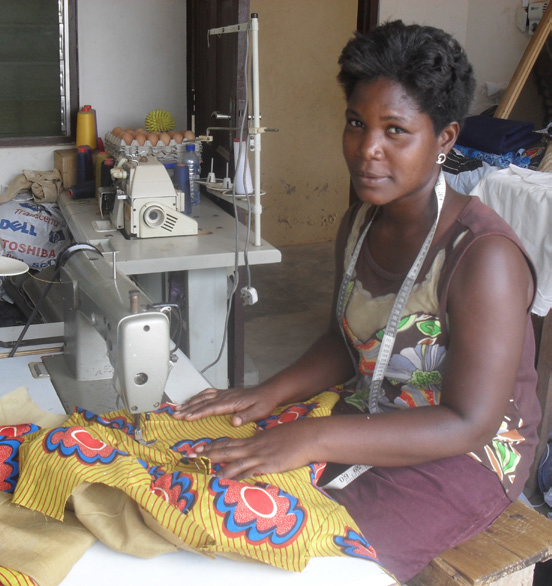
amahomepage Coming from a poor background, Ama Attah became a seamstress’ apprentice, hoping to learn and eventually use the skill to improve her family’s financial standing. However, shortly after the completion of her apprenticeship, Ama’s sewing machine was one day accidentally knocked from a table to the ground, damaging it beyond repair.

As a result of WEBike’s intervention, Ama received another, working sewing machine. She is overjoyed that she can now put the sewing skills she worked so hard to learn to use and can make money to support herself and her family.

Sewing Machines for El Caño

by Patricia Hamill
Fall 2013 InGear

High rates of unemployment, alcohol abuse, and teenage pregnancy. Little or no access to free or inexpensive transportation to good schools and employment opportunities. Our inner cities and rural areas are locations of potential concern for us, but, with multiple petitions, appeals to government officials, and perhaps celebrity involvement, communities may very well gain financial allotments for educational and environmental programs that enable at-risk youth to climb out of fiscal uncertainty and create financial independence. But what if the country is not large or powerful enough to compete for international attention of consequence or if the bedrock of the growing economy such as tourism and retail is not of benefit to those in remote locations? What if international celebrities have overlooked a place in need in their quest for the highest return on their sponsorship? The solution to the cycle of poverty must rest solely on a community’s ingenuity, savvy entrepreneurs, and established nonprofits who work in remote areas or small countries that don’t often rate primetime news coverage.

elcano

In the Monte Plata region of the Dominican Republic, the rural community of El Caño is in the process of developing its own sustainable niche in the economic development of this country. The financial divide here is not unfamiliar.

According to the 2013 Index of Economic Freedom, published by the Heritage Foundation with the Wall Street Journal, “Corruption, wasteful government spending, and unreliable electric service reduce investment returns, driving high unemployment.” Much of the country’s wealth is not trickling down.

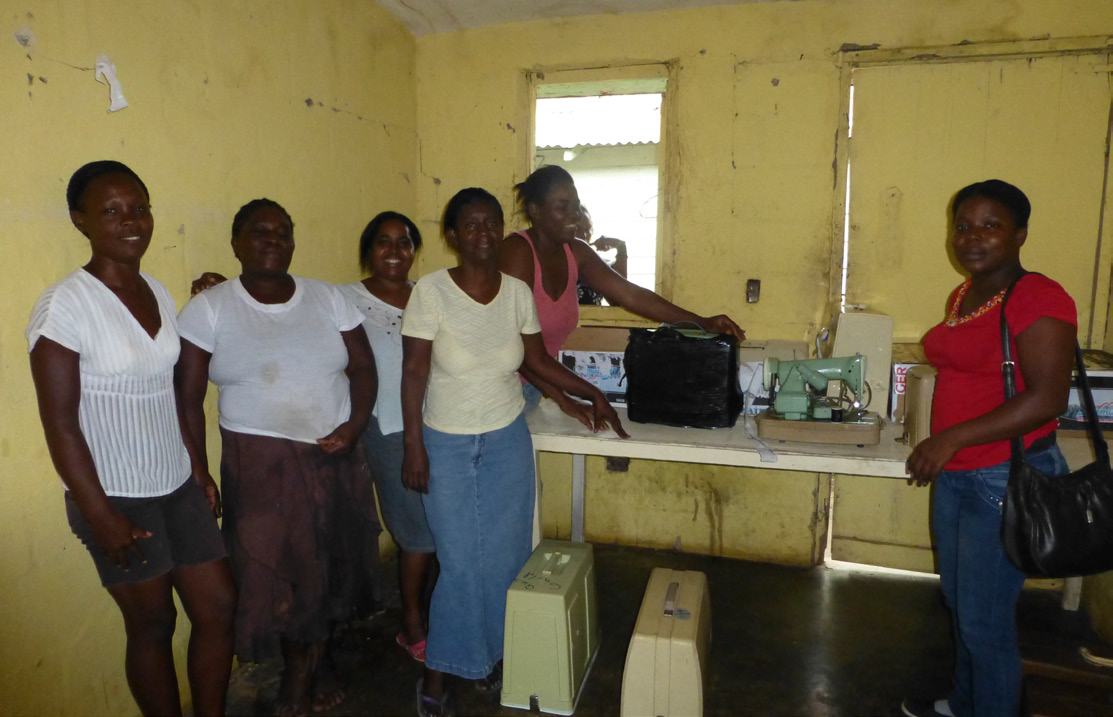
The community of El Caño had, at one time, a functioning sewing project in place, but this ended when the partnership with the NGO dissolved. Then came the students of Boston’s Northeastern University who visited El Caño as part of their Social Enterprise Institute’s (SEI) Innovation Consulting Project. Students conducted an asset map and quickly learned about the community’s needs in order to increase their marketable skills and income.

As a result, the idea for the Cooperativa de Costura de El Caño (CCC) was born. The students then developed a partnership with the nonprofit MOSCTHA (Socio-Cultural Movement for Haitian Workers). Originally formed to focus on human rights, advocacy, and infrastructure services for oppressed Haitians, MOSCTHA has expanded it’s work in “improving and empowering underrepresented communities” to the Dominican Republic.

To replace the sewing machines that departed with the previous NGO, Pedals for Progress has stepped up to the plate and arranged delivery of 13 sewing machines for the approximately 28 sewers who range from younger to older men and women. All are welcome to join the co-operative. When the CCC reached out to P4P, they requested foot-operated manual machines. This would logically be in consideration of unreliable electric power and thus be another way to avoid pitfalls to production schedules and project development. Unfortunately, at the time of this writing, P4P could only find one to send them.

Once the sewing machines arrive, output of products like table cloths and school uniforms can resume and the members of the CCC will return to selling their goods to neighboring communities and even to people in Santo Domingo, the capital of the Dominican Republic. Catalogs of the co-operative’s products, created by participating Northeastern students, will enable the CCC to promote more goods to a wider segment of the population. This income will gradually empower their younger generation by providing access to higher education, gainful employment, and comfortable and safe living conditions.

This type of sponsored self-sufficiency looks to be a promising antidote to the socioeconomic pitfalls poor and uneducated people must overcome in order to enjoy the advantages many of their fellow countrymen already have. Thanks to the partnership and cooperation of the students of Northeastern University, MOSCTHA, and P4P, the men and women of El Caño have and maintain gainful employment and the dignity and respect that comes from participation in your present and control over your future.

52nd Container to Rivas

May 18th, 2013, marked the shipment of the 52nd container of bicycles to EcoBici in Rivas, Nicaragua. Our relationship with this organization is the longest in our 23 years of partnership building. This current delivery contains 580 bikes that add to the 22,044 cycles already in circulation in the region and will contribute to the organization’s goal of community development and focus on enabling much-needed reforestation in the region.

P1030868P4P is also pleased to add 6 sewing machines to the container shipment. Our readers are of course already familiar with the Clif Bar Family Foundation’s steady and generous support of our programs and so it is not unexpected that the shipping and import taxes have been covered by them. What is new here is that the sewing machines are destined for a different locale in the region. In April, we were contacted by Noelle London, a Peace Corps volunteer who is involved in small business development in Nicaragua. London wrote that she lives on Ometepe, an island close to Rivas. This island, situated on Lake Nicaragua, is steadily becoming a tourist destination and she informed us that, currently, most of the souvenirs visitors purchase there tend to be made in Granada or Masaya.

London informed us that, with reliable and efficient tools, the local women could develop a thriving base of manufacture in their community of Balgüe: “They have begun to sell in a couple of locations on the island and even in a fair in Managua but are unable to keep up with the current demand as they only have 3 working machines.”

942817_168081573356090_1040016389_n
This region is ideal for building a tourist trade in local crafts as there are many attractions to draw steady crowds yearly. The beaches on the island of Ometepe are black volcanic sand, and the lake, long separated from the ocean by an earthquake, is an ideal location to observe the many species who have adapted to this environment. Lake Nicaragua is the only lake in the world with very large freshwater sharks. Tours of the island include trips to Altagracia and its Pre-Columbian stone statues and to Magdalena Farm in Balgüe where organic coffee is grown. It is a lush land with fertile soil fed from the Volcano Maderas.

London included this statement in her e-mail to us: “I have normally been the one to shy [local women] away from donations, as they have to eventually [establish] a fully sustainable business as opposed to a project. However, after working with them on productivity countless times, I have come to understand that they simply lack the sufficient resources to really take off.” What stands out to us at P4P is London’s very realistic take on the development of self sufficiency. Charity does not build business infrastructure. Long-term goals, reliable tools, and ongoing training programs are the only hope for people in places like Ometepe to foil the existence of questionably sourced “authentic” souvenirs of their own region and take control of the industry for themselves. This is a beneficial situation for visitors of the region as well, of course. Value is added to the experience of visiting a country where the textiles and other mementos are made by local people and cooperatives. Even better if a visit to the places of manufacture are part of a tour itinerary.

“It has been a pleasure to work with these motivated and talented women. They have dealt with countless obstacles and have continued to fight to keep their business afloat,” states London. P4P is very happy to see the contents of one container contribute to an old reliable partnership in Rivas and a new and promising one on Ometepe.

Country Update: Guatemala

Spring 2013 InGear

Doña Marina lives in the town of San Andrés Itzapa, Chimaltenango, Guatemala in the county of San Antonio. Growing up, Marina’s family was very poor. She was never given the opportunity to attend school as her father died in 1980, leaving her with the responsibility of taking care of both her mother and her handicapped sister.

2013springGuatSewingTo help provide for the family, Marina learned to sew. She started out making aprons and small cushions, each of which sold for the equivalent in American currency of one penny and one-and-a-half pennies respectively. Over time, Marina’s skill improved so that she was capable of sewing blouses, skirts, day dresses, wedding dresses, and women’s pants. For many years, she used the same sewing machine: an extremely old, foot-operated model. This made performing the work integral to her livelihood a laborious and protracted task.

However, in the year 2000, Marina received her first electric sewing machine from Pedals for Progress partner, FIDESMA. This greatly increased the ease with which she could produce garments. Furthermore, as a result of the added speed provided by an electric sewing machine, Marina was able to take on many more jobs. Eventually, in 2012, she made enough money to purchase herself a second sewing machine.

Doña Marina is extremely grateful to Pedals for Progress and FIDESMA for giving her the opportunity to own two electric sewing machines despite her low income. She is now able to work much more rapidly and can produce multiple items of clothing daily. Now, with the extra money she makes, Marina can better support her sister and her elderly mother.


Héctor Rolando Sunuc Mututz is a 33-year old Guatemalan who has worked for the Catholic mission, The Apostles of Infinite Love, since he was a child. Born into a poor family, Rolando always needed to make money, forcing him to abandon his education after completing elementary school. With his family having so few resources, The Apostles of Infinite Love took care of and looked after Rolando throughout his childhood. Now, as an adult he is still with the mission and has become one of its key employees.
2013springGuatBikeRider
Rolando is married and has four children. He and his family live in the town of San Andrés Itzapa, 2km away from the mission. In need of transportation to and from work, Rolando’s only option initially was to hire a motorized tuk-tuk on a daily basis. However, considering his modest income, this was not a practical solution to his transportation problem. So, Rolando turned to FIDESMA, a Pedals for Progress partner that distributes bicycles, supports agricultural extension, and performs other services within the community of the San Andrés Itzapa area.

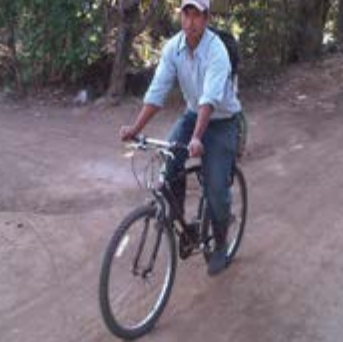
The bicycle Rolando received from FIDESMA and P4P provides him with his own method of transportation for his daily commute. Furthermore, with the goal of him and his family becoming fully self-sufficient, Rolando has acquired some land on which he grows corn, beans, and various other fruits and vegetables. However, the land is 10km away from his home. He is only able to tend to his garden and keep it flourishing thanks to his bicycle that allows him to make the 20km round trip once every week.

Rolando states that he is very thankful to FIDESMA and Pedals for Progress for their bicycle program. As affordable transportation options in his area are scarce, Rolando would have to walk for hours and hours to accomplish what he can instead do quite rapidly now that he has a bike. Above all, Rolando is just happy to have the ability to get to where he needs to go on his own terms.

Incarnations of Unwanted Sewing Machines: From Landfill Candidate to Instrument of Economic Recovery

by Patricia Hamill
Spring 2013 InGear

It’s true. Most high-end products and appliances these days are more expensive to fix than to replace and, though this is an uncomfortable reality, it is one that most Americans have become used to. So, until we can address and rectify this wasteful trend in production, what is one to do with machines destined to be discarded? No one really wants to add to landfills and groundwater pollution even if replacement is the only economical option; but these things can’t be stored in a “cloud” like data.
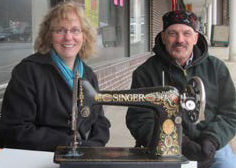
newtonsewingFor teachers in the Governor Livingston High School (GLHS) in Berkeley Heights, NJ, this problem became a pressing issue. Because of the high cost of labor in the United States, it became necessary to replace the aging sewing machines in the school’s Home Economics class rather than to repair them. It was not, however, an option for the school to simply toss the rejected machines in the garbage. Having heard about P4P’s programs and realizing that sewing machines are part of the organization’s collection focus, GLHS chose to donate rather than dump their 15 sewing machines.

It is not often that a group, school, or organization is able to support economic development in another country while also ensuring that American students get training in needed skills. While this option became a reality for GLHS, there was still the issue of repairing the machines for use once they found a stopping point at P4P. Mark and Martha Hall represent the unseen portion of the process that gets the sewing machines from rejection and collection to distribution. Martha recalls her initial contact with P4P: “I first learned of P4P when my local YMCA did a bicycle collection in 2006. We had the typical basement full of outgrown and unused bicycles. I brought several over to that collection.” When she went to the web site to learn more about P4P’s collections and partners, she learned that sewing machines were also in demand. This got her full attention: “I like the idea that unused sewing machines can be put back to good use in teaching young people how to sew and especially to help women set up independent and productive sewing businesses.”
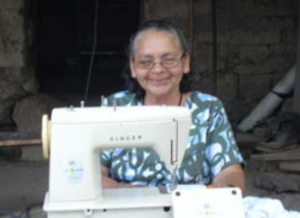
spring2013elSalvadorSewer1Martha’s interest in sewing developed in her Home Economics class as a child, continued into her activities in the Girl Scouts, and evolved into a passion for creating quilts and quilted art. It took some time, but, in 2011, Martha was able to gather her quilters’ guild members and schedule a sewing-machine collection. With the help of P4P staff member Gary Michel, Martha and her husband Mark oversaw the event, and, thanks to the participation of the guild members and public outreach, 16 sewing machines arrived to await new homes.

Many of our readers are not privy to the work required after we have finished a day’s collecting. P4P is not just a transportation center for bicycles and sewing machines. It is a stop point for evaluation and rehabilitation of the cycles and machines and we take very seriously the importance of providing reliable and lasting goods as well as access to resources for repairing these after they have arrived at our partners’ bases.

It was during the above 2011 collection that a casual conversation led to Mark becoming P4P’s go-to man for the repairs of donated machines. According to Martha, they established an efficient and thorough process with Mark being the overall repairman and Martha being in charge of cleaning the parts and doing the test runs of finished machines. Ultimately all of the machines are cleaned, their gears greased, and all moving parts oiled. Dried out rubber O-rings are replaced so that bobbin winders run smoothly. New needles are a must. Any machines too far gone to be fixed are used for parts. Finally, each machine is tagged and ready for David or Gary to retrieve them for shipping to waiting partners.

The particular machines from the Governor Livingston High School were destined for a group of women living in the barrio Rosario Tablon in the county of Tenancingo, El Salvador, a country where P4P’s partner CESTA has run other environmental programs. Tenancingo (Tenantzincu or the “place of the little valleys”) is located north of San Salvador and is counted as part of an extension of the “department” or region of Cuscatlán, created for the Yaquis and Pipil Indians. The twelve years of armed conflict that began in 1980 and engulfed all of El Salvador severely affected this region, causing this county to have one of the highest rates of poverty in the entire country. Of the approximately 7,488 inhabitants, 1,195 people are located in urban surroundings and 6,293 live in rural environs. CESTA’s mission is to support the creation of a sustainable economy and improved lifestyle for these people.
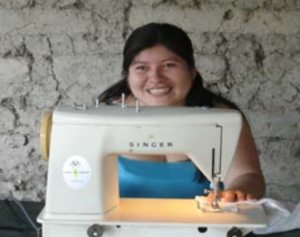
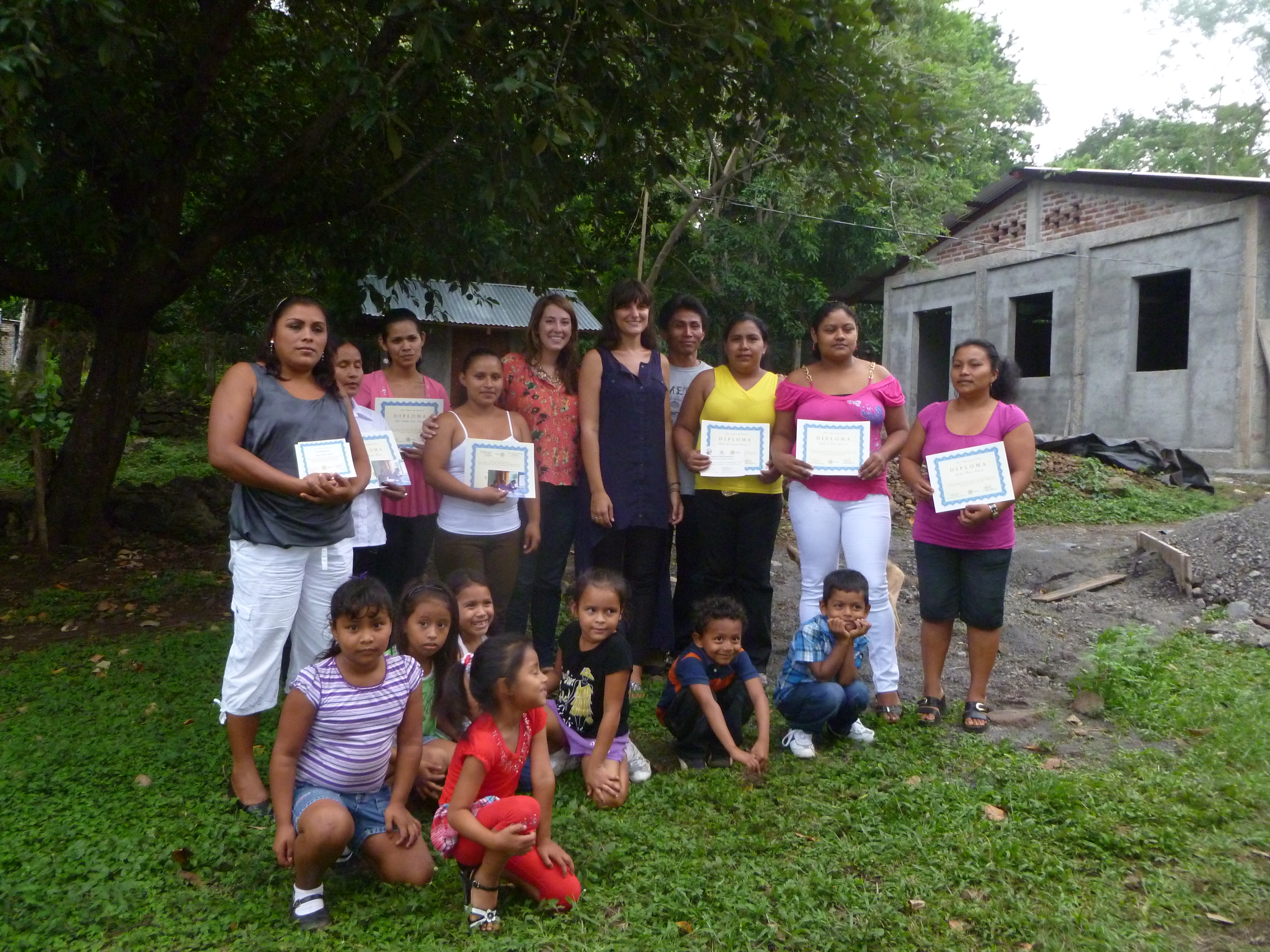
spring2013elSalvadorSewer2The opportunities for income here are limited and CESTA and the mayor’s office of the town work together to generate more options for people in the rural locations of Rosario Tablon, Pepeto, Corral Viejo, and Rosario Perico. Tenancingo is currently best known for its palm plantations and the production of palm hats, which are braided by hand by the women who live in this area and sold in Cojutepeque as well as in San Salvador. There are other opportunities for income generation like ownership of small commercial stores, various types of agricultural activity such as pig farming, and seasonal work, mechanical repair and security services but, just as with any developing infrastructure, there must be economic growth. When the municipal government realized the potential that the influx of sewing machines held, they requested that CESTA increase the number to about 30 with a plan to create small factories for sewing and dressmaking where many women and young people would be employed.

So it is that the ten sewing machines from the 15 collected in New Jersey arrived fully repaired and ready for work in Rosario Tablon, where the group who received these sewing machines constructed a cultural center in which different sewing skills such as embroidery, dressmaking, and tailoring are practiced. The parts of the unsalvageable 5 machines were incorporated into these 10 or set aside for future repairs. Nothing wasted. The people awaiting the future deliveries of machines may never know that their future employment was influenced by the choice of one American school to incorporate global awareness into its own financial considerations.

If our readers had not before comprehended the impact that a few Americans and their seemingly obsolete possessions have had and will continue to have on international economic development, empowerment of women, and skills acquisition for the young, the above system of collection, repair, and distribution hopefully illuminated the tangible contributions of P4P and its partners to this change. For the many of us who did not know who works behind the scenes ensuring that contributions are truly ready for immediate use and long-term continuity, this revelation offers a new dimension to the image of who it is that steps up and gets involved in our mission.

For more information: P4P CESTA page, CESTA home page (Spanish)
Sewing in Nicaragua

s4
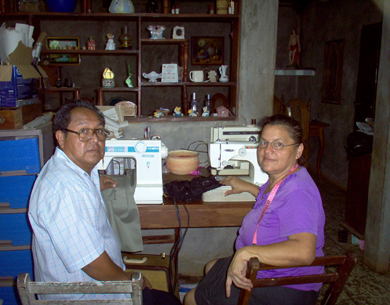
Juan Carlos and Migdalia Dávila, live in Diriamba, Carazo, Nicaragua, they are both 58 years old and have 1 son who is 11 years old. Until November of 2008 Juan Carlos worked as an office assistant for a private company in Jinotepe. Even though he had a steady job he worked as a tailor at night to make some extra money for his family. Since the help of the sewing machines from Pedals for Progress came 2 years ago, Juan Carlos and his wife Migdalia have been building a small side business so that if Juan Carlos lost his job they would have another source of income. So when he was told that he was no longer needed in his position they were ready. Today Juan Carlos and his family are able to make ends meet with their sewing. They sell dresses, blouses and men’s clothing. They are grateful to Pedals for Progress for the high quality yet affordable machines P4P provides in Nicaragua.

From Iowa to St. Vincent

A Peace Corps Volunteer Brings more than Good Will to an Island School
by Patricia Hamill
Winter 2011 InGear

As you may have read on our web site, we received a wonderful letter from Peace Corps volunteer Liz Deppe thanking us for making it possible for the school where she teaches to acquire 20 sewing machines. Located on the island of St. Vincent, the Barrouallie Secondary School (BSS) is the fortunate institution to welcome Liz and, hence, receive the machines. Originally from Ames, Iowa, Liz has only been in St. Vincent for 8 months as an assistant to the teachers in the art and reading courses; however, in that short time, she has made an enormous difference. Having known about P4P from our work in Iowa, she decided to contact us about donations of sewing machines to incorporate into the curriculum.

What can they do for employment without this skill? While banana production has dominated the economy, the government has been seeking ways of diversifying so that Vincentians do not continue to be vulnerable to price fluctuations and crop diseases. Tourism is an industry that has grown widely, but not everyone is able to profit from this type of expansion. This is where the importance of a solid education backed up by practical vocational skills comes into our story. According to Liz, “That first project and many more projects the students at BSS will work on are teaching them more than just how to sew. They are learning patience, creativity, problem-solving skills and a sense of accomplishment.”

While the machines are not used for production but strictly for classroom learning, there is hope that more machines can be acquired so that families may be able to purchase them and begin their own businesses. At the very least, the students have a marketable skill to offer alongside the knowledge they gain from their studies. Liz has witnessed firsthand the lasting effect that tangible results from focused effort provide: “What I believe is the most rewarding part of our newly created sewing program is a sense of accomplishment. At a school with little resources and many struggling students, it is amazing to watch a student who has never felt proud show you what they have accomplished. Their face beams as they hold up the finished product, something they can use and show off.”

It is part of our mission to do the utmost to send our shipments as economically as possible while striving to get the sewing machines and bikes out to those in need as quickly as possible. P4P was able to ensure that the sewing machines could make it to the school and with as little financial burden as possible by sending them via sea rather than air. The cost was demonstrably lower at $10 apiece. If all goes well, we may be able to continue this relationship not only with the school but also expand to other institutions on the island. It is Peace Corps Volunteers like Liz and people like our partners and contributors who think progressively, initiate programs, and give support that make our efforts so successful.

P4P reaches a new country: Georgia

Pedals for Progress partners with a wide variety of organizations to promote and aid sustainable economic development throughout the world. One of our partnerships this year was with International Relief & Development (IRD), a NGO with truly global reach that provides $500 million in development assistance in nearly 40 countries annually. Our collaboration with IRD involved a joint program of theirs with the United Nations to aid more than 800 refugee families in Georgia displaced during that country’s 2008 conflict with Russia.

P4P was pleased to be able to help that effort by providing 82 donated sewing machines. The shipment cleared customs in early September and the machines have by now been fully distributed. Our hope is that the sewing machines will in some measure encourage entrepreneurship and return self-sufficiency to families who had been forced from their homes during the fighting and returned to find their belongings stolen or destroyed. Most of the aid was distributed in the Shida Kartli region of central Georgia (just south of contested South Ossetia).

Below is a thank you note forwarded to us by IRD:

“I am Iamze Chutkerashvili, a solitary mother and I am looking after my two sons alone. I am a teacher and my salary is not enough for keeping the family. Without the assistance from non-governmental humanitarian organizations as IRD our life would have been much more difficult.

“I have already received a solid assistance from IRD and I was amazed and very excited when I saw your representative once again in my family with quilts, sewing machine, and sewing kits.

“As you know our village is one of the villages from the former buffer zone and during the war in August 2008 almost every family were damaged and looted, so you can easily understand how important such kind of assistance for me is.

“I want to say once again that all beneficiaries in my village are very thankful to IRD for the assistance.”

As much as we wish it were otherwise, Pedals for Progress simply can’t get the items our domestic supporters donate to all the places in the world where people desperately need a leg up. Partners like IRD help us help those whom it would normally be prohibitively difficult for us to reach alone.