Category Archives: Collectors

Lesson Learned: kids are not buying as many bikes as they used to

By David Schweidenback

February 2020

In February 2021 I will have spent 30 years collecting bicycles. A lot has changed over the years. Initially we received mainly 10-speed bicycles with a smattering of old English 3-speeds. The most common brands were Schwinn and Huffy. Today we receive mainly mountain bikes and the most common brand name by far is Trek! This is actually quite an improvement because mountain bikes are much more useful in the areas we ship to.

When I started we received one 20-inch-tire bicycle for every two adult bikes we collected. This was important for several reasons. A 20-inch BMX or banana-seat bicycle is a great bicycle overseas. It’s the correct size for many adults in the developing world. And these bikes are basically indestructible.

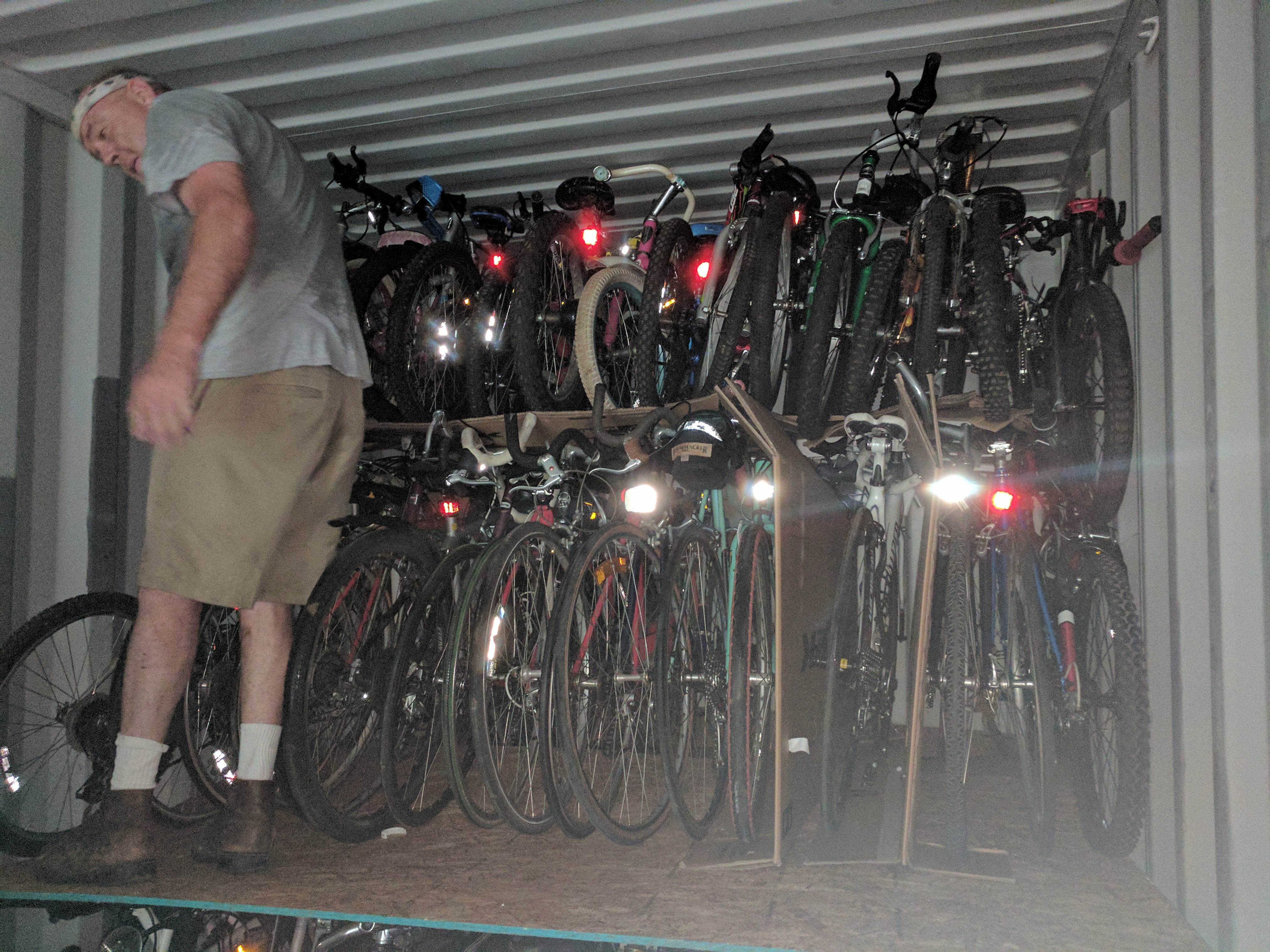
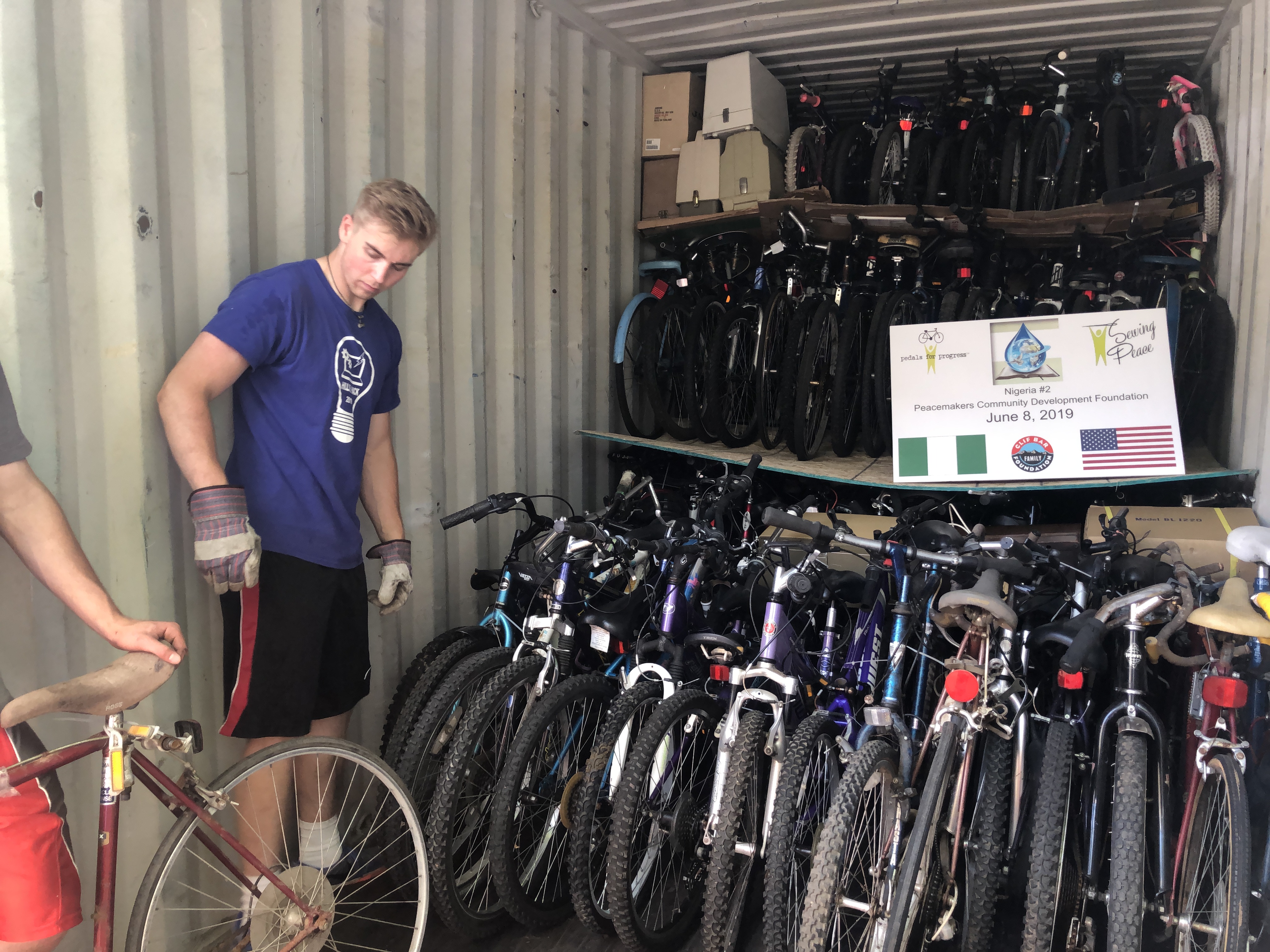
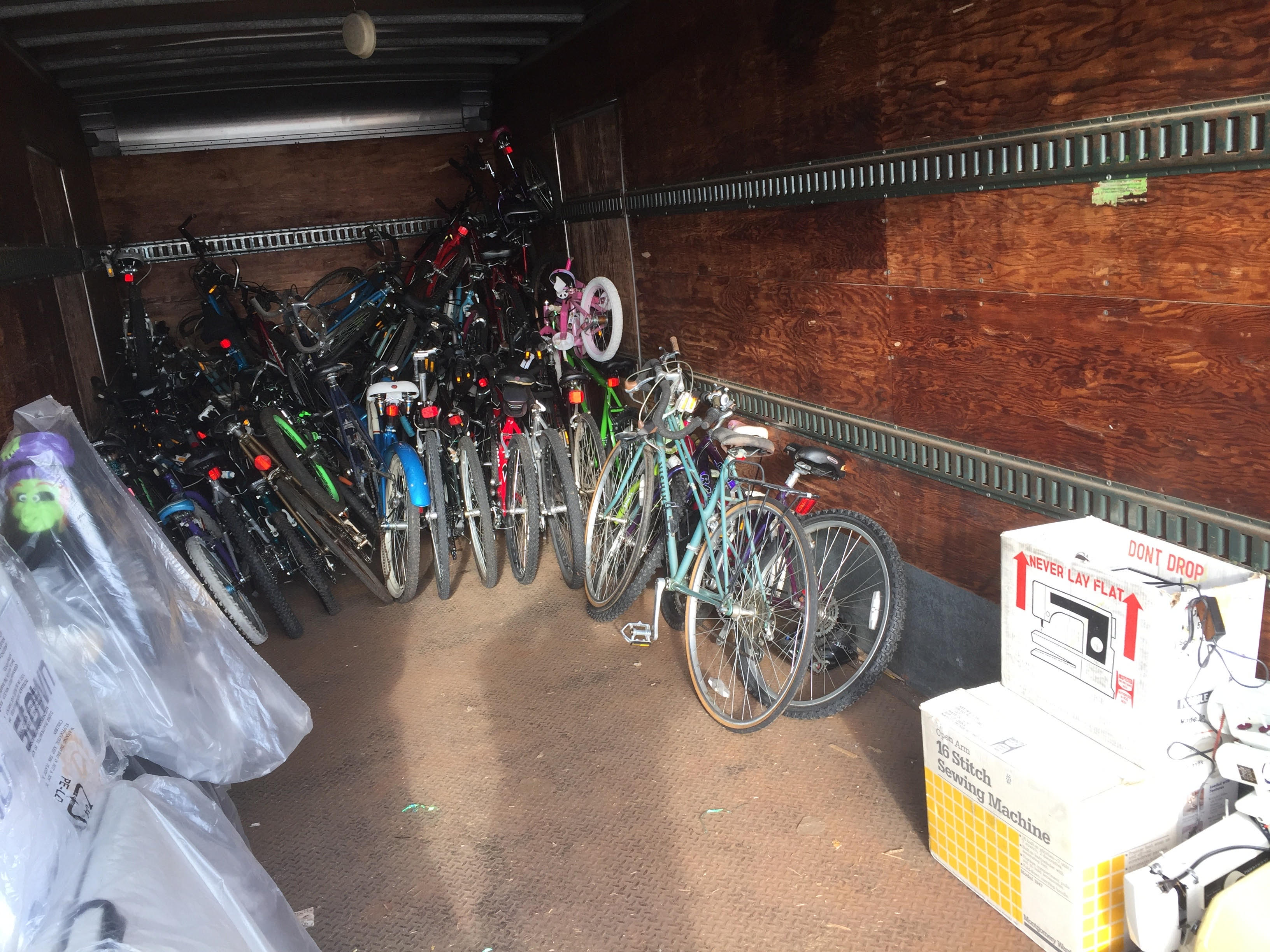
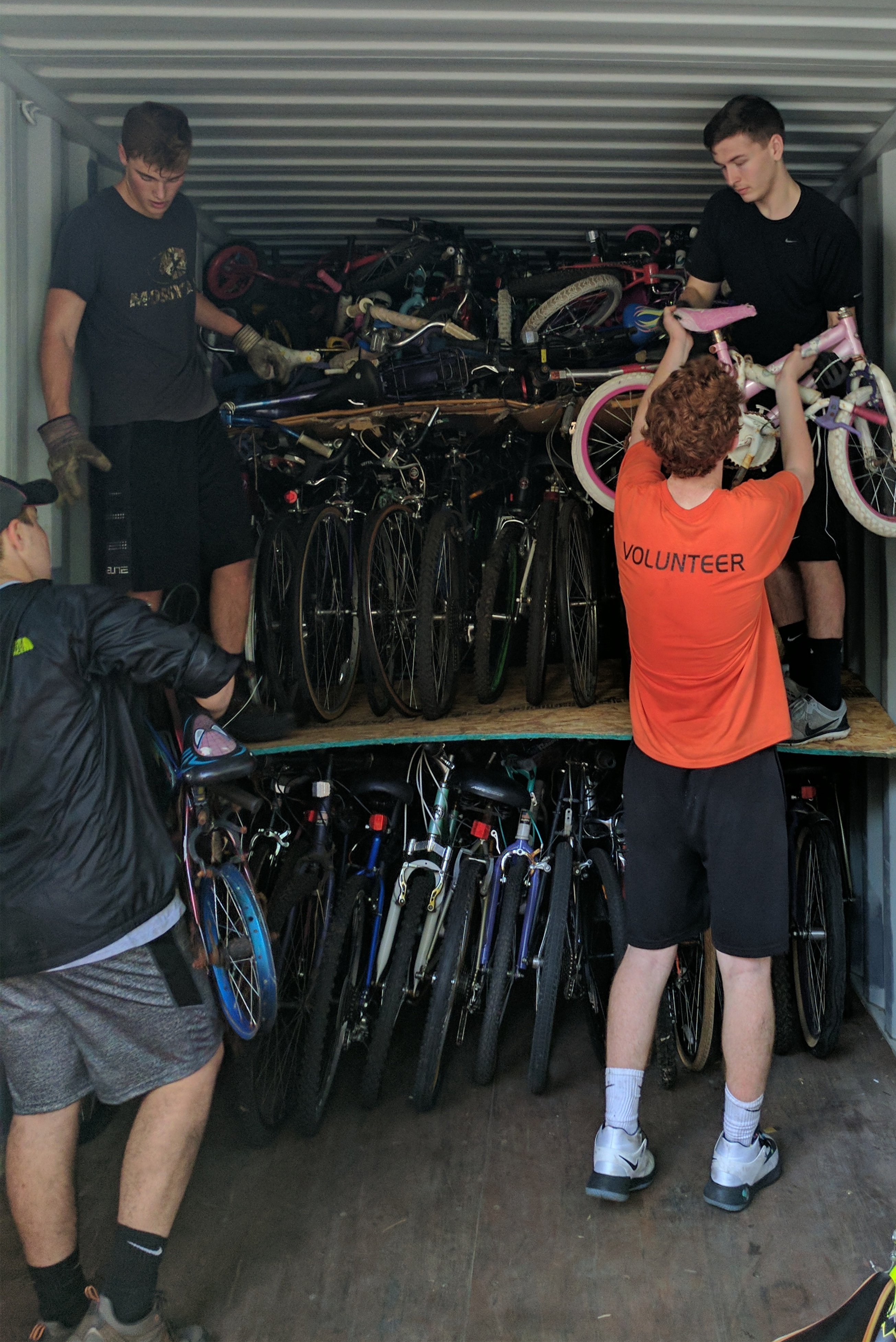
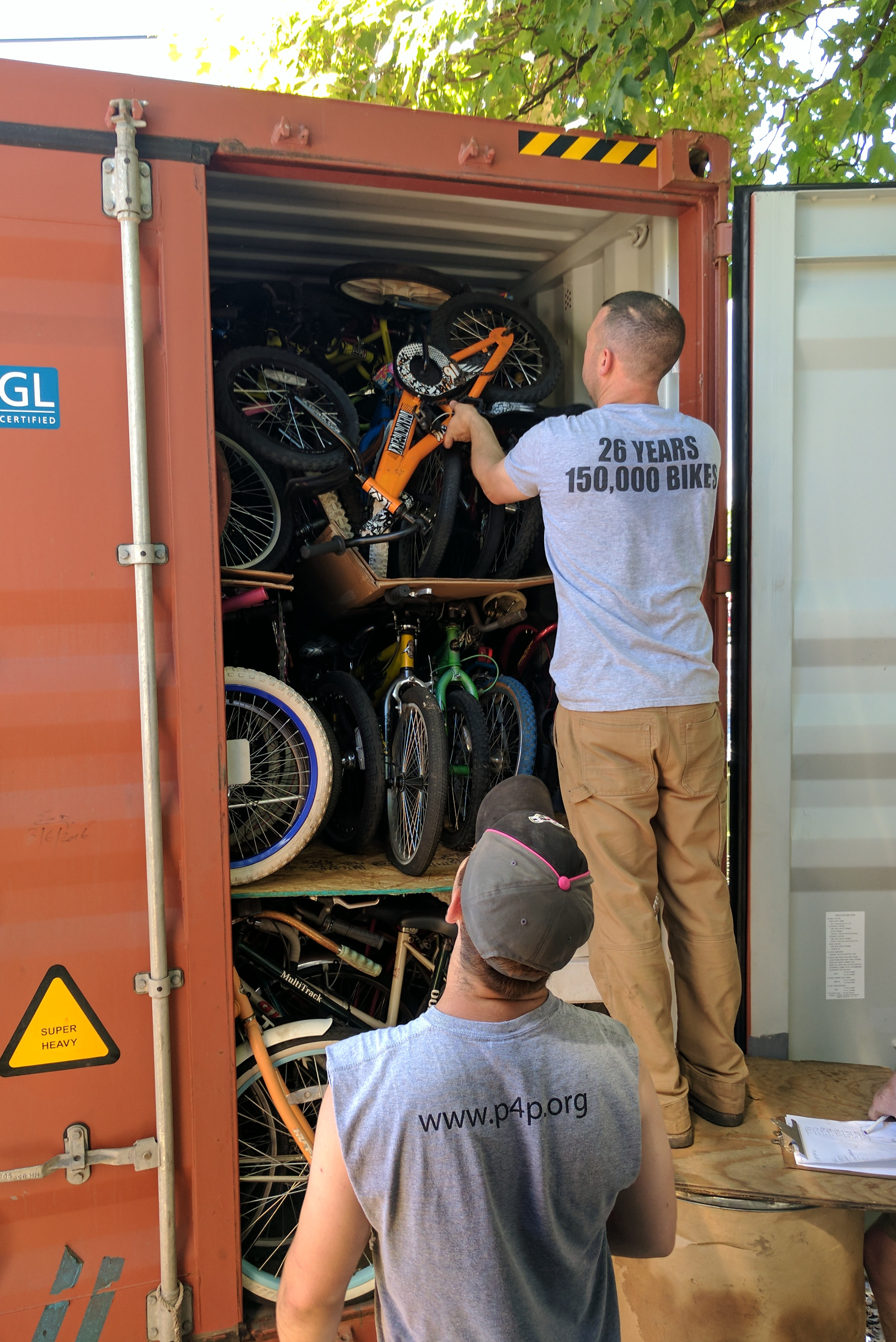
The 20-inch bicycles were also very important in shipping. When we load a container, we put a row of adult bikes side-to-side in the container, plywood on top of them, and then a second tier of adult bikes. We then put cardboard on top of the second tier of adult bikes and have enough room to stand up a row of 20-inch bikes as a third tier. This arrangement uses all the space in the container, so we can fit more bikes.

During the last year or two we started just getting fewer and fewer 20-inch bicycles. When I first started we had no competition for bicycles but now there is significant competition from other groups that are also collecting bicycles for their own domestic purposes. Initially I just assumed someone else was getting those bikes before Pedals for Progress could. The number of 20-inch bikes just continued declining and I realized that competition could not explain the lack of collectible 20-inch bikes. It really has become a problem in the loading process: instead of rolling 20-inch bikes on top of the second tier we now need to lay adult bikes flat on top, which is very strenuous for the guys doing the loading: they’re in a cramped space, lifting 30-pound bikes, and bending forward to stack them.

I was speaking with a bike shop owner and I mentioned this problem of not having enough 20-inch bikes to fill the smaller places in our containers. He was not surprised at all and told me that although he had 20-inch bikes in his shop he almost never sold any. That’s when the light bulb lit up in my mind.

It is not competition taking the bikes but just the sheer lack of availability. Very few 10-year-old kids ask their parents for a bicycle for their birthday. New iPhones and virtual-reality goggles are preferred. There are still many kids of that age who have a bicycle, but every 10-year-old used to have a bike. Now it seems having a bike at that age is the exception, not the norm. Who knew? The lack of 20-inch bicycles is not some fault in our collection system. It is not a serious problem that threatens our Corporation but I was glad to learn the lesson: societies change.

Report from Vermont, Fall 2019

Fall 2019 Newsletter

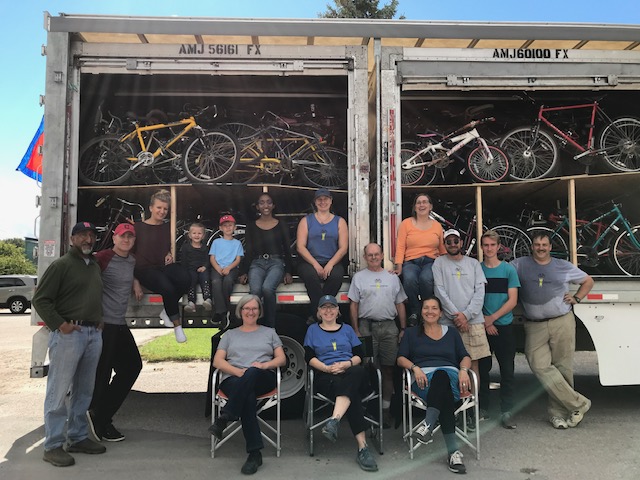
On 21 September 2019 the Vermont Green Mountain Returned Peace Corps Volunteers (GMRPCV) held their annual collection. Vermont Knights of Columbus groups also held a September collection. The combined shipment from Vermont contained 139 bikes and 95 sewing machines, including the 500th sewing machine from the GMRPCVs. Here are the reports.

Green Mountain Returned Peace Corps Volunteers

By Joanne Heidkamp

We packed a total of 245 items into 4 containers: 139 bikes and 95 sewing machines. We also shipped 25 new bike seats donated by Terry bicycles.

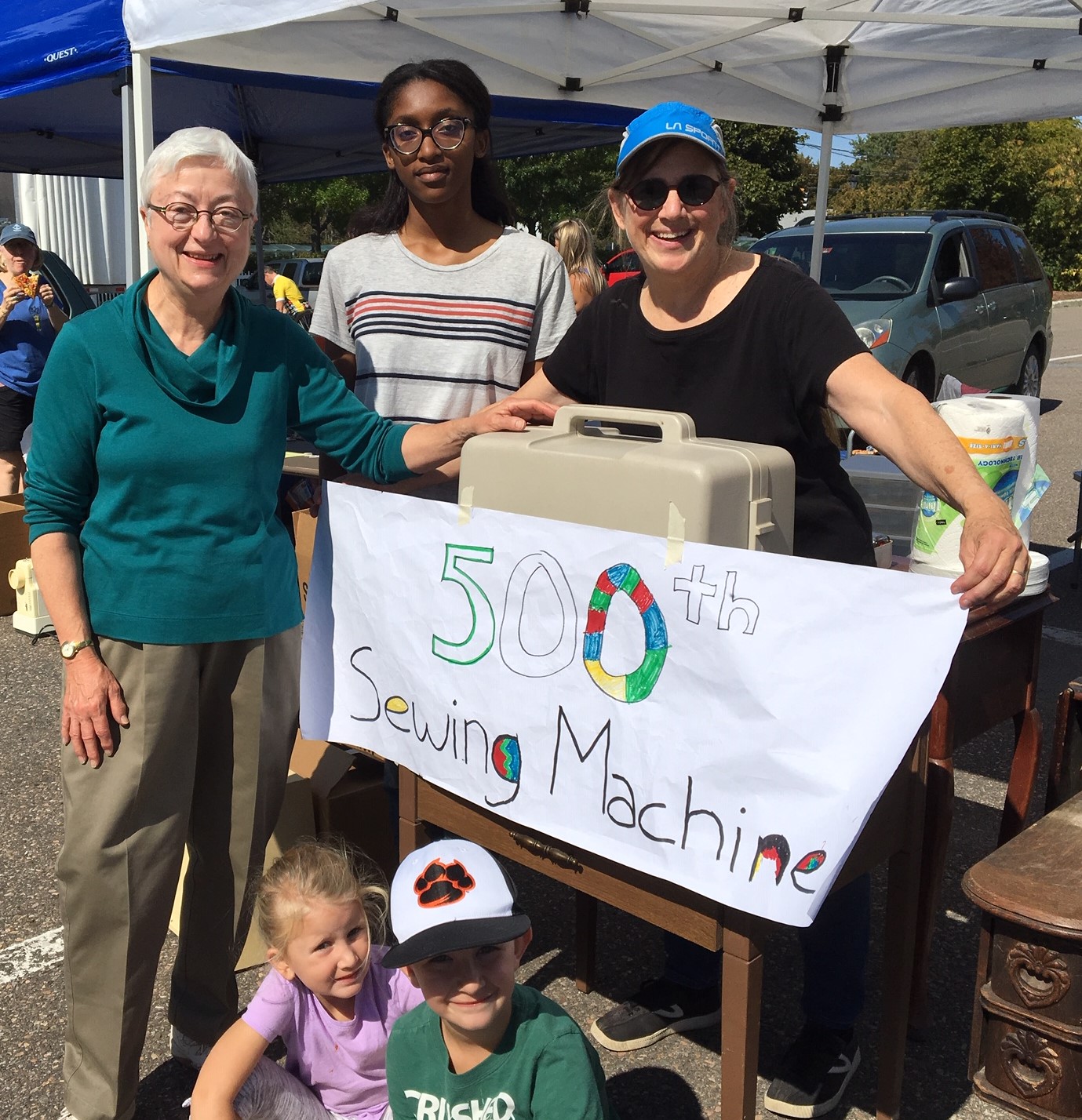
A highlight of the day was receiving our 500th sewing machine, a lovely Bernina donated by Lucy Beck, of Shelburne, Vermont.

We collected $1,795 in cash and checks. You’ll be receiving a separate check for $410 for Mary O’Brien’s 41 lovingly tended sewing machines. Several people did not donate items, but have emailed me asking about sending shipping money directly to P4P — including a woman who works for USAID in Albania! And I hope to get $150–$200 for the 7 sewing machine cabinets that I have listed on Craigslist. Individuals in the group absorbed several hundred dollars in costs, including pizza and snacks, postage for the reminder postcards, plywood, … We can confidently say P4P will have $10 per item in hand by Thanksgiving.

Quality of the bikes and sewing machines was great overall, with a few really nice, high value items.

Thanks to everyone for their help. Thank God it’s only once a year!

Knights of Columbus, District #1, Fairfax, Vermont

By Ed Nuttall

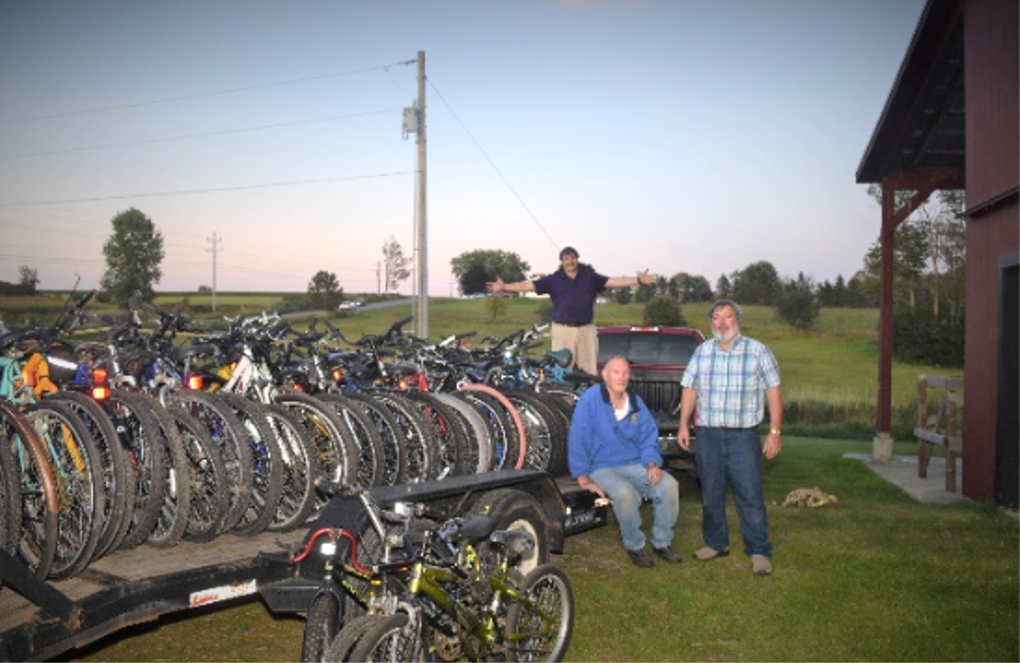
Ed Nuttall, Peter Fitzgerald, and Bob Thompson

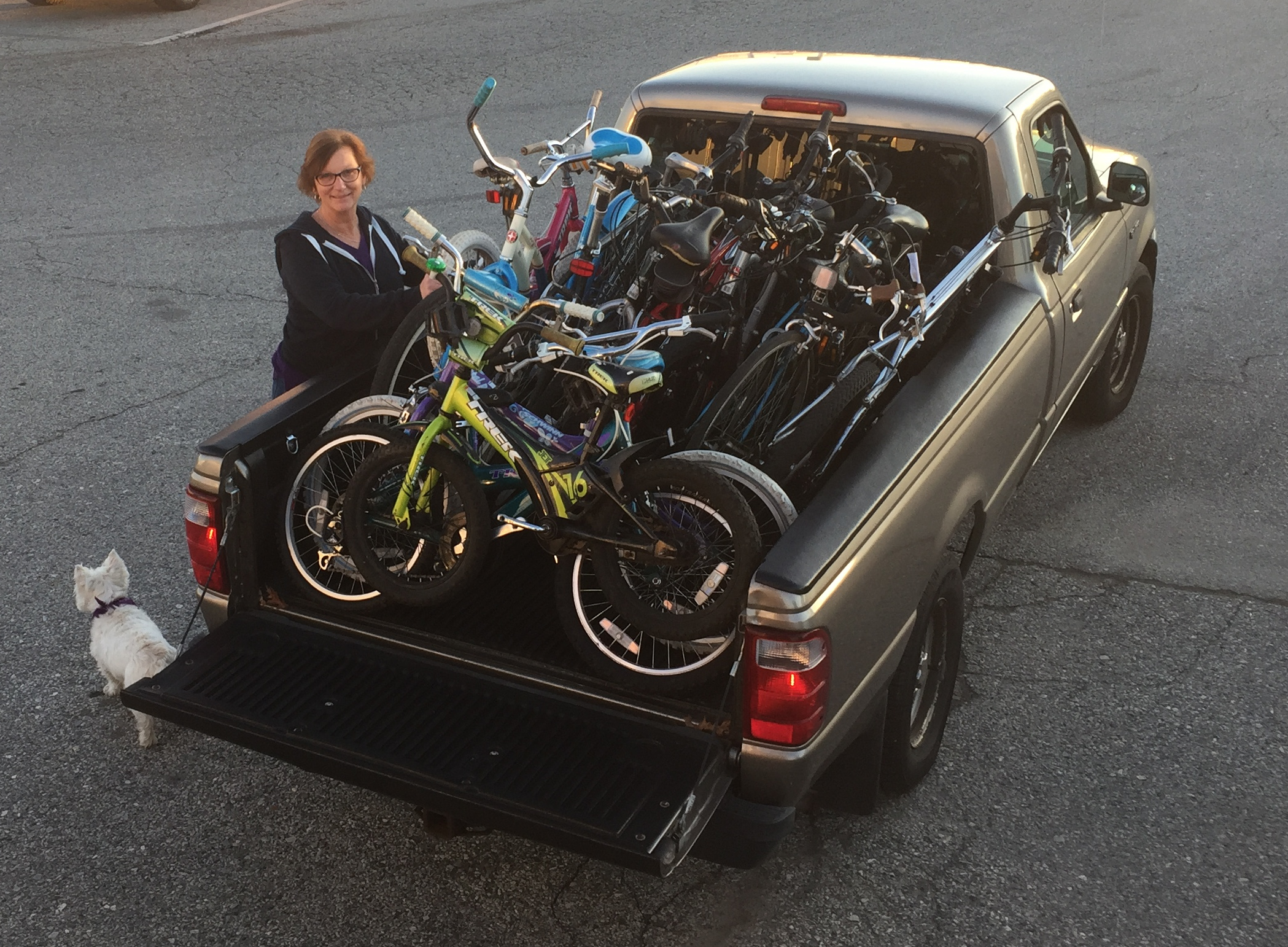
On 7 September 2019 members of Knights of Columbus Council 10830 held a bicycle collection at Langelier’s Car Wash. Fairfax Council 10830 and Milton Council 10417 (Police and Fire Department contribution) collected fifty bikes. The bikes were stored in Pete Fitzgerald’s barn. We also collected 5 sewing machines.

The following Knights participated: Bob Thompson, Doug Lantagne, Peter Fitzgerald, Keith Billado, Skyler Billado, Greg Hartmann, and Ed Nuttall.

On 20 September, we loaded 53 bikes onto a trailer and delivered them to Burlington, where, along with the bikes and sewing machines collected by the Green Mountain Returned Peace Corps Volunteers, they were loaded onto a FedEx truck for delivery to the P4P/SP trailers in Glen Gardner, New Jersey.

Robert Musil’s Sewing Machine: from New York to Togo

By Dave Schweidenback
Fall 2019 Newsletter

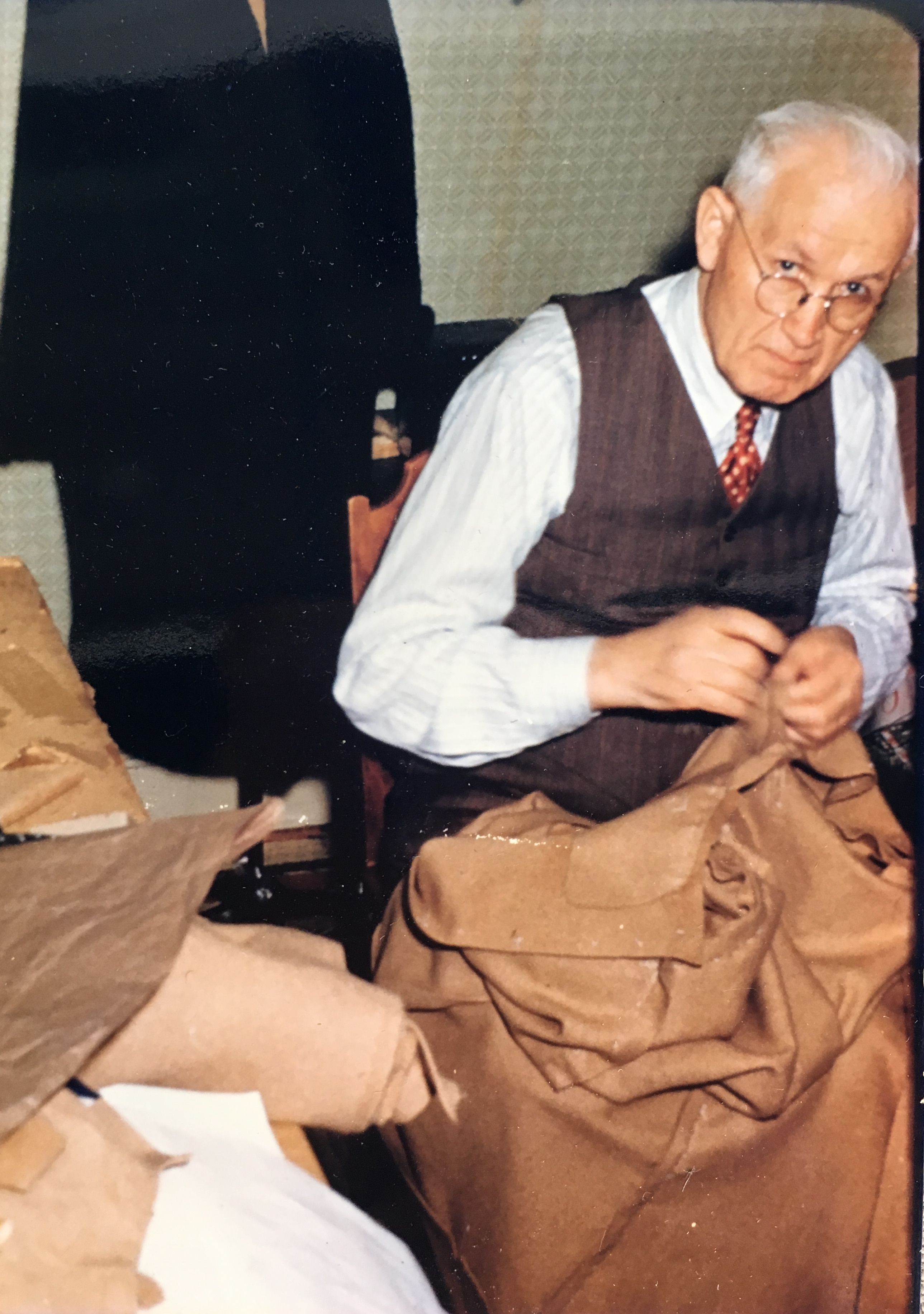
Robert Musil

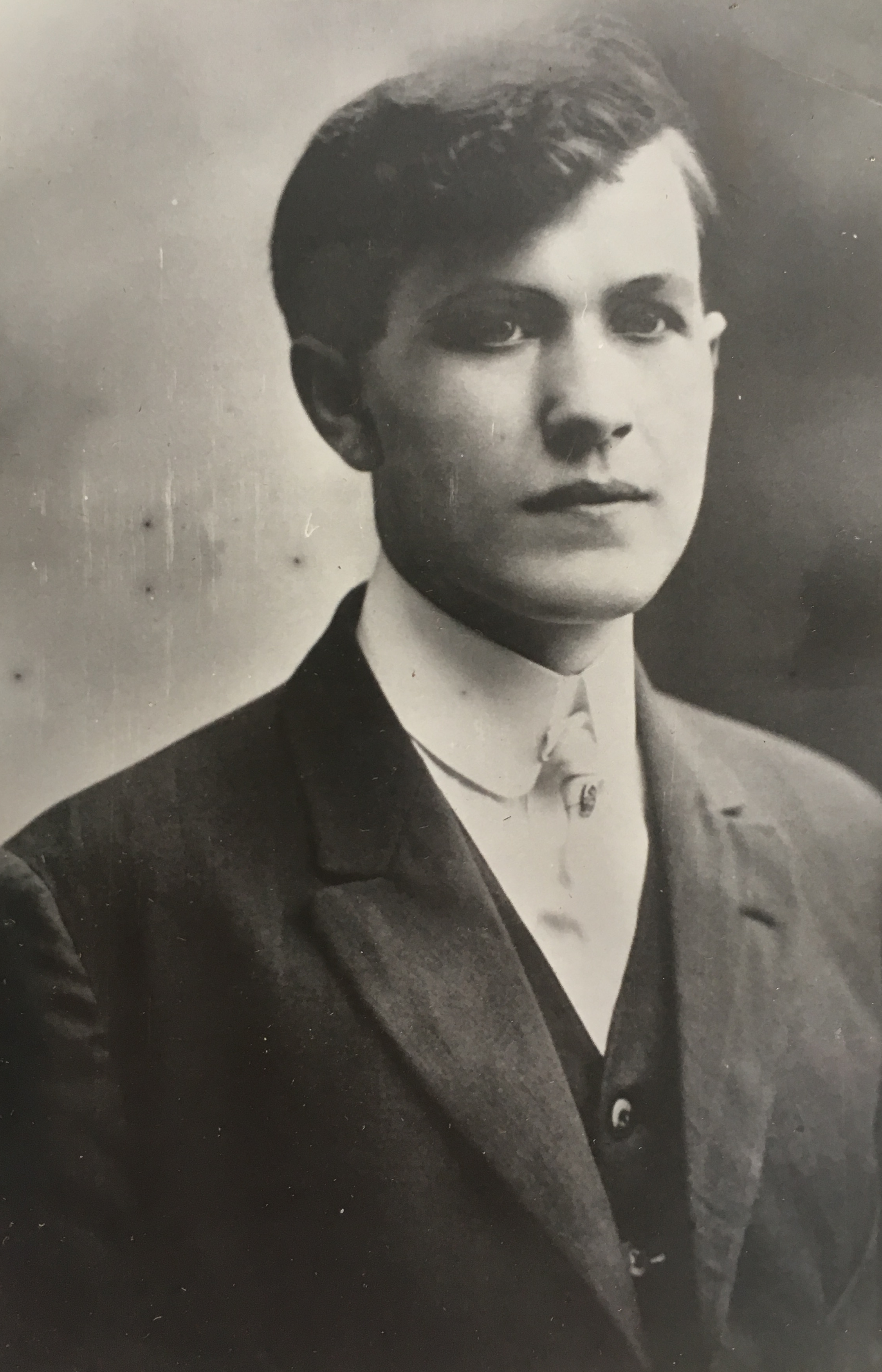
Robert Musil, 23 years old, left Krizanow, Moravia (now the Czech Republic), in October 1910. His sister Fanny Vogel had previously emigrated to the U.S. and she and her German husband sponsored Robert’s trip. He traveled north to Bremen in Germany and embarked for the U.S.

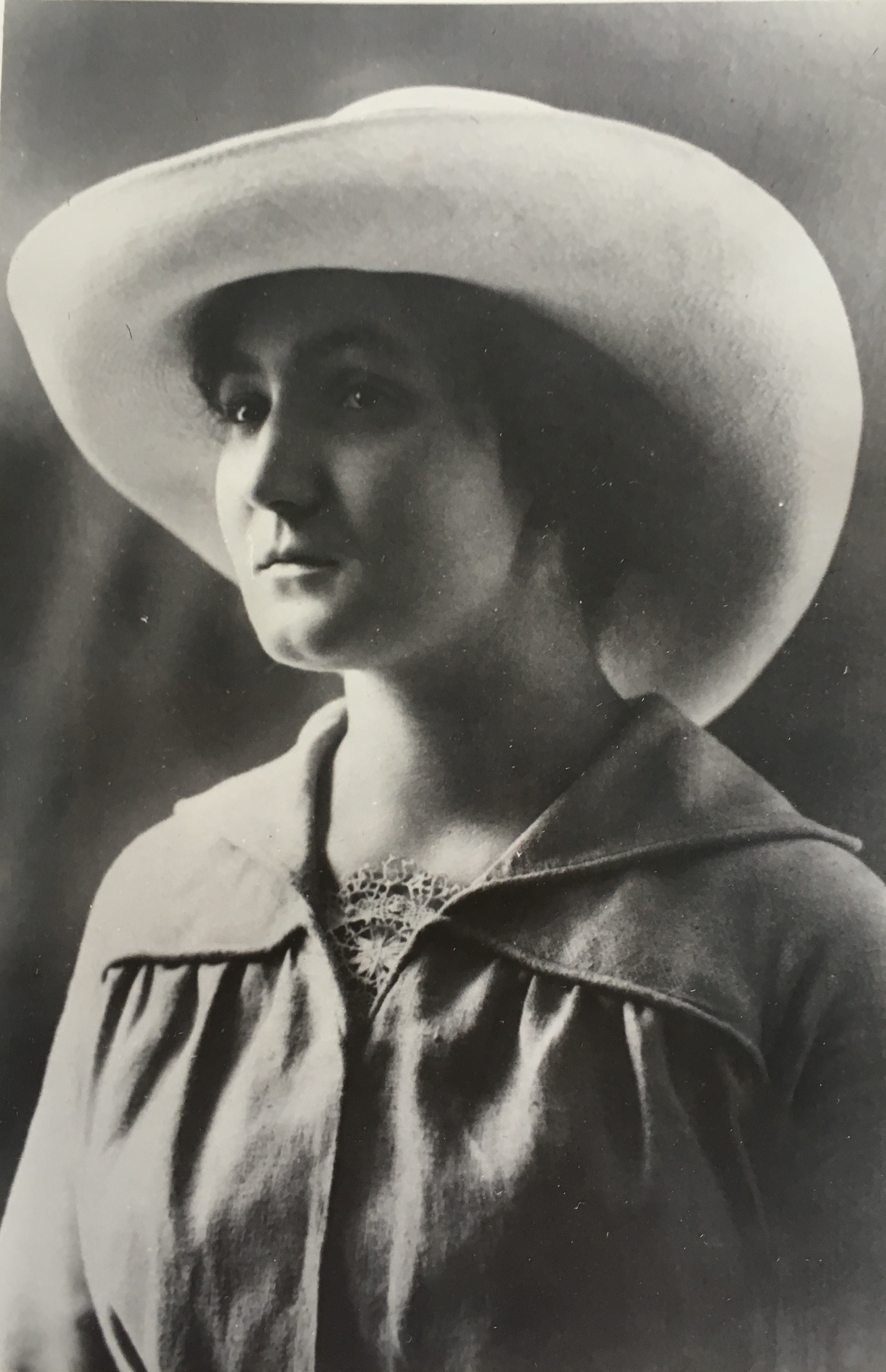
He arrived at Ellis Island November 17, 1910, looking for a new life and greater opportunity. Like most immigrants he was not looking for a handout but rather to become a creative part of his new country. He was ready to work. Robert was a tailor, made a living his whole life sewing. He is an American success story of how immigrants enrich America. In 1912, Robert married another Czech, Bozina Ourednik. They had two daughters, born in 1914 and 1917.

Bozina Ourednik

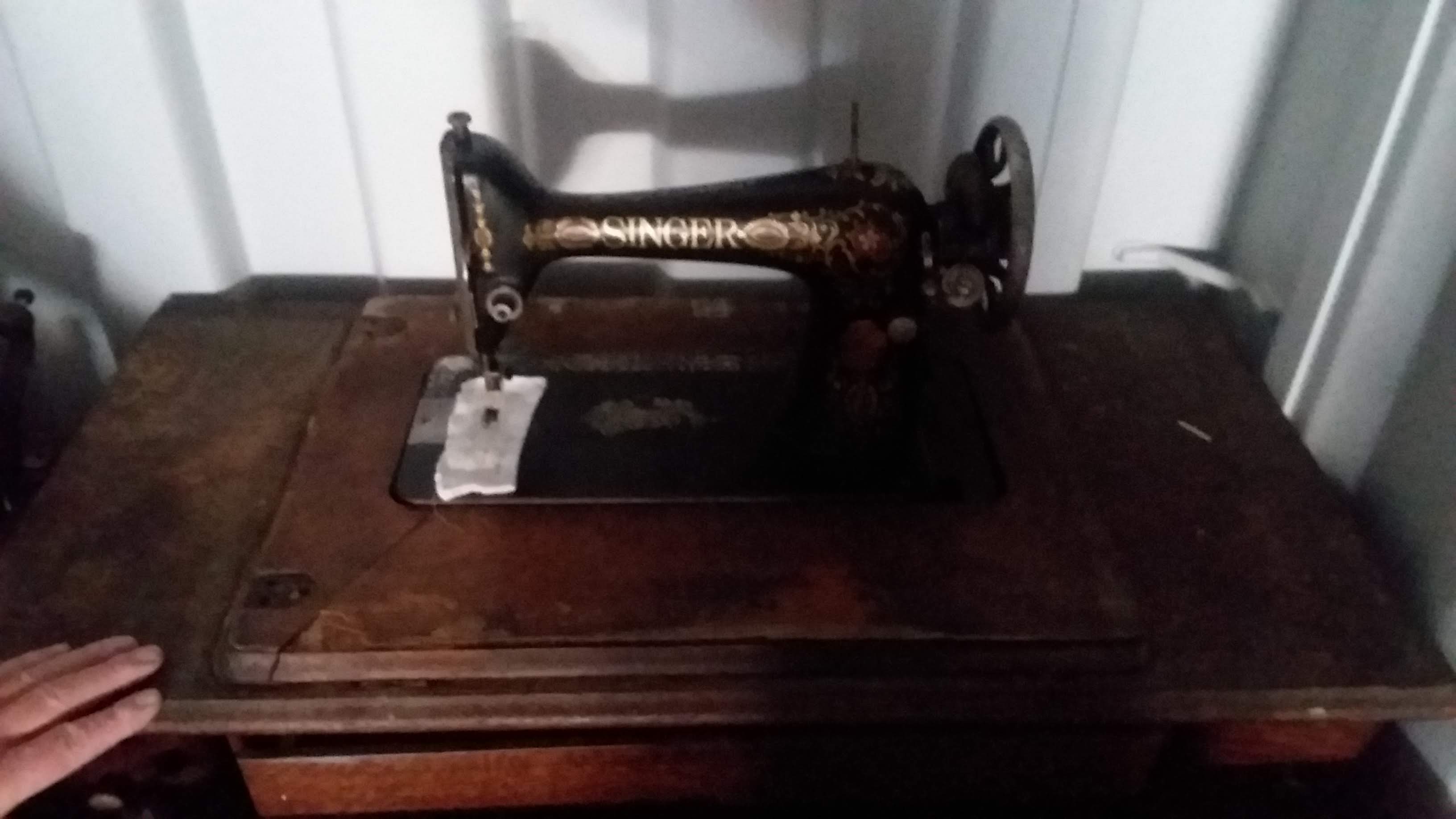
Robert was an entrepreneur who supported his family through hard work and great skill. He bought himself a new 1912 Singer manual sewing machine and went to work. In New Rochelle, New York, he worked out of the front parlor of his home where he had a large triple mirror so his clients could see themselves in the custom-made dresses and suits he made. He basically had only a half-dozen wealthy customers, for whom he made evening gowns, suits, and coats.

Robert passed away in 1960. His sewing machine stood idle, finally ending up in his granddaughter’s garage, a family heirloom but what to do with it? The 1912 Singer was waiting for a new life somewhere, ready to go back to work. All these years later his granddaughter, Betsy Richards, still had the sewing machine packed away in her garage. After learning of the mission of Sewing Peace, Betsy decided the best thing to do with it was to donate it so someone else could make a living with that high-quality machine made in the U.S.

Robert Musil’s 1912 Singer Treadle Machine

In comes Anne Fitzgerald, sewing machine collector extraordinaire. Betsey found Anne because the P4P/SP collection was announced in the local newspaper. On October 5th, 2019, Anne brought the sewing machine to the P4P/SP collection at the Asbury United Methodist Church in Croton-on-Hudson, New York. The collection was sponsored by the Croton Lay Interfaith Council.

Robert Musil

Gary, our V.P. and collection coordinator, went to that collection and brought that sewing machine back to the warehouse. Then Dennis our tinkerer did some minor maintenance on the machine. It is now working beautifully!

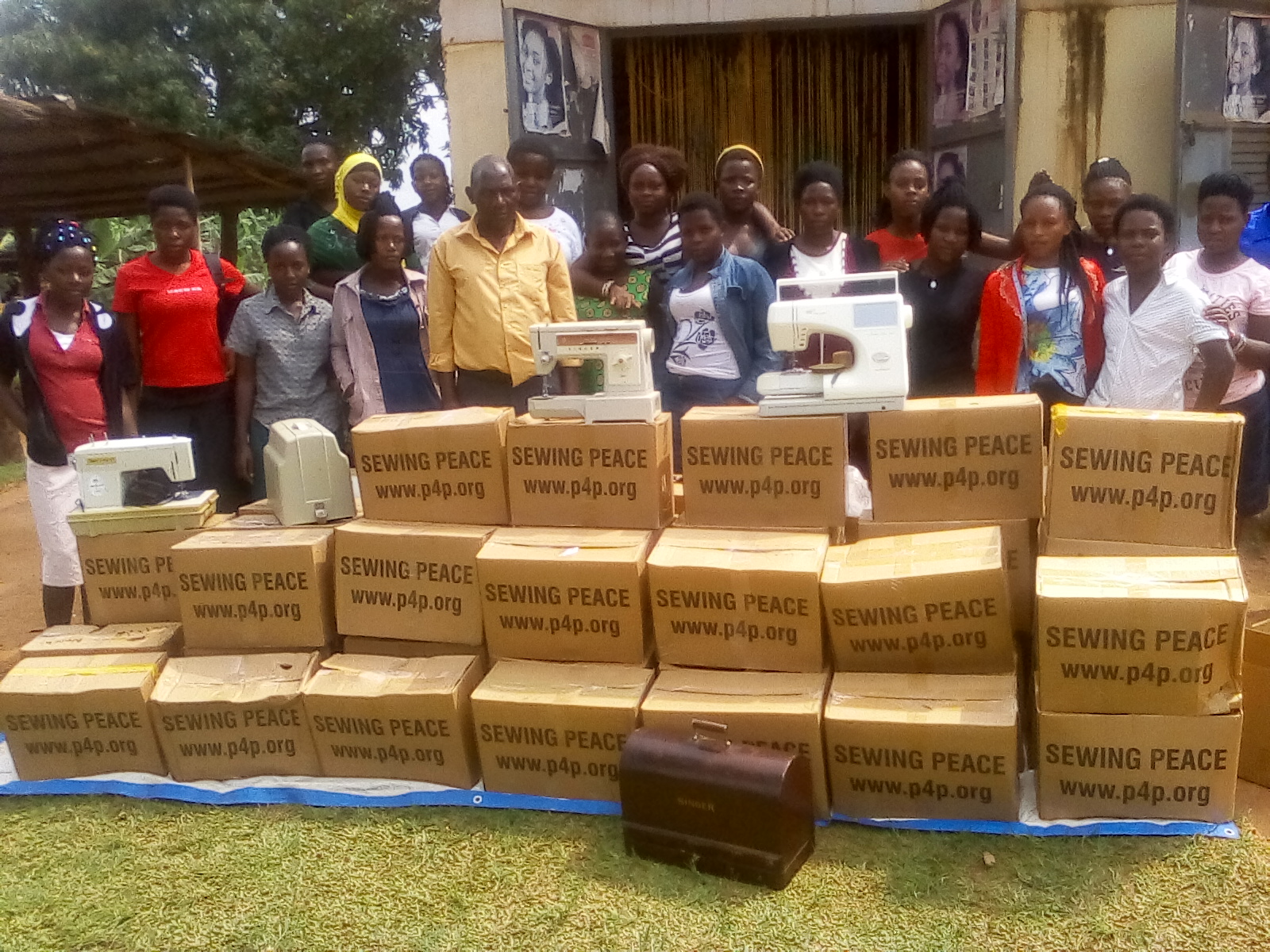
Robert Musil’s sewing machine shipped to DRVR, our partner in Togo, West Africa, on October 26, 2019. Previously, DRVR had received only one shipment of sewing machines. But with the generous support of the Clif Bar Family Foundation, DRVR is now a bicycle program as well as a sewing program. We hope to be able to trail along to the final destination of Robert’s machine and bring you the conclusion of the story in our 2020 spring newsletter. [Here is that story.]

Collecting Sewing Machines for Sewing Peace, 2019

Spring 2019 Newsletter

[Editor’s note: this is a report from one of our very best sewing machine collectors, who wishes to remain anonymous. The dozens of machines we get every year from this volunteer arrive clean and in perfect working condition.]

I am the recycling coordinator for a solid waste management district.  I work with five transfer stations, three of which collect used sewing machines for me.

The collection of sewing machines here is a group effort. The employees at the transfer stations keep an eye out for sewing machines and set them aside for me to pick up. Plus, of course, we have generous donors who not only provide the machines but also throw in thread, extra needles, bobbins, pins, etc. The older machines are my favorites; I’ve been working on one that is 81 years old and came with its original manual. It’s a trooper.

The process of collecting and shipping the machines has evolved over the years. In addition to cleaning, oiling, and testing the machines, I now make drawstring bags to hold sewing notions, sew dust covers, cut out and embroider felt pin-holders, and put together sewing kits for each machine. And there’s my long-suffering husband, who has accepted the annexation of an entire room in our house for the Sewing Peace project.

My hobby has become a labor of love for people I will never meet but feel very connected to through a shared appreciation for sewing machines. I am very grateful to have the opportunity to contribute to Sewing Peace’s wonderful mission.


Postscript to the 2018 GMRPCVs FedEx Shipment

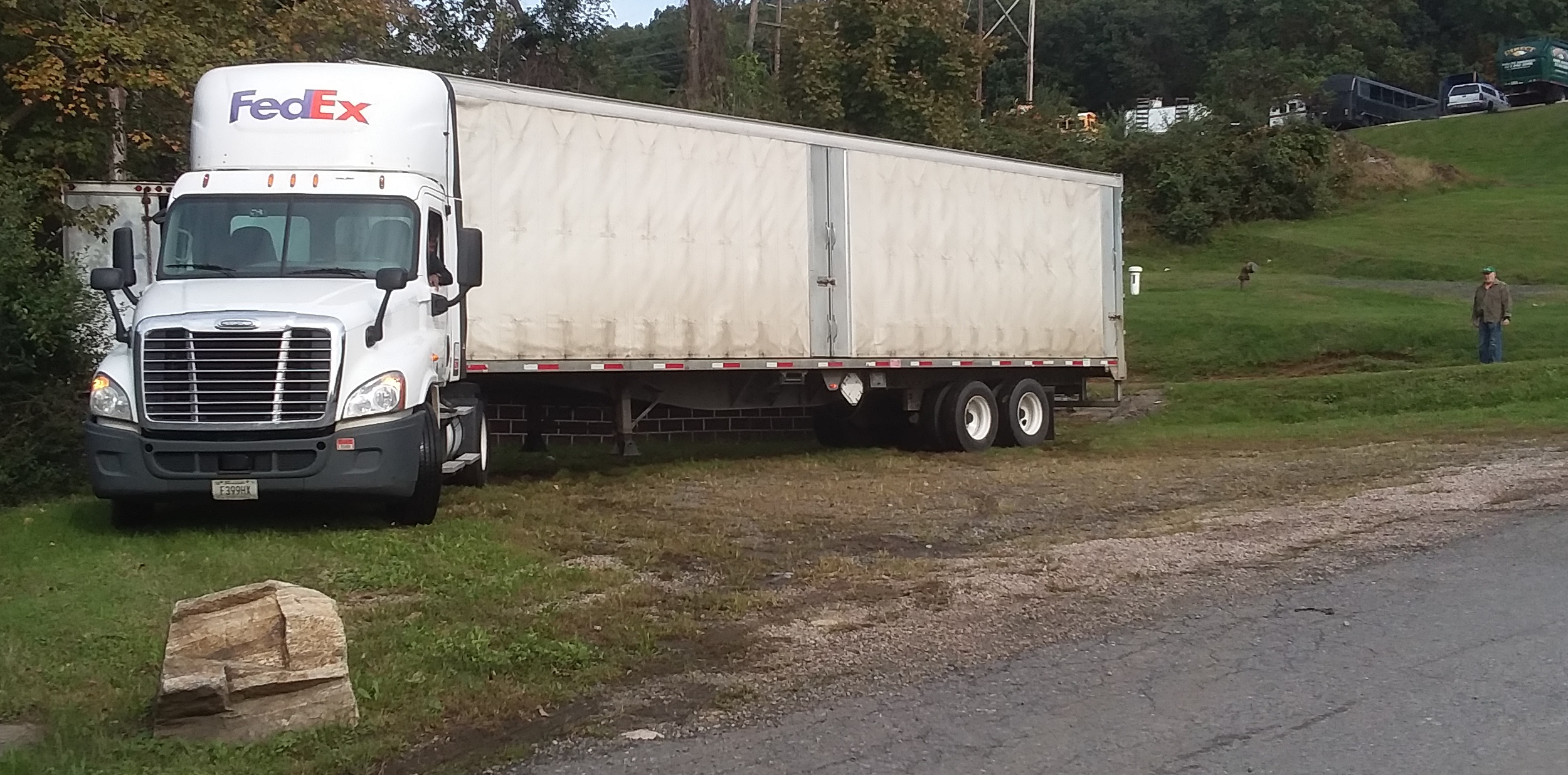
On October 16, 2018, the FedEx truck from the Green Mountain Returned Peace Corps Volunteers got to the P4P trailers in Glen Gardner, New Jersey.


We had our regular driver and he is highly skilled. We were perfectly happy with his first try to park the truck next to our loading dock, but he was not. He wanted to be closer to the dock to make the unloading easier.

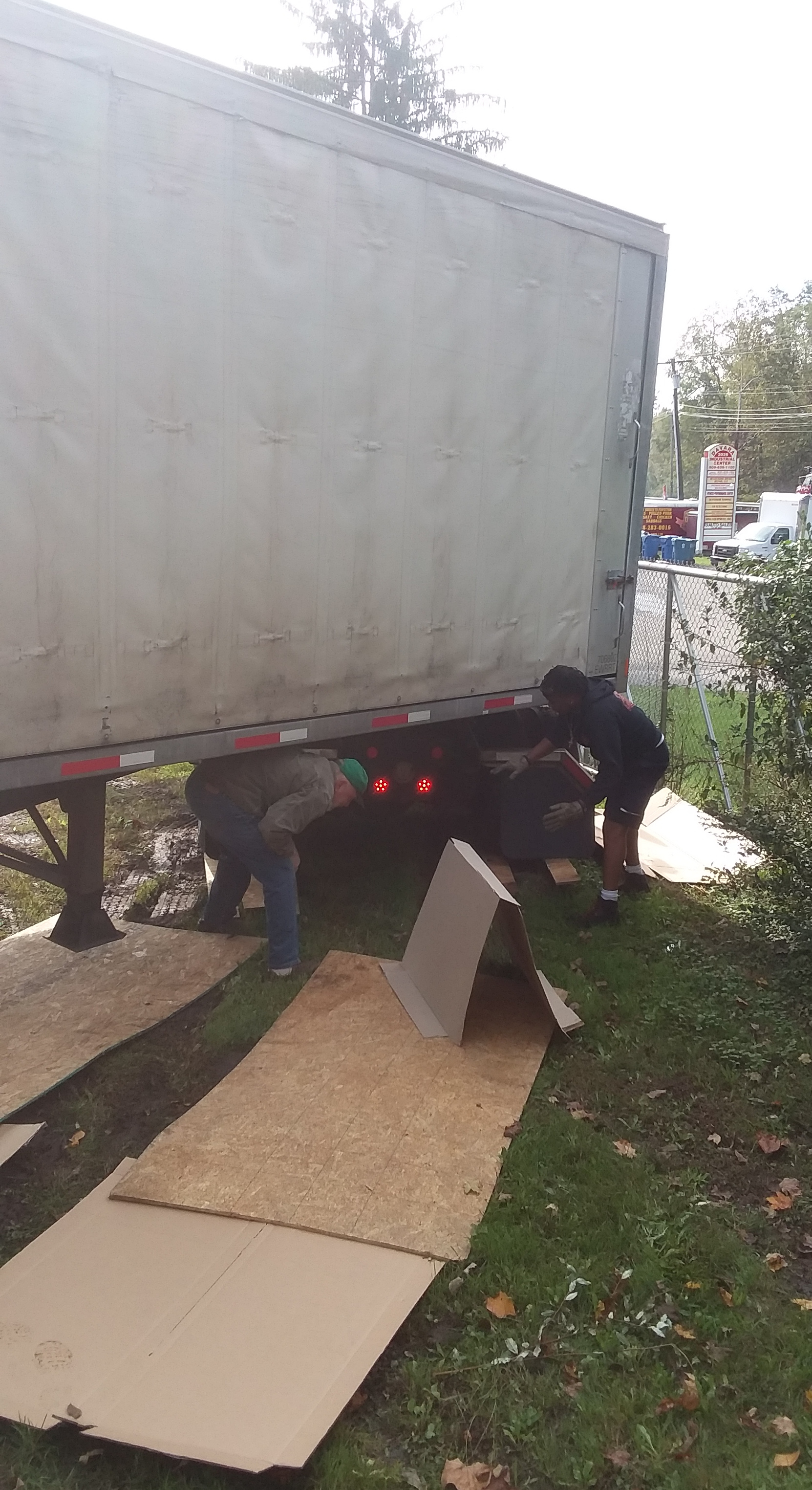
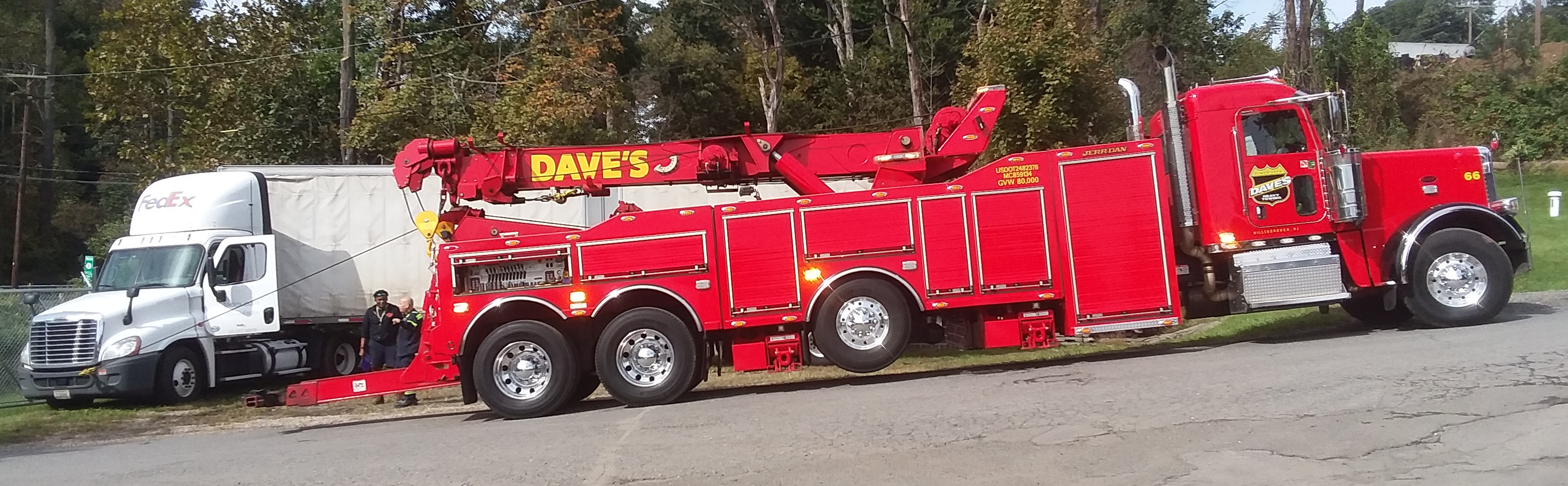
When he tried to get closer, though, he got stuck in a hidden low muddy spot in front of the trailers—wheels spinning, mud flying, truck not moving. I was sure that getting the stuck tractor-trailer out would be a huge problem.


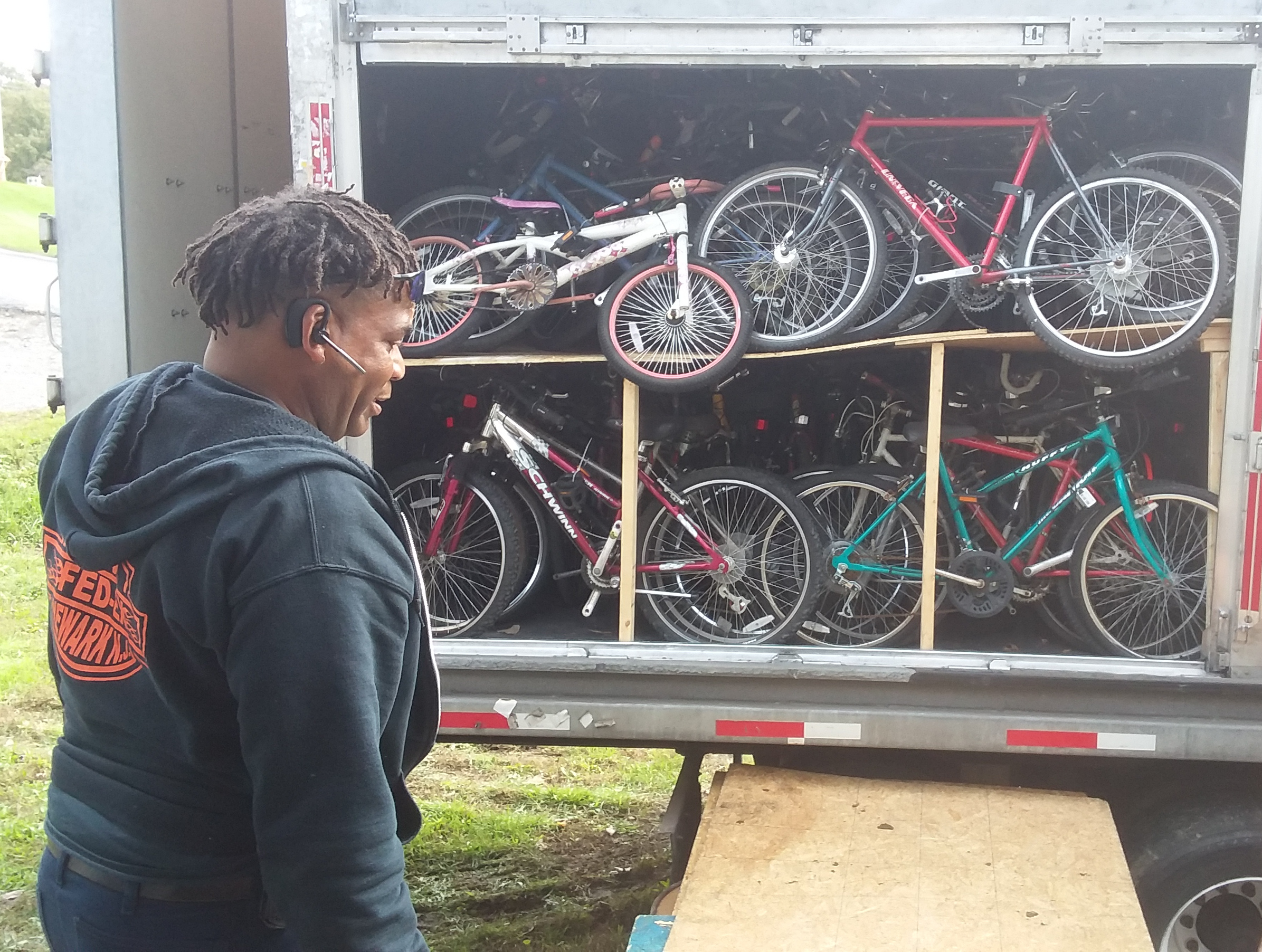
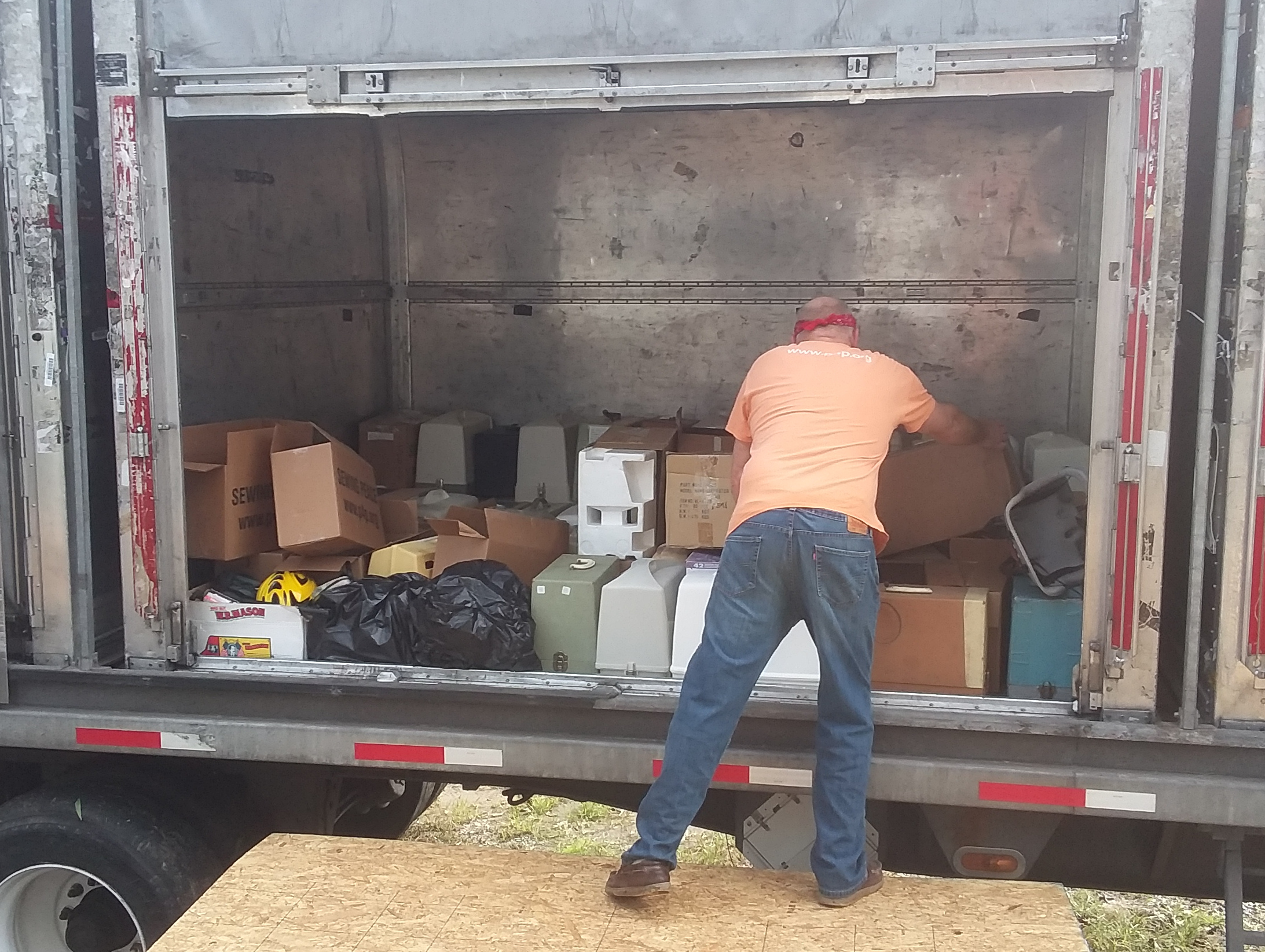
Unloading FedEx truckIn the meantime, we unloaded the 4 FedEx canisters: 193 bikes and 75 sewing machines.

The driver called a local towing company and the biggest tow truck I have ever seen showed up. The two drivers chatted amiably for a few minutes. Then the tow-truck driver hooked up a cable to the FedEx truck, flipped a lever on the tow track, and winched the FedEx truck to the asphalt in about 15 seconds. The tow truck never moved. What problem?


Report from Vermont, Fall 2018

By Joanne Heidkamp
Fall 2018 InGear/InStitch

[The partnership between the Green Mountain Returned Peace Corps Volunteers and P4P goes waaaaay back. They started their P4P collections in 1999. Twelve years later, they wrote this Recipe for Collecting Bikes. In 2014, they collected their 3000th bike. Now, in fall 2018, they sent us another truckload of bikes and sewing machines. Here’s the report.]


Our 2018 collection on Saturday September 29th was successful. We loaded 193 bikes and 75 sewing machines into 4 FedEx containers.

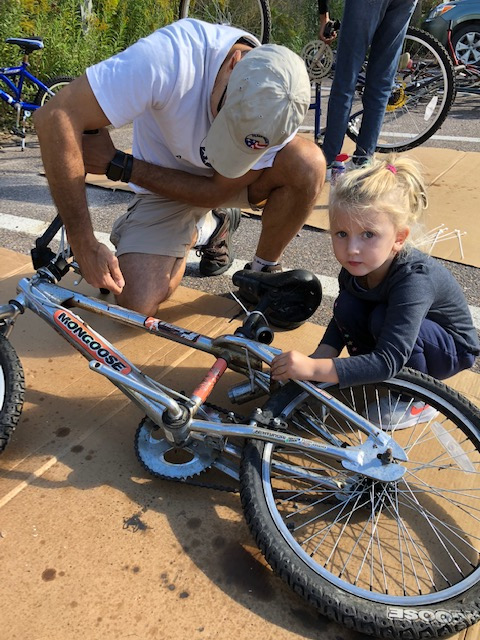
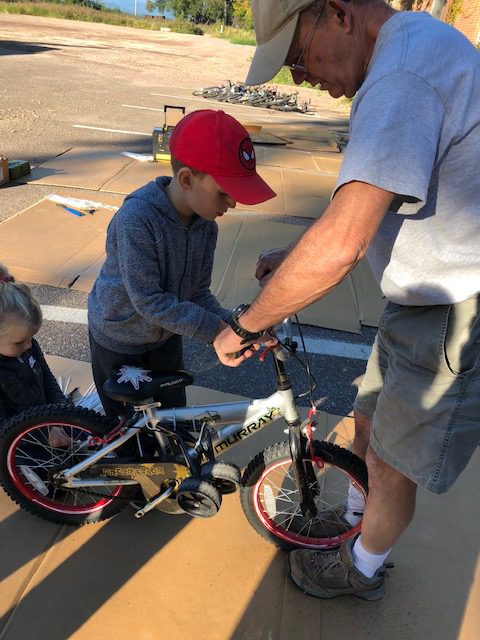
The two miniature bike mechanics Noah (age 5) and Melek (age 3) arrived at 8:30 a.m. to donate Noah’s outgrown bike. They stayed on, with their parents, until we closed up the truck at 1:30. They never stopped working. They strapped pedals to the frames, they greeted people bringing bikes and sewing machines, and they looked everyone straight in the eye and said, “Will you be donating $10 for shipping by check or with cash?” Quite a few people ended up donating extra.

Unfortunately, the quality of bikes is down this year. About 100 of the bikes came from some rural churches that held mini-collections—even after we eliminated the bikes with obvious rust, there are still quite a few marginal bikes in the load.

We are also feeling the impact of Old Spokes Home, a local bike shop plus non-profit that has expanded considerably in the past couple of years. They hold several big collections a year. At this point they are probably skimming 500–800 high-quality bikes a year from the local donation pool. It’s hard for us to compete with their impressive local accomplishments in providing transportation and skills to local teens, refugees, people who can’t drive or don’t have cars, guys on parole, etc. It’s an excellent project. They have donated bikes to P4P when they have a surplus. They get bikes from college campuses in the spring, and from local police departments—both are sources we can not tap into because we don’t have storage, and we don’t want to have to fundraise the $10 per bike.

We also loaded 4 cases of brand new bicycle seats donated by Terry Bicycles, a women-focused bike clothing and accessories company located in Burlington. Our contact at Terry is Colin Sturgess, the operations manager. Colin was the manager at FedEx who first provided us free shipping to New Jersey, back around 2000. He saw our truck in the KMart parking lot last year and left a note sending good wishes. We followed up, and this year he invited us to do outreach at Terry’s annual tent sale in August, and made the offer of donated bike seats as well.

The quality of the sewing machines is up. Half of the machines were collected by Mary O’Brien in Springfield, who checks each one carefully before turning them over to us. The other half came in on Saturday—a lot of nice 1980s portables in their own cases, as well as several Bernina overlock sergers, which are fantastic for sewing knits. We also loaded a 1930s Singer with a knee controller.

Mary O’Brien works in solid waste management for the Southern Windsor County Regional Planning Commission, southeast of Burlington. She has been collecting sewing machines for us since 2014. This year she collected 36 machines that she had individually tested. The solid waste district covers the $10 per item. We are in awe of her!


New Collection Partner: Habitat for Humanity, Warren County, New Jersey

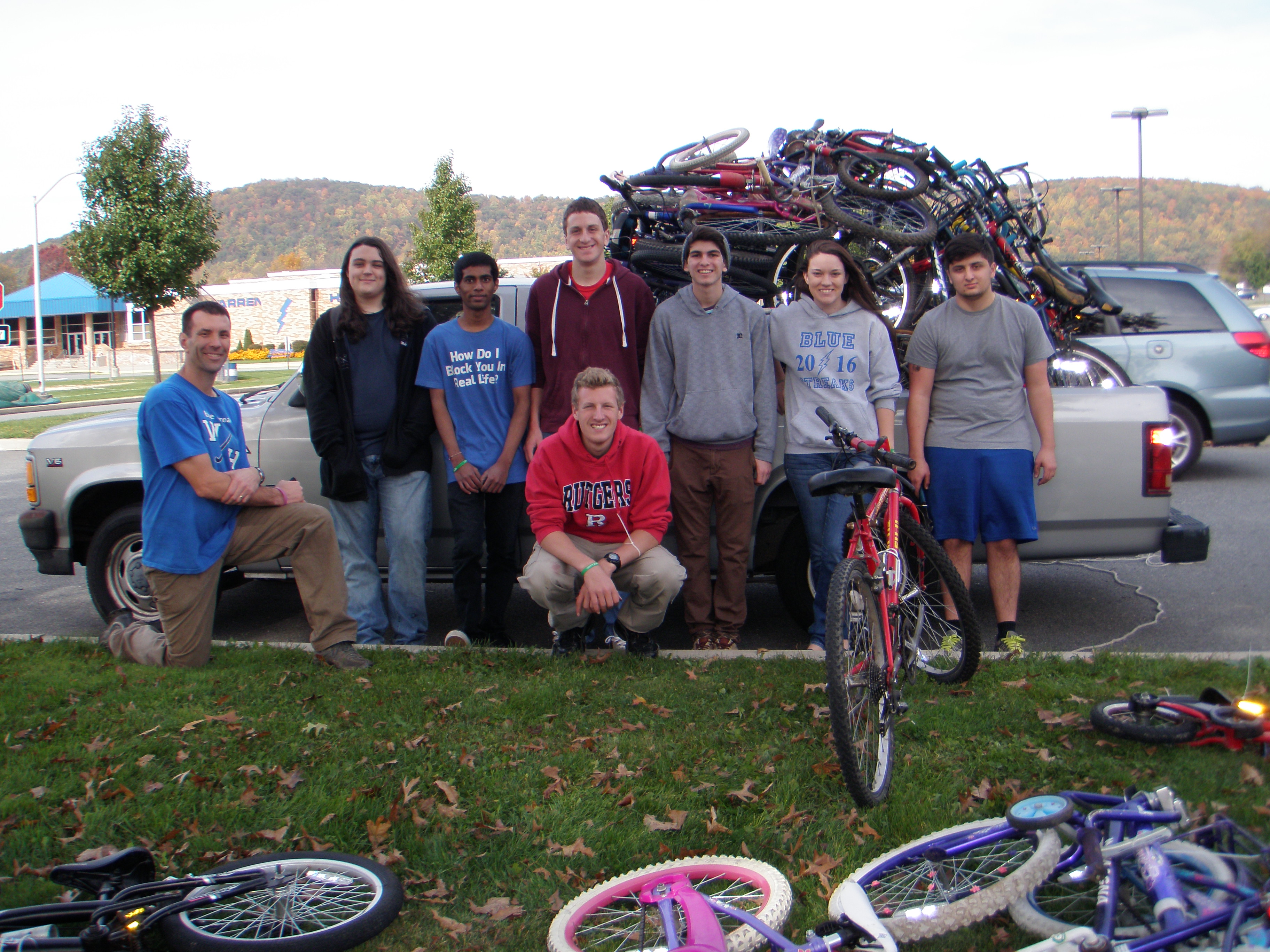
Pedals for Progress is proud to announce a unique new collection partner: Habitat for Humanity of Warren County New Jersey. The partnership is due to Daryl Detrick of the computer science faculty at Warren Hills Regional High School (WH) in Warren, New Jersey. Daryl is also director of the WH Chess Club. He and his students have been volunteering at both Habitat for Humanity and Pedals for Progress for the last few years.


For the past several years, the Chess Club has gotten a number of bicycles from Habitat for Humanity for their annual Pedals for Progress bicycle collection. Habitat for Humanity has been collecting more bicycles than they can sell. P4P’s challenge is to get a minimum $10 donation with each bicycle and sewing machine; this donation is a fundamental part of our business model. To pick up a bicycle or sewing machine, prepare it for shipping, truck it to the warehouse, and pack it away in the warehouse so that is ready to be shipped, we spend an average of $20. Every time someone donates a bicycle or sewing machine with $10 we still need to independently raise another $10. We refuse a lot of bikes that don’t come with money — it is better to collect perhaps fewer and stay in business than collect a whole bunch and be bankrupt.

In 2018 Daryl got into a conversation with the Habitat county director Ben Eskow. Daryl mentioned that he might have to take fewer bikes because he was having trouble raising the $10 per bike that Pedals for Progress needs just stay in business.

Ben met with his staff and board at Habitat for Humanity. They were keenly aware that they were receiving many many more bicycles and sewing machines than their resale store could possibly use. Habitat for Humanity also has some discretionary funding that they can use for international programs. The board of Habitat for Humanity of Washington County decided that they would contribute the $10 per bike and sewing machine to Pedals for Progress and Sewing Peace. Therefore P4P/SP will now be able to pick up their extra bikes and sewing machines on a regular basis.

This is a wonderful collaboration between two institutions searching for a way to help the poor have a better life. Pedals for Progress has a new source of bicycles, which we hope may produce up to 250 bikes this first year. From the perspective of Habitat for Humanity, they have a volume problem and they have found a way to solve it within their mandate by partnering with Pedals for Progress and Sewing Peace. Win-win for the betterment of all.

Rotary Club of Norristown, PA, December 2017

by Mark Call

[The Norristown, Pennsylvania, Rotary Club is one of our most successful long-time collectors. We just got this end-of-season report. They are already collecting for next year.]


Janet Steiner is a friend of the club who makes numerous donations to our collection each year. She runs ads in her church bulletin asking for bike donations, and she stores donated bikes in her garage.

Ginny Politz is the owner/operator of Bikesport in Trappe, PA. Bikesport makes several deliveries to us each year of trade-in bikes that people no longer want.


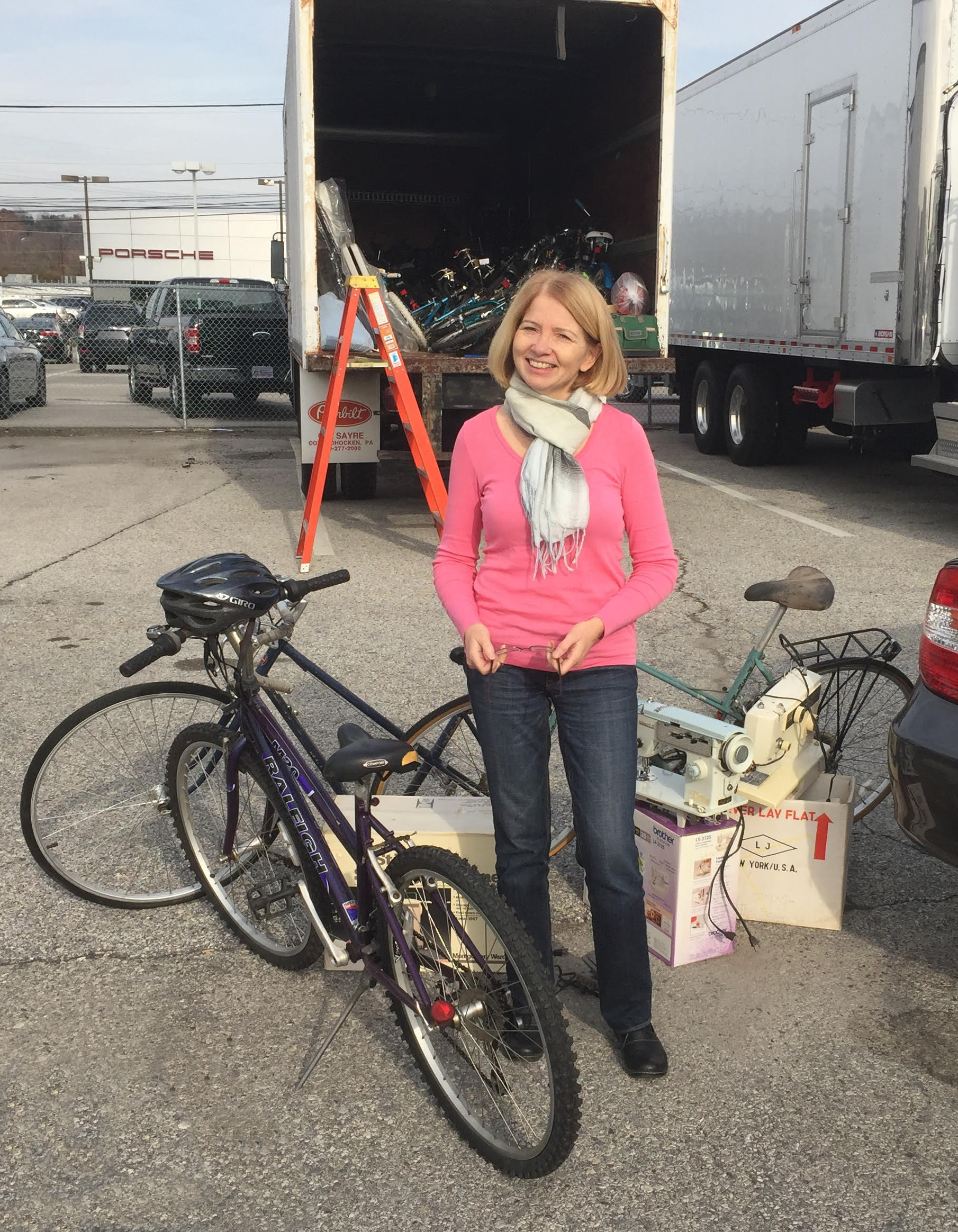
We have the use of a trailer generously donated by G. L. Sayre trucking in Conshocken, PA. We process the bikes and store them in the trailer until the next P4P collection. We already have 45 bikes and 10 sewing machines.

Our last two collections have netted 97 and 95 bikes. Our next collection is May 19, 2018, at the Norristown Area High School lot during West Norriton Community Day.

End of the 2017 Collection Season


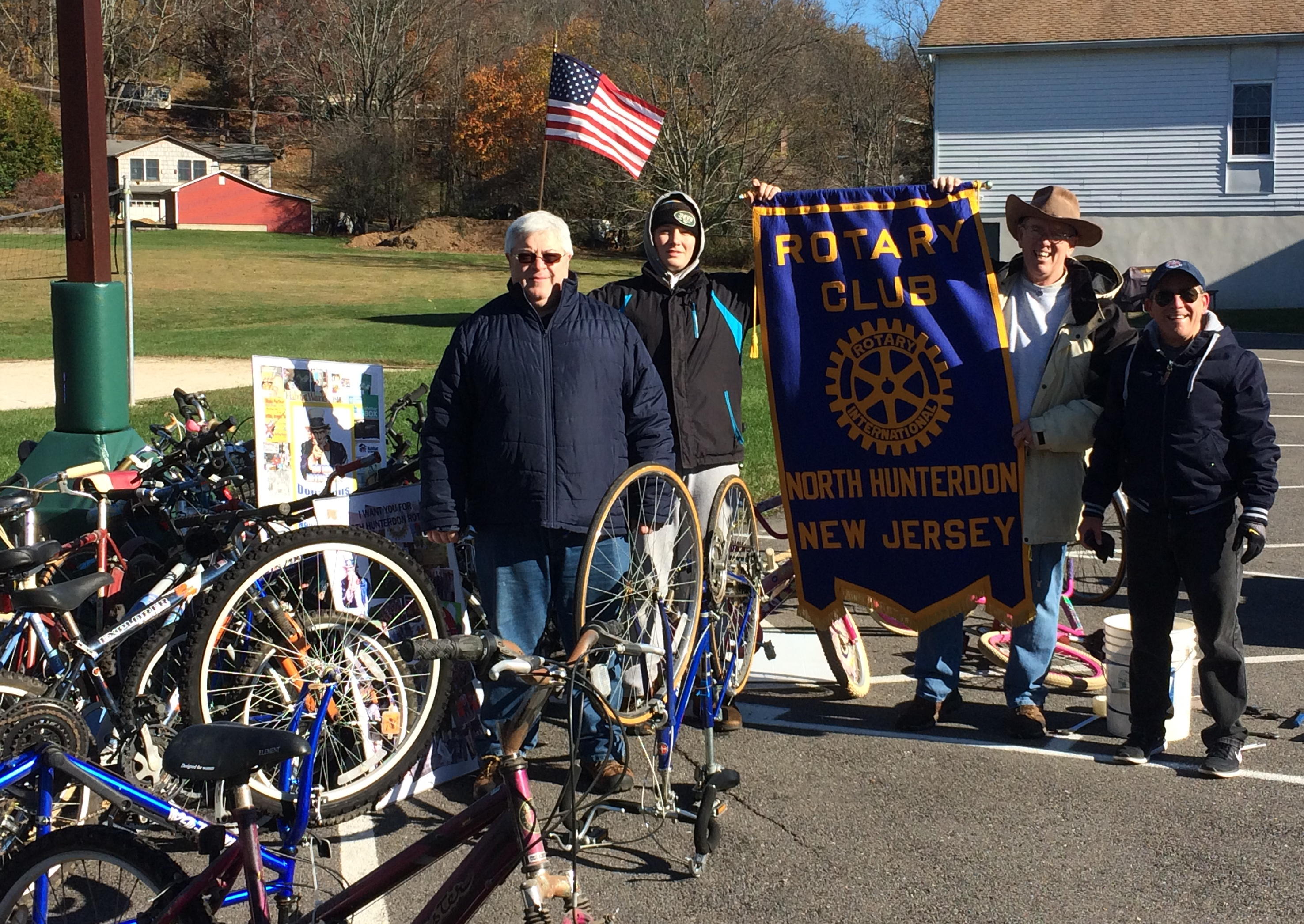
Our 27th calendar year collecting bicycles came to a close today on Veterans Day, November 11th, 2017. On a below-freezing morning, the Bunnvale Assembly of God together with the North Hunterdon Rotary Club collected 106 bicycles and 8 sewing machines — a great result in any weather. We would like to thank all of the participants, and especially Jim Murray, who was instrumental in making this collection happen.

There is a strange dynamic for end-of-season collections in the fall: Once we get to November, people are really thinking about getting their car into the garage, and sometimes unused bikes are in the way, so we have a better chance of collecting a lot of bikes. On the other hand we also have a greater chance of bad weather. Cold weather was obviously not a problem for today’s collection.

I would like to personally thank all of the collectors who have helped make 2017 a record-breaking year, with 12% growth in the collection of bikes and an amazing 55% growth for sewing machines. And to all of you springtime collectors, the time is now to book your spring 2018 collection to get the date you want. Get in touch with Lori at 908-638-4811 or lori@p4p.org.

We have been preoccupied with an incredible fall collection season. However, our new end-of-the-year newsletter is almost ready and we will be getting it to you very soon!
Big Weekend in June 2017

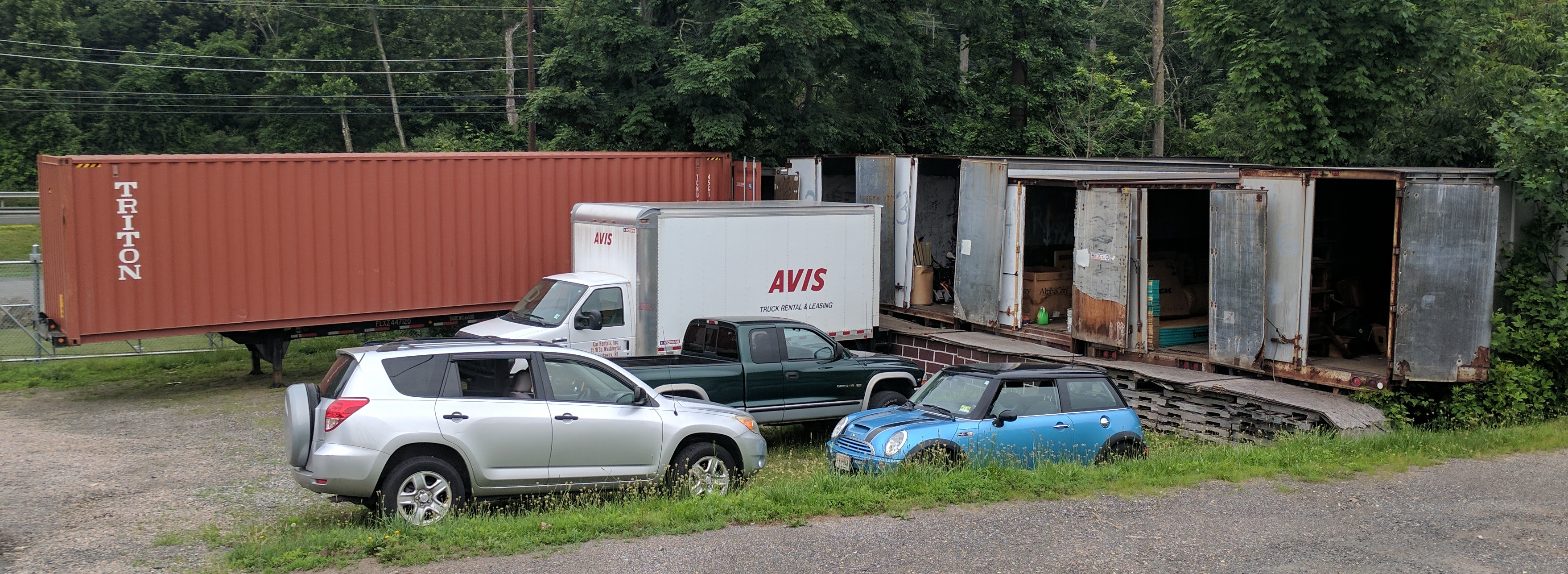
You knew the weekend of June 24, 2017, was going to be action packed when you saw the P4P trailers and parking lot. The Triton 40-foot container had been delivered for our 11th shipment to Albania. The Avis rental truck was ready for the final collection of the spring season. And Dave’s Mini and a couple of volunteer vehicles were parked out front.


Sewing Machines to Tanzania

We had collected enough sewing machines for a shipment of two pallets to Tanzania. Our tinkerers Simon Rosenstein and Dennis Smyth had worked tirelessly over the last few months getting the machines into good working order. Several dozen machines were boxed and ready to pack. We had just made the final arrangements with our partner in Tanzania, the She Can Foundation. The Summer 2017 InStitch newsletter has this post about a recent trip around Tanzania by She Can founder Sophia Mwakagenda, a Member of the Parliament of Tanzania.

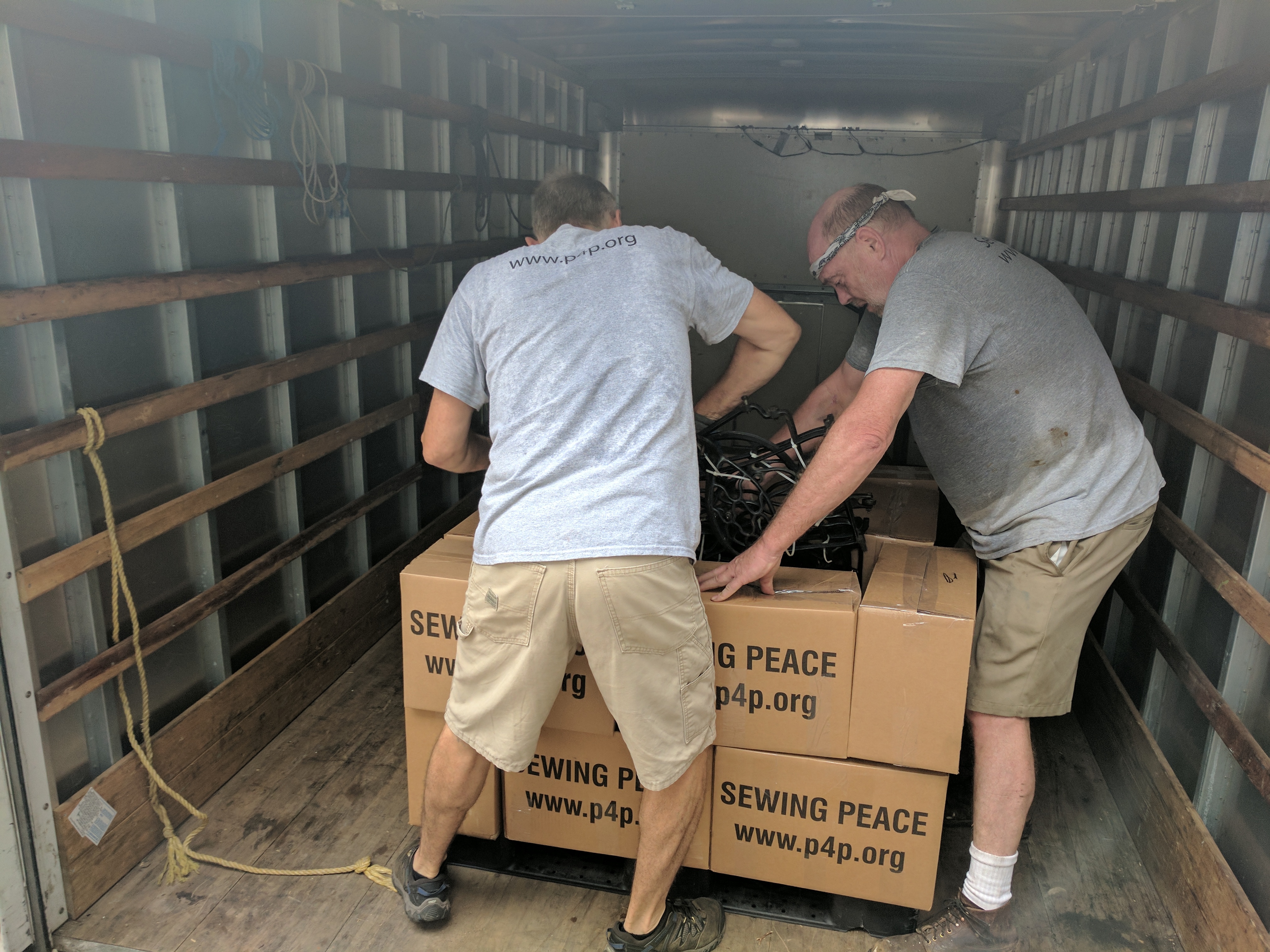
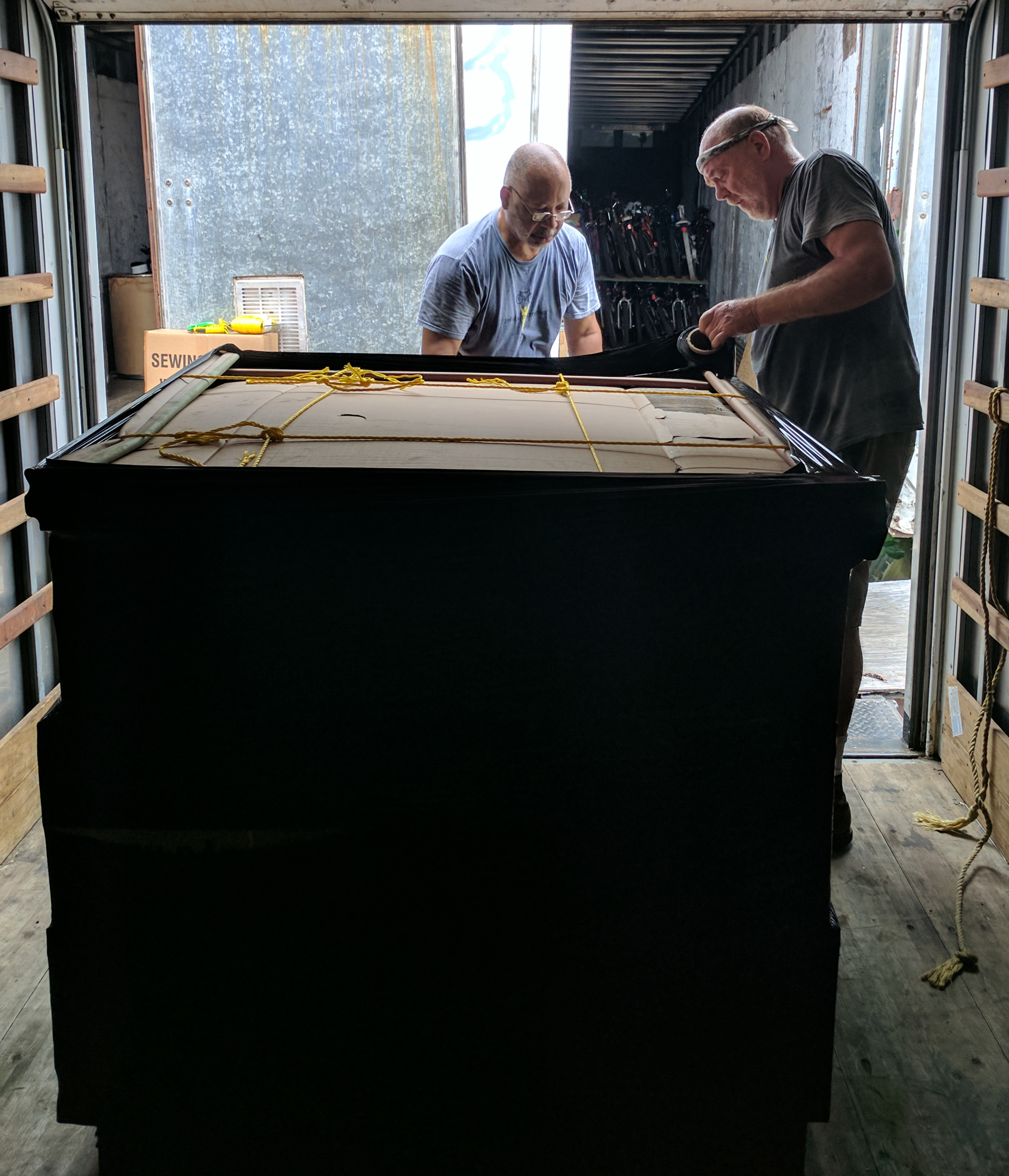
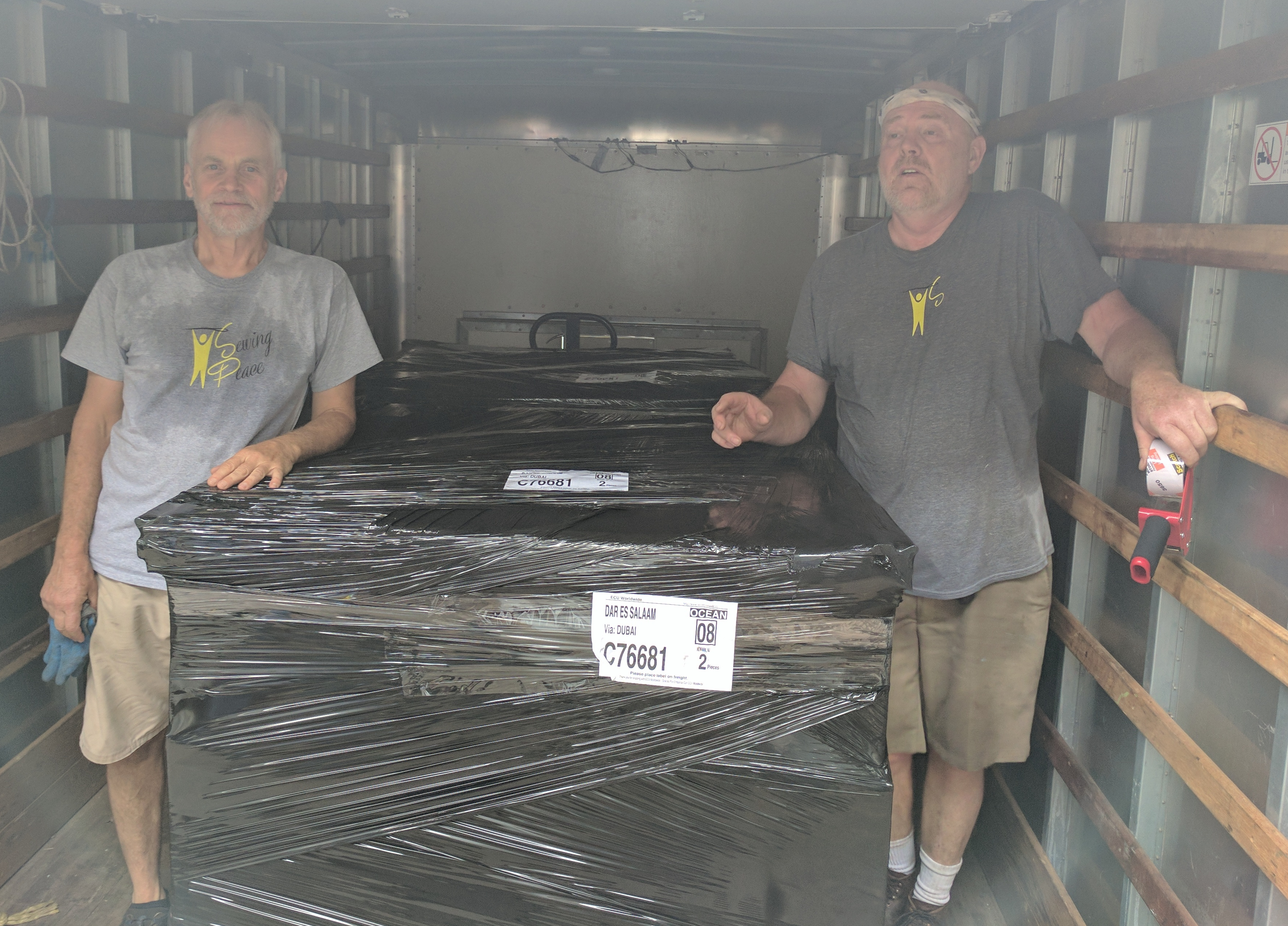
On Friday, we prepared the two pallets. We stacked the boxed machines on a pallet, leaving room for a couple of sets of the heavy treadle stands. We nestled the treadle stands inside the walls of boxed sewing machines, put a cardboard roof over the treadles, and added another layer of boxed machines. We added some cardboard padding, roped it up, then shrink-wrapped the whole thing into a neat 4-foot cube. We shipped a total of 68 machines in the two pallets.

Bon voyage, sewing machines. See you in Tanzania!

Eleventh Container to Albania

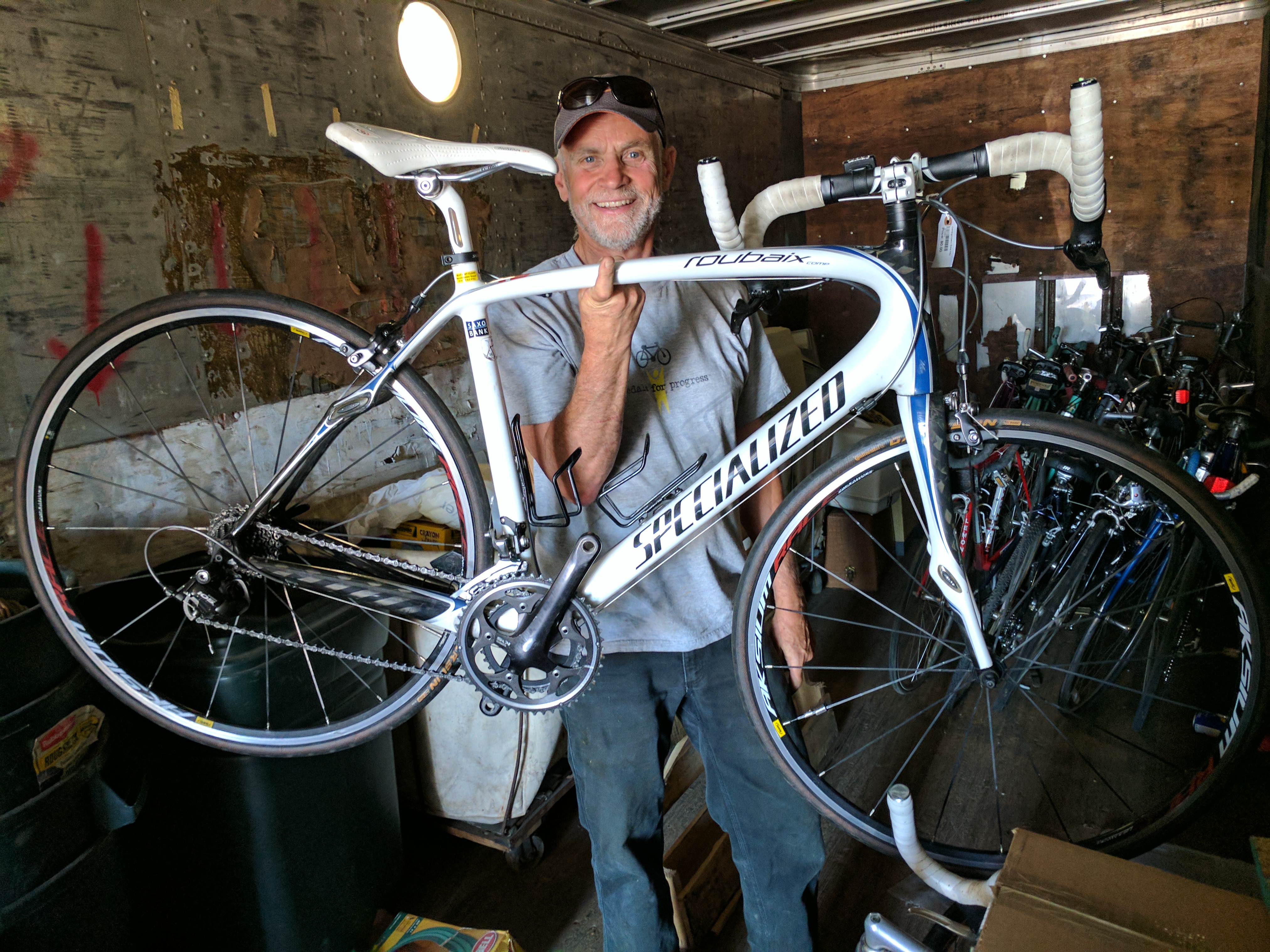
Also on Friday, we pre-loaded 53 adult bikes, 25 kids’ bikes, and some sewing machines into the container bound for Albania. The pre-load lets us take care of any special packing before the big push on Saturday. This time we used the pre-load to pack very carefully a handful of spectacular bikes, including that famous carbon-fiber Specialized Roubaix. In the photos you can see that it has its own personal cardboard stall. These bikes will go to people who love cycling and are willing to pay a high price for a special bike. Our partner in Albania, PASS/Ecovolis, will be extremely happy to get some high-end bikes they can sell to help support their programs.
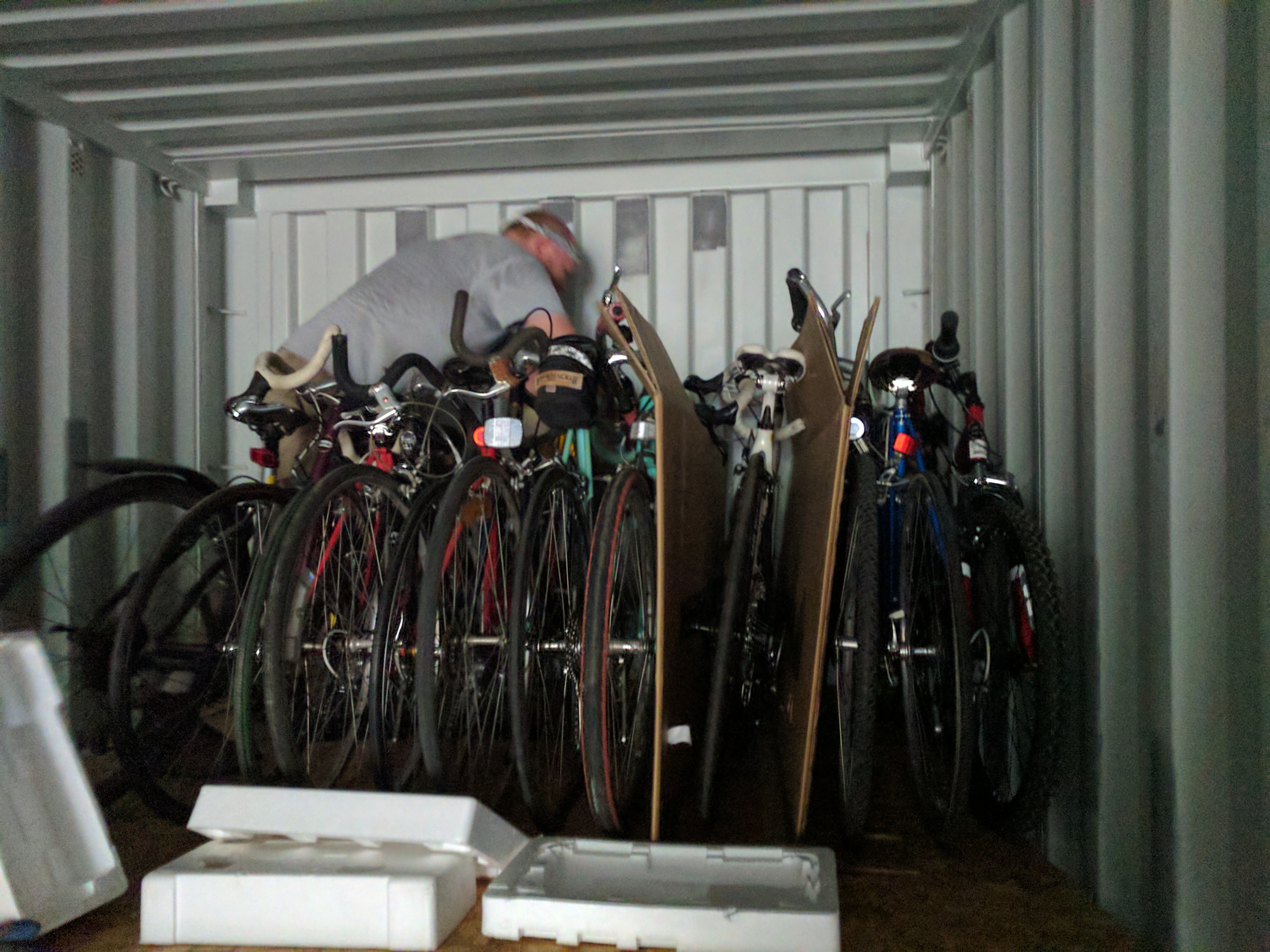
On Saturday, the real loading crew took over and did the hard work. They started at 7am to try to avoid the heat of the day, when the interior of the container attains advanced sauna status. Some sections of the container get three rows of bikes stacked on top of each other: two rows of adult bikes and one row of kids’ bikes. To pack the top row, you climb into a sweltering 3-foot niche with the broiling roof of the container blistering your flesh. Then you contort yourself into the most awkward position you can think of and take ridiculously heavy kids’ bikes from the person passing them up. Then you push them into position, using hands, feet, and any other body part that proves useful. The idea is always to get as many bikes as possible into the container—the shipping cost is fixed, so every bike adds to the bottom line.

When the container is almost full, we close one of the two container doors and jam in the last few dozen bikes, jig-saw like. Our partners are well aware of our packing methods, so they open the container doors gingerly, hoping not to be crushed by an avalance of bicycles.

The final count for the Albania container: 426 adult bikes, 100 kids’ bikes, 25 pairs of pedals, 9 saddles, 12 baskets, 25 helmets, 9 sets of training wheels, 2 bike racks, 4 wheels, 8 tires, and a few other miscellaneous bike parts and accessories, plus 15 sewing machines. That’s a full container!

Our Albania partner, PASS/Ecovolis, is one of our most active partners. They have a bike shop and a bike sharing program in Tirana, the capital of Albania. They also have projects in reforestation, childhood literacy and nutrition, and low-income housing.

As for sewing machines, Ened Mato, head of Ecovolis, tells us that they now have extra importance. Partly thanks to Ecovolis efforts in political persuasion, Tirana merchants now must charge a small fee for plastic shopping bags. Yet another PASS group, Trasta o Nona, manufactures fabric shopping bags, using Sewing Peace machines. The PASS shopping bags should sell much better with the new fee on plastic bags.

Flemington Collection

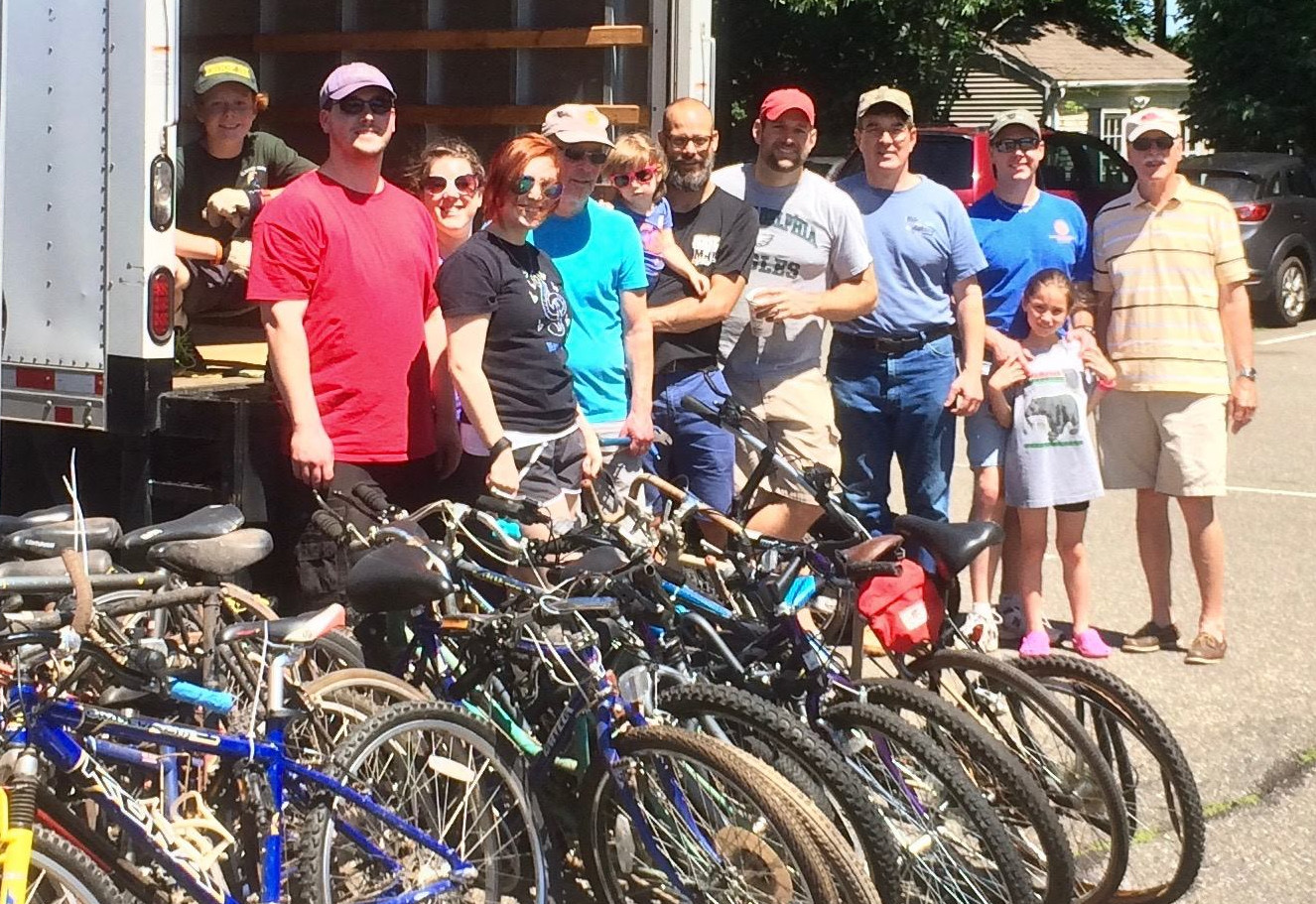
While the crew was loading the Albania container, Gary was running the final collection of the spring 2017 season. The Presbyterian Church of Flemington and the Flemington Rotary Club collected 42 bikes and 19 sewing machines.

Summer Break

So that was our big weekend: we shipped 68 sewing machines to Tanzania on Friday, finished loading 526 bikes and 15 sewing machines for Albania on Saturday, and also on Saturday collected 42 bikes and 19 sewing machines in Flemington. Well done all around.

The shipments to Tanzania and Albania emptied the trailers of most bikes and sewing machines, but there are a few left as a start on our next shipments, which we will make later in the year.

Our collections resume in September. Get in touch if you’d like to host one. Have a great summer.