by Patricia Hamill
Summer 2012 InGear Señora Antonietta Mesa
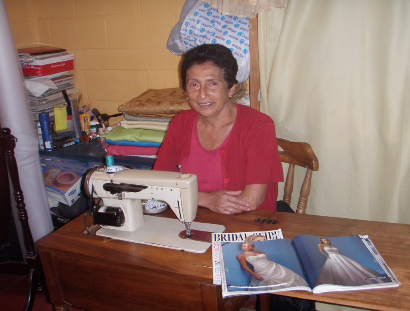
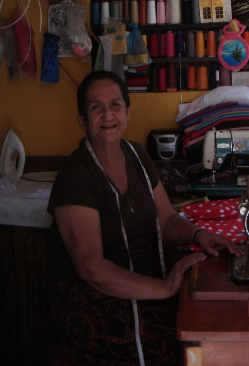
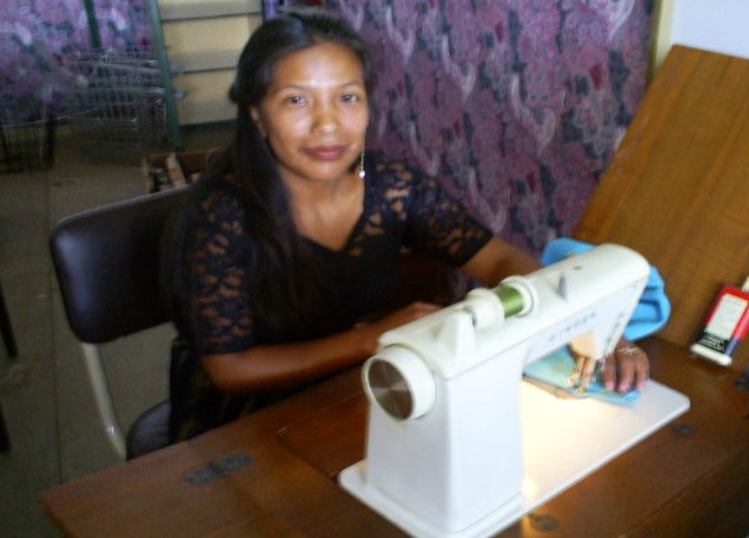
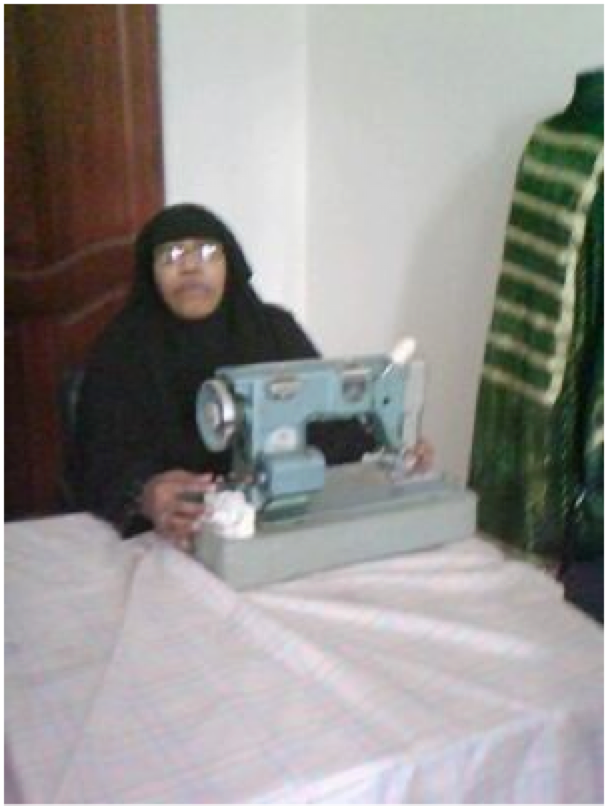
Señora Antonieta Mesa and her sister Señora Irma Mesa were quite welcoming when David and Gary arrived to visit their sewing studios. These ladies clearly each know what market they want to focus on and how to keep their businesses thriving. Señora Irma makes her living by sewing school uniforms and selling to or doing custom work for the middle-class families of the town and she does her best to donate what she can to the poor families who cannot yet earn enough to purchase her clothes. Looking at the dresses made by Señora Antonieta really dispels the idea that only the very poor or unsophisticated are influenced by the outreach work of FIDESMA and P4P.
Señora Irma Mesa
Señora Antonieta originally started her business using cheap plastic machines from an unknown source but, through the micro-credit provided by FIDESMA, she was able to get an older model heavy-duty machine from them. It could sew through thicker layers of more expensive cloth. This advantage enabled her to create the much coveted wedding dresses seen in high-end bridal magazines and the very necessary lovely gowns for young women’s “sweet 15” parties. Yes, 15 not 16. The age may differ, but the idea is the same. Señora Antonieta does rely on yardage from overseas for the more intricate orders, but she is often able to make use of fabric made in Guatemala. And these knock-offs don’t compete with the real thing because the stores that sell these types of dresses are nowhere near these ladies or their customers. It’s fair competition for a fair price. Imagine being able to own something exactly like the design you saw in Vogue or Cosmopolitan for the equivalent of $500? No, it’s not cheap, but much cheaper than the real thing, available locally, and excellent quality.
This duo of sisters contributes to the clothing of daily use and to the elegance and beauty of special occasions. They apply wise business practices that can be implemented with little impact on the environment. Local products, personal service, reasonable prices, sustainable practices—all because of P4P’s machines and FIDESMA’s micro credit and determined distribution practices.
FIDESMA has established facilities in San Andrés Itzapa from which it implements its programs in all of the surrounding communities. Established in 1998, the foundation has a very clear mission: to promote the sustainable development of families and communities by initiating or supporting programs and projects in the areas of education, with technical assistance and economic aid for conservation and protection of the environment in the rural regions of Guatemala.
One grant from Japan and one from a Canadian monastery together established FIDESMA. Japan’s participation in this project enabled the foundation to erect their administrative building complete with computer labs. The foundation was also able to build satellite labs called “capacity centers” in the more remote hill regions and small towns. Each satellite lab has 4–5 computers. These labs are used solely for the purposes of teaching technological skills to those interested in this type of occupation.
The agricultural arm of the foundation exists thanks to a monastic order located in Quebec. The order had land in San Andrés and, once they became aware of what FIDESMA was setting out to accomplish, they donated a portion of this property to the foundation.
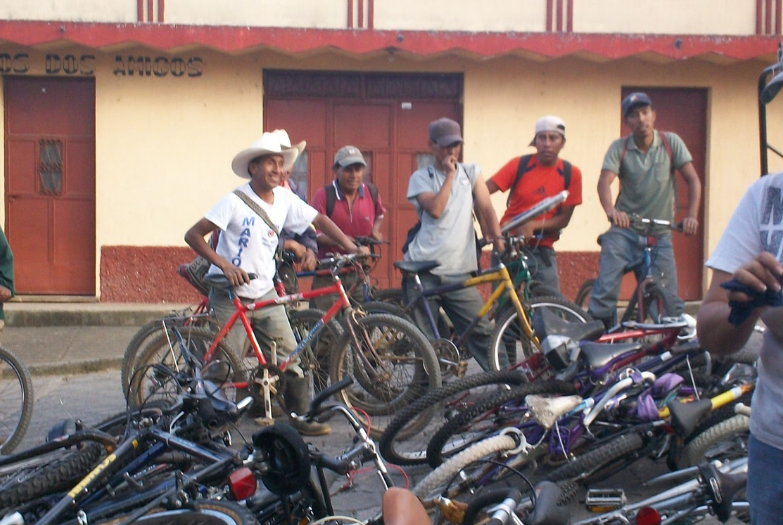
Bicycles for sale at the local market
P4P partnered with FIDESMA in ’99 and, since this collaboration began, there have been more than 6,000 bicycles and close to 200 sewing machines shipped. The initial proceeds of these sales were not for discretionary spending but to use for the handicapped of the region. The unfortunate reality of life there is that children who have any type of disability, from mild physical handicaps to severe mental and physical debilitations have no opportunity for aid. There is little or no birth control in this region as well, so a severely handicapped child is most likely part of a large family, thus there is often even less money and time to attend to specialized needs. FIDESMA works to assist these families in understanding and accessing proper nutrition and consistent hygienic practices—especially for those who are especially incapacitated and unable to travel.
It’s really quite amazing how the sale of an American bike actually has enabled such products as fresh, local vegetables or a toothbrush and toothpaste to become available in a remote region in Guatemala and help an overwhelmed parent properly care for her disabled child. While these families still receive assistance, the proceeds of sales of bikes and sewing machines now also enable FIDESMA to expand their interests.
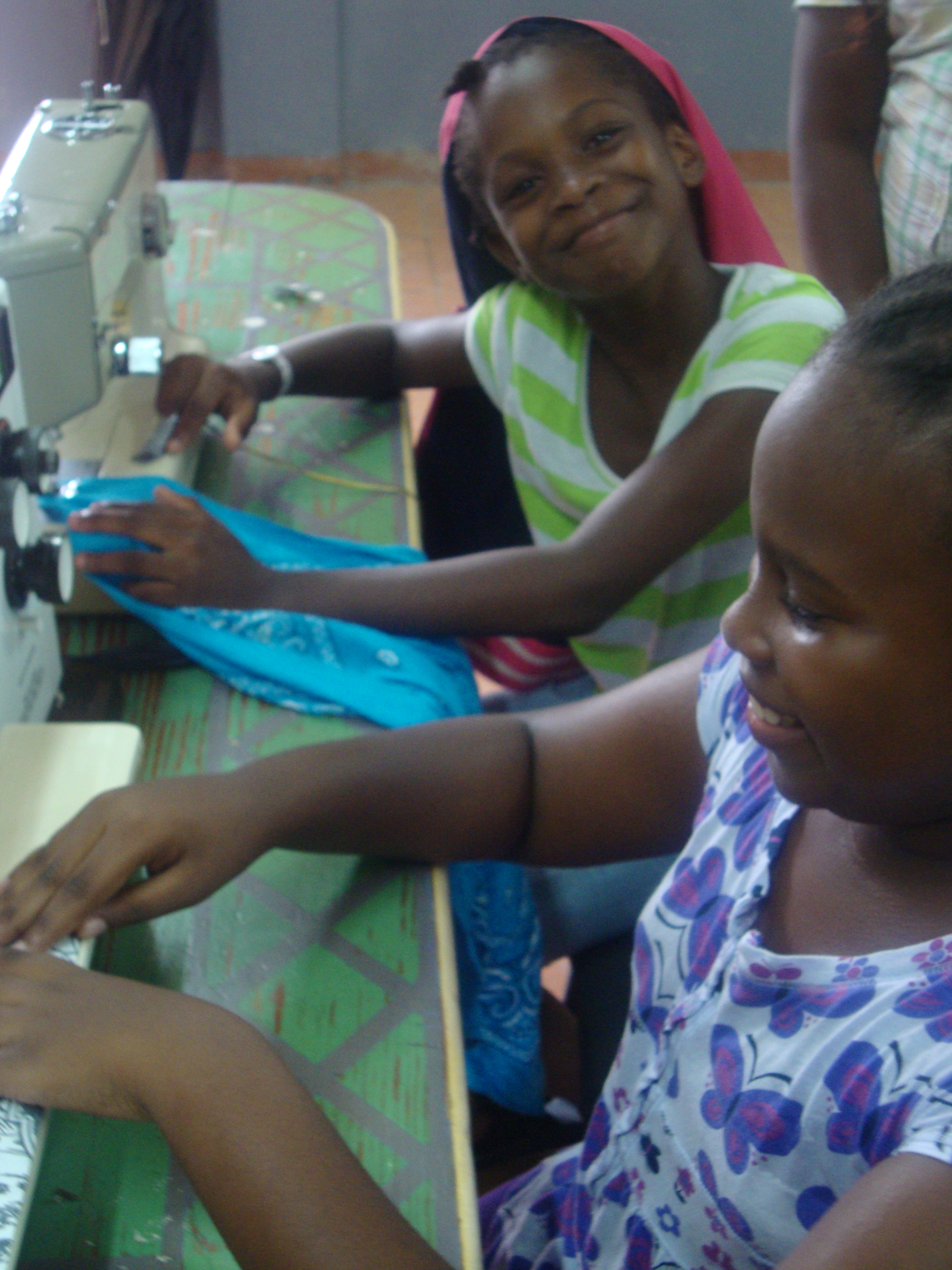
An eager sewing student in the FIDESMA sewing classroom.
FIDESMA is fundamentally concerned with education and creating or nurturing one’s capacity to work at regular jobs or start a business. There are carpentry, baking, computer, and plumbing courses to choose from. In fact, the foundation buildings include dormitories in order to lessen students’ concern over daily travel or lodging. When you think about the combination of bicycle travel and lodging for students, two elements of this economic expansion stand out: FIDESMA is not contributing to excessive fuel consumption and is preventing pollution of the local environment.
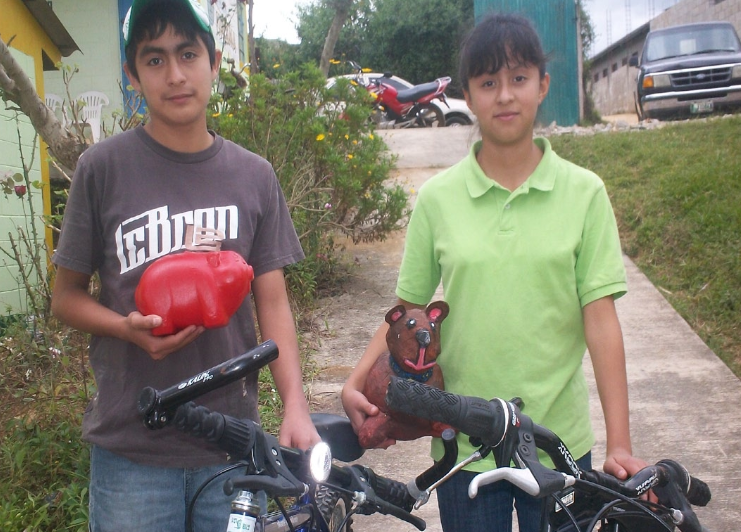
This preservation of the community on the personal and environmental levels shows in the beaming faces in the photographs that Señora Margarita flashed before us on the screen. The audience was treated to images of small children proudly showing their perfectly sized bikes and the teenagers sporting bright red or sleek black trail bikes. Moms happily roll by with youngsters mounted behind them. One of the most memorable images was a testament to the pride that people develop when they earn rather than receive their possessions: A group of young men sporting plastic piggy banks filled with the money that they had earned and saved in order to purchase their first bikes.
A brother and sister saved their change to purchase their own bicycles.
FIDESMA brings opportunity to you if you cannot come to them. Members of the foundation will take bikes out to villagers who cannot easily get to them to make the purchases. They also set up groups of bikes during feasts and holidays where there is guaranteed to be a crowd. Walk miles to celebrate? Ride home on affordable transportation.
P4P just shipped its 13th container to Guatemala. This is a long-term and strong relationship that promises to remain that way and we hope that Señora Margarita and FIDESMA’s executive director Señora Isabel Salazer will be willing to return to Hunterdon County to update us on the progress of these programs and treat us to more images of these working programs and independent business owners.
UNITY IN DIVERSITY FOUNDATION (UDF) is a Non-Governmental Organization and Non-Profit Making. Registered under Companies Ordinance (Cap 212) Companies Limited by Guarantee no having a share Capital. Registered on September 28th, 2004. Certificate of Incorporation No 50181. Also we have certificate of Compliance of Non Governmental Organization Registered under Vice President’s Office given at 13th March 2006. Our Registration No is 1597. Was founded for the following reasons. To unify, train and empower financially diverse expertise of idle expertise in different trades for the purpose of running their projects effectively.
OUR VISION. UDF envisages seeing that the idle expertise are unified and empowered.
OUR MISSION. To identify, unify, and offer training in their respective expertise for the purpose of running projects that will contribute towards the increase of the national economy and to procure and manage funds to be provided to the trained grantees for using them in running their projects.
OBJECTIVES. (a) To run educational institutes from grass-root level that is Nursery school, primary school, secondary school, vocational training school, secretarial, business/commercial, tourism etc. (b) To assist the marginalized sectors of the community by providing them with relevant education and information in order to assert their rights and seek improvement of their living conditions with particular emphasis on women, street children, orphans, disabled and HIV/AIDS victims.
THE PROJECT OF BICYCLES. The Bicycles project will help the idle expertise of Tanzania who were walking on foot, transporting goods on their heads, now will be using the bicycles for transportation of agricultural crops from their farms. The bicycles will be used by women and men in productive activities. Also the bicycles will be used by students who are walking 7 kms to 10 kms going to school every day. Also the bicycles will be used by women who are walking 6 kms to 10 km seeking water. The bikes will be doing a lot of activities such as carrying pregnant mothers from the village to town. Where there is no means of transportation the bikes will be carrying sick people and pregnant mothers.
THE PROJECT OF SEWING MACHINES. The sewing machines will be used to empower idle Girls in Tanzania, idle orphans, idle widows, idle women groups, idle youth group who are lacking employment and will be employed by this project. Due to the high movements of girls who are migrating from the villages to town the only solution is to provide them with sewing machines so that to lessen them from engaging into prostitution, drug abuse, unwanted pregnancies, theft, sexual abuses, etc. The sewing machines will provide them with employment for their self sustainability, self reliance and self employment. The sewing machines will help also the people living with HIV/AIDS and women groups who are idle. They will benefit from this project so that they may be encouraged into productive activities for improving the national economy by making different clothes like table cloths for decorating the tables and selling clothes to other nearby countries like Malawi, Zambia, and DRC. The sewing machines will bring a lot of changes soon because we have so many teachers who can teach them. It takes only three to six months for a young lady to master the sewing machine.
Through the Project of Bicycles and Sewing machines the vision of UDF which is to empower the idle expertise will be achieved. Also the vision of MATABE to Make Tanzania Better will be achieved effectively because everyone will busy working and our economy will be improving day after day and there will be no famine, no drug abusers, no prostitution, the kids will be attending the school well, at last everyone will be smiling in this world.
The night of April 20th, 2012, was an especially inspiring evening for P4P. Gathering in the intimate space of the Hunterdon Medical Center auditorium, we sponsored two wonderful presentations. The night was dedicated to a talk by Señora Maria Margarita Caté de Catú, founder of FIDESMA (Foundation for the Environment and Sustainable Development), whose organization runs economic-development programs in the rural highlands of her native country, Guatemala. Many of the programs that FIDESMA sponsors, including agricultural and technological development, are funded by the sales of bicycles and sewing machines that they receive from us.
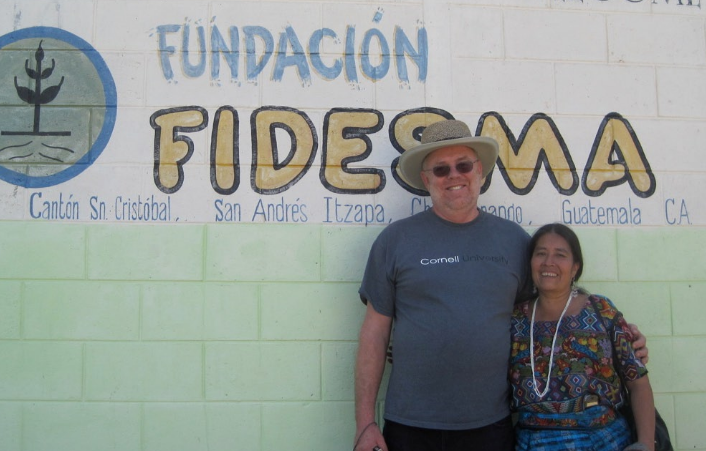
Dave and Margarita in front of the FIDESMA building
Opening for Señora Margarita, so to speak, was documentary film-maker Greg Sucharew who shared the trailer for his upcoming film, The Bicycle City. This is “the story of the struggle, determination, idealism, and hope that has brought about the transformation of an entire society.” Greg’s lens records the tangible changes occurring in Rivas, Nicaragua, thanks to organizations like Pedals for Progress who have energized the economy by making bicycles an accessible commodity for the local population. We all eagerly await the release of this important testament to the measurable success of how American citizens’ involvement in nonprofit goals affects economically limited regions and countries across the world.
On stage, Señora Margarita described the location and mission of FIDESMA before proceeding to highlight the ongoing programs, aided by a wonderful slide show of participants in the foundation’s programs. The audience witnessed students in groups or individually working at computers or attending lectures related to computer proficiency, nutrition, agriculture, and other such personally and professionally useful topics. Photos showed people of all ages and both genders using bikes to get to work or working on these bikes for a living. Multiple family members were shown proudly displaying their bikes and we were treated to the image of a mob of serious competitive cyclists at the starting line of a race. Ladies looked up from their sewing machines and large pots of agave leaves boiled on stoves in a large indoor workroom provided by FIDESMA.
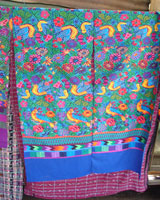
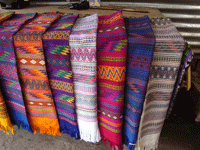
A table sat nearby the stage laden with expertly woven and beautifully colored wraps, purses, scarves, and pouches made by women who have been affiliated with FIDESMA for quite some time. A number of us purchased multiple pieces and, with the aid of our trusty translators, CEO of P4P David Schweidenback and our hard-working web master Reykha Bonilla, Señora Margarita patiently explained the meaning and relevance of the colors and designs of each backstrap-woven textile. She made a point of likening a traditional motif—the partial physical connection of two passing snakes—to the relationship of FIDESMA and P4P. No, not tangled or poisonous, but interconnected and flowing and meeting together even though moving independently. It really was a pleasure to be able to spend such intimate time getting to understand both the work that was being purchased and knowing where the dollars spent were definitely going. There were lots of smiles and many laughs even with the slight delay of the language barrier.
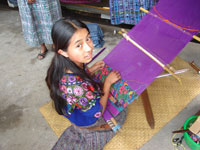
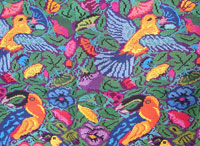
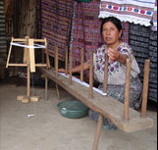
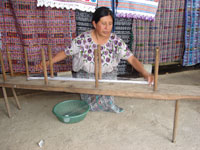
Mujeres Maya (Mayan Women) Kaqchiqoel of Santa Caterina de Barahona is a cooperative weaving business whose members create amazing hand weavings by using the traditional weaving techniques handed down to them by their grandmothers. The Mujeres Maya received a micro-loan from our partner FIDESMA in Guatemala to start their business. Today they have a stall in the major tourist city of Antigua, where they sell their goods.
Maria using the hand loom
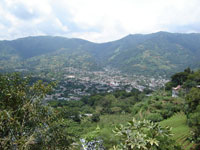
Santa Caterina de Barahona
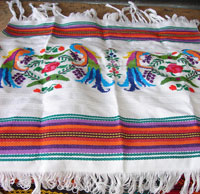
Table cloth with Quetzal
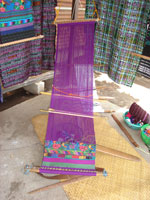
Traditional hand loom
Huipil: traditional indigenous garment
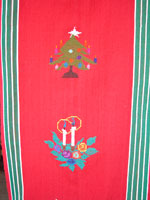
Christmas table runner
Table cloths
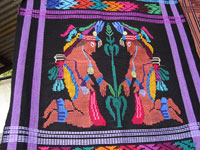
Dios de Maiz, Corn God
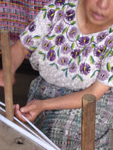
Detail of a huipil
Isabel demonstrates how the threads are counted for the hand-loom.
Señora Margarita is the founder of the Guatemalan foundation FIDESMA (Foundation for the Environment and Sustainable Development). The mission of FIDESMA is to promote the sustainable development of families and communities by promoting programs and projects in the areas of education, with technical assistance and economic aid for conservation, and protection of the environment in the rural regions of Guatemala. P4P has sent over 6,000 bicycles and close to 200 sewing machines to FIDESMA since 1999 to help support these programs.
Señora Margarita will give the presentation explaining in detail their programs that they run from their foundation headquarters in the rural highlands of her native country. FIDESMA has established facilities in San Andres Ixtapa from which they implement their programs in all of the surrounding communities.
Joining us will be documentary filmmaker Greg Sucharew sharing his trailer for the upcoming The Bicycle City. Based in Rivas, Nicaragua, this is “the story of the struggle, determination, idealism, and hope that has brought about the transformation of an entire society.”
For all of the supporters of Pedals for Progress and for those interested in discussing the sustainable and measurable success of partnering with a nonprofit, this is a wonderful opportunity to hear first-hand how American bicycles and sewing machines have had a significant impact on many Guatemalan and Nicaraguan lives and how important it is that we are able to continue supporting FIDESMA and related endeavors.
60 Sewing Machines from Pedals for Progress
Yemen is the poorest country in the Arab world and consistently ranks at the bottom of the United Nations Development Index. Still, for those fleeing war, persecution, and famine in the Horn of Africa, it is both a transit country and destination. With an estimated 210,000 refugees in Yemen, the capital city of Sana’a hosts one of the country’s largest urban refugee populations. With high levels of unemployment across the country, especially amongst the refugee population, livelihoods opportunities are hard to come by.
In 2011, IRD Yemen received 60 sewing machines from Pedals for Progress as a donation to support its UNHCR funded program, Community Services Assistance to Urban Refugees. The aim of the program is not only to support urban refugees, but also to add value to other organizations’ programs that support refugees in the capital city of Sana’a. As such, IRD works closely with a local NGO which provides vocational training services to female refugees and Yemeni women alike. From the in-kind donation, a total of 64 women (42 refugees and 22 Yemenis) are being trained on the sewing machines, of whom 50 of the top graduates will be rewarded with the actual machines upon graduation. In this way, the beneficiaries will not only have learnt the skills to develop livelihoods opportunities for themselves but they will also have the equipment to do so.
One of the challenges faced with this donation concerns the model of the sewing machines. Singer, the company that produces the machines, does not operate in Yemen and hence spare parts and maintenance services are not readily available. As such, 50 of the machines are being used for training while 10 of the lesser quality second-hand machines are being used for spare parts.
Zahra Jama Ahmed, a Somali refugee mother, was particularly grateful for the support, ‘Thanks to having the machines, I have been able to learn to sew which means I will be able to bring an income for my family’
As you may have read on our web site, we received a wonderful letter from Peace Corps volunteer Liz Deppe thanking us for making it possible for the school where she teaches to acquire 20 sewing machines. Located on the island of St. Vincent, the Barrouallie Secondary School (BSS) is the fortunate institution to welcome Liz and, hence, receive the machines. Originally from Ames Iowa, Liz has only been in St. Vincent for 8 months as an assistant to the teachers in the art and reading courses; however, in that short time, she has made an enormous difference. Having known about P4P from our work in Iowa, she decided to contact us about donations of sewing machines to incorporate into the curriculum. What can they do for employment without this skill? While banana production has dominated the economy, the government has been seeking ways of diversifying so that Vincentians do not continue to be vulnerable to price fluctuations and crop diseases. Tourism is an industry that has grown widely, but not everyone is able to profit from this type of expansion. This is where the importance of a solid education backed up by practical vocational skills comes into our story. According to Liz, “[t]hat first project and many more projects the students at BSS will work on are teaching them more than just how to sew. They are learning patience, creativity, problem-solving skills and a sense of accomplishment.” While the machines are not used for production but strictly classroom learning, there is hope that more machines can be acquired so that families may be able to purchase them and begin their own businesses. At the very least, the students have a marketable skill to offer alongside the knowledge they gain from their studies.
Liz has witnessed firsthand the lasting effect that tangible results from focused effort provide: “What I believe is the most rewarding part of our newly created sewing program is a sense of accomplishment. At a school with little resources and many struggling students, it is amazing to watch a student, who has never felt proud, show you what they have accomplished. Their face beams as they hold up the finished product, something they can use and show off.” It is part of our mission to do the utmost to send our shipments as economically as possible while striving to get the sewing machines and bikes out to those in need as quickly as possible. P4P was able to ensure that the sewing machines could make it to the school and with as little financial burden as possible by sending them via sea rather than air. The cost was demonstrably lower at $10 per piece. If all goes well, we may be able to continue this relationship not only with the school but also expand to other institutions on the island. It is Peace Corps Volunteers like Liz and people like our partners and contributors who think progressively, initiate programs, and give support that make our efforts so successful.
When we initiated new programs we very diligently investigate our potential new partner. The 1st obvious reason is to select the best partners overseas. The 2nd reason is we realize, especially with sewing machine programs, we have very little ability to monitor many of these far-flung programs. In fact, to monitor the program is often more expensive than supplying the program. We have a basic understanding at P4P that we do not send gringos overseas. The material we ship is appropriate technology, they do not need technical support from us. We are much more effective using our limited funding for shipping as much material as possible.
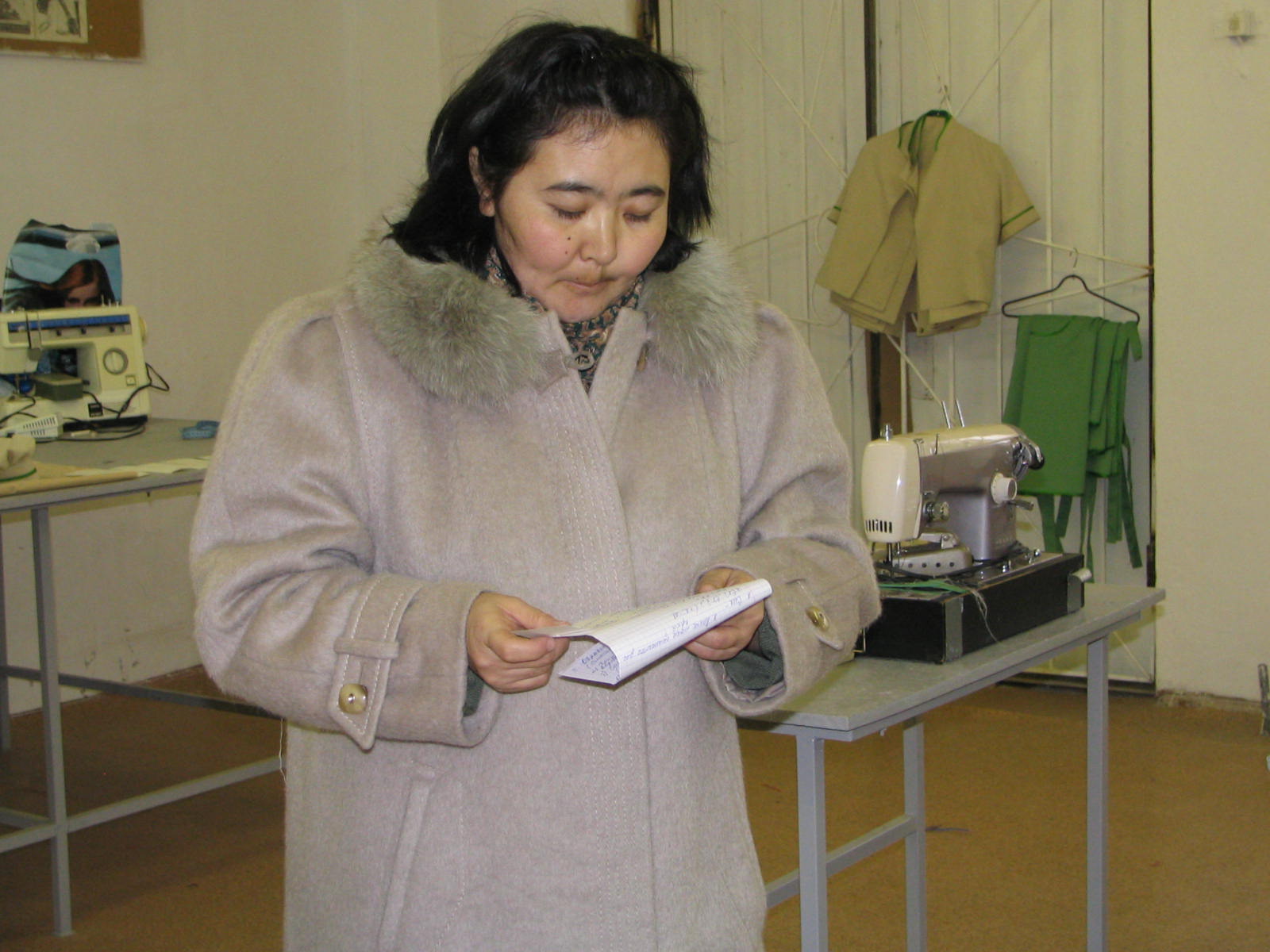
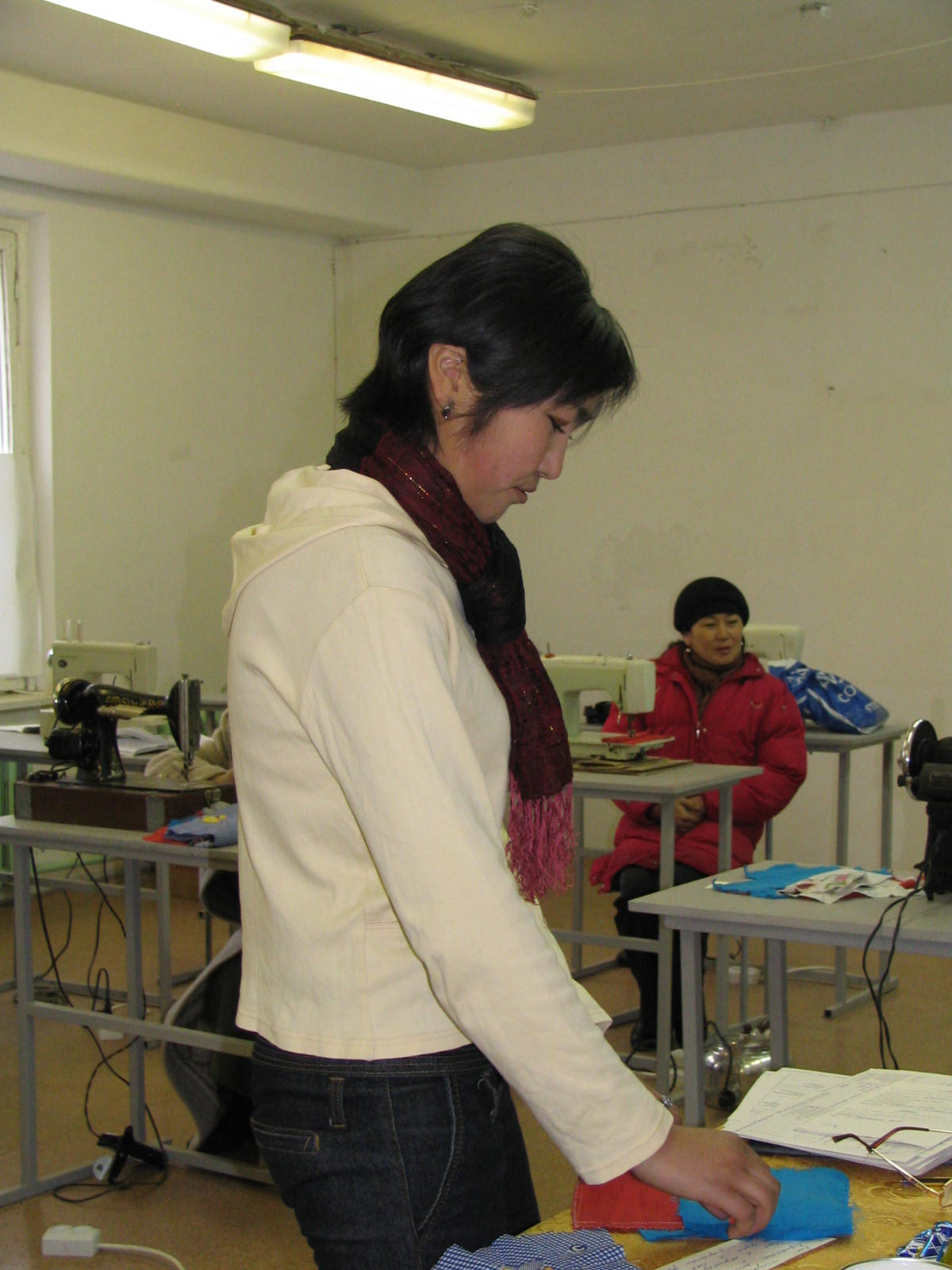
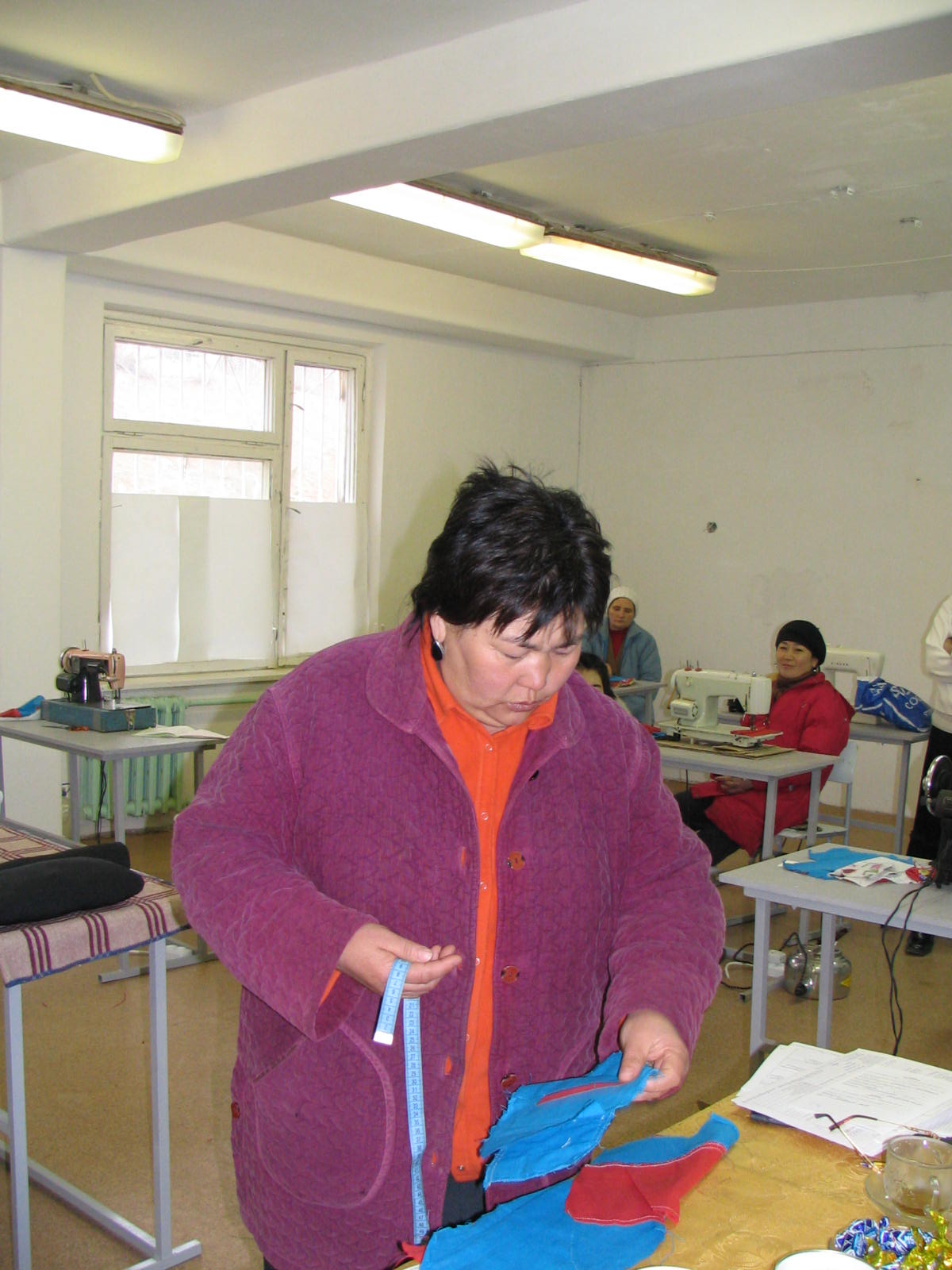
Longtime readers of our web site and newsletters will probably remember in 2008 with some assistance from the Clif Bar Family Foundation we sent a consignment of sewing machines to a Peace Corps volunteer in Kyrgyzstan. Kyrgyzstan is one of those geographical locations that we don’t happen to pass by often. When PCV Roberto left Kyrgyzstan, we lost contact with the sewing machine program.
I never lost faith that the sewing machine project in Cholpon-Ata could be successful, I just knew that I had no way to find out. I was so pleased this weekend to receive the following e-mail and photographs.
David,
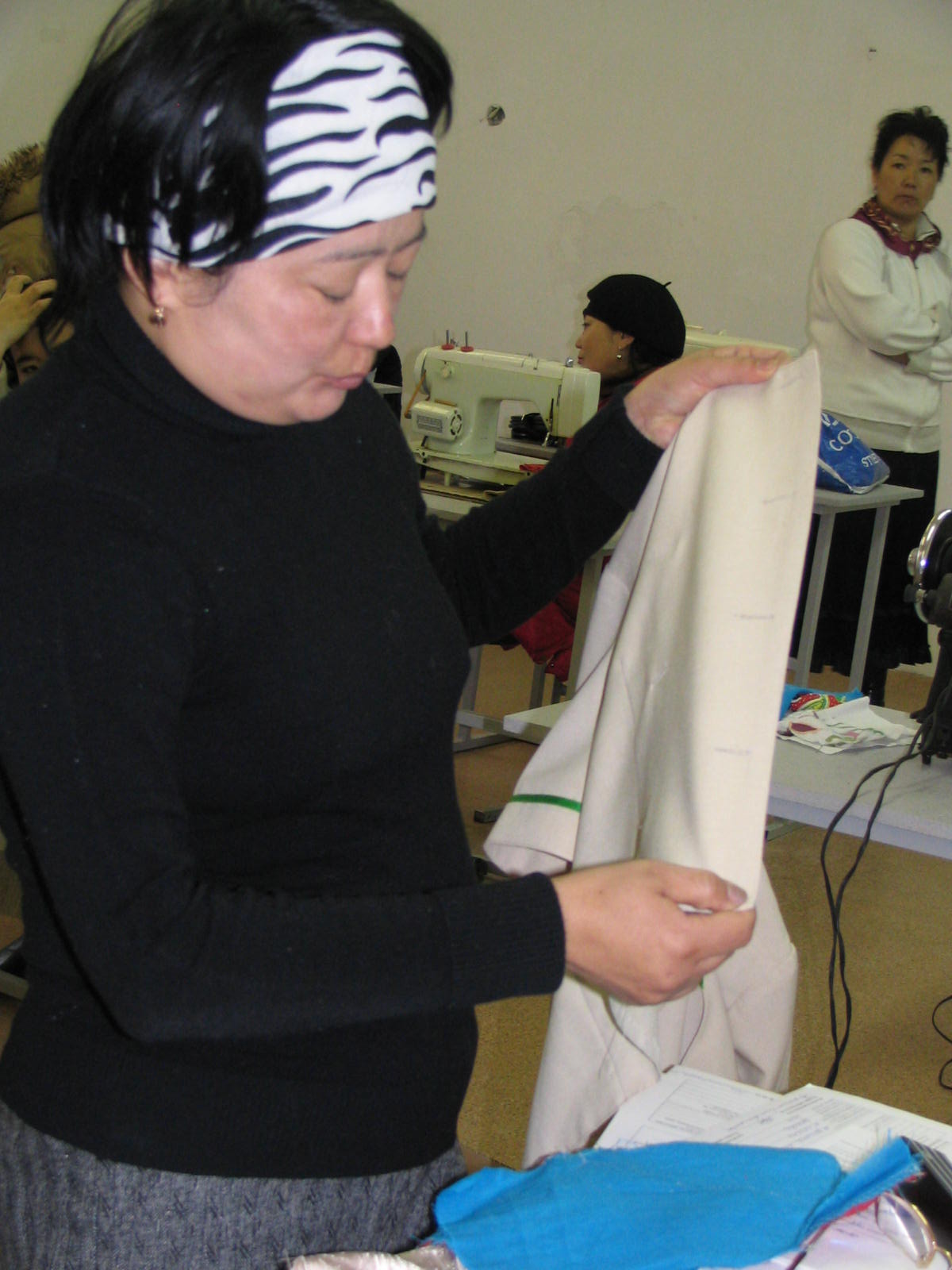
I’m happy to report the sewing cooperative is functioning as both a producer of linens and a training center unemployed women who are interested in taking up sewing. The Peace Corps volunteer there forwarded me some new up-to-date pictures. Rob
Even though sometimes I do not get the story and photographs back quickly, to the community the bicycles and sewing machines we ship are so vitally important that they are made use of. To those of you who donated funding and or sewing machines in 2008, thank you from our staff and the employed women of Cholpon-Ata.
Dave Schweidenback
Donate bicycles and sewing machines to developing countries