Category Archives: Sewing Partners

Big Weekend in June 2017

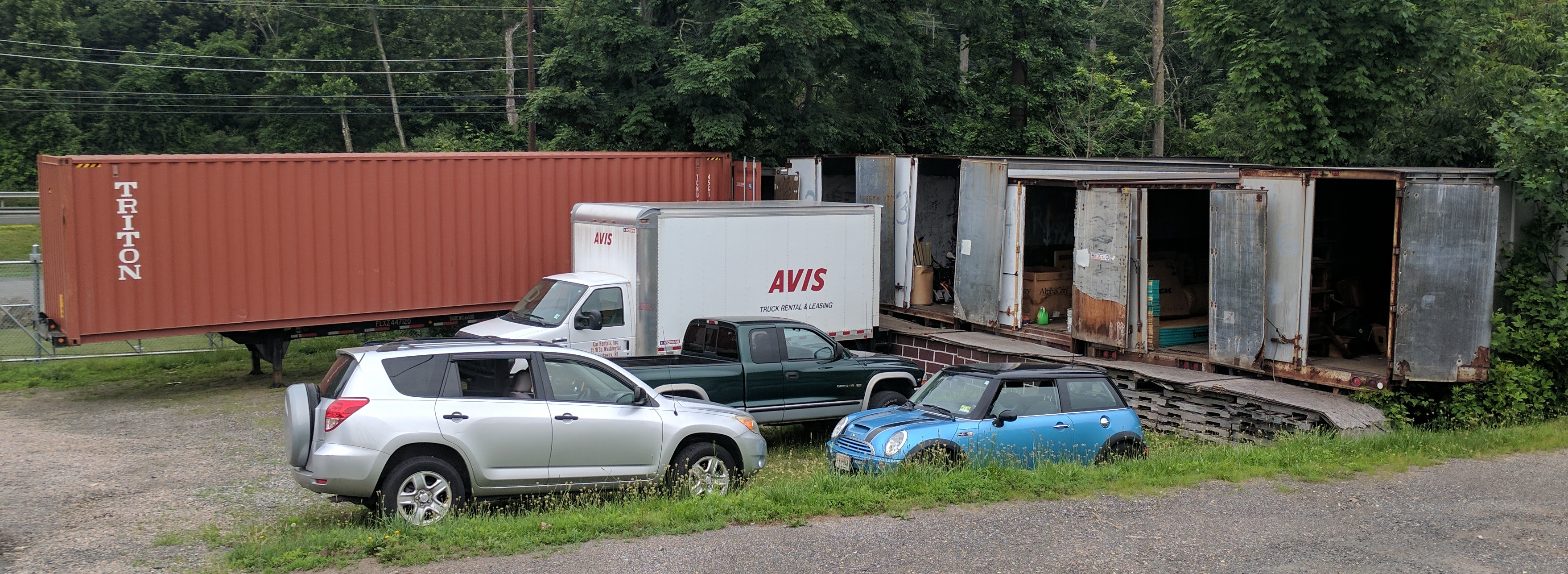
You knew the weekend of June 24, 2017, was going to be action packed when you saw the P4P trailers and parking lot. The Triton 40-foot container had been delivered for our 11th shipment to Albania. The Avis rental truck was ready for the final collection of the spring season. And Dave’s Mini and a couple of volunteer vehicles were parked out front.


Sewing Machines to Tanzania

We had collected enough sewing machines for a shipment of two pallets to Tanzania. Our tinkerers Simon Rosenstein and Dennis Smyth had worked tirelessly over the last few months getting the machines into good working order. Several dozen machines were boxed and ready to pack. We had just made the final arrangements with our partner in Tanzania, the She Can Foundation. The Summer 2017 InStitch newsletter has this post about a recent trip around Tanzania by She Can founder Sophia Mwakagenda, a Member of the Parliament of Tanzania.

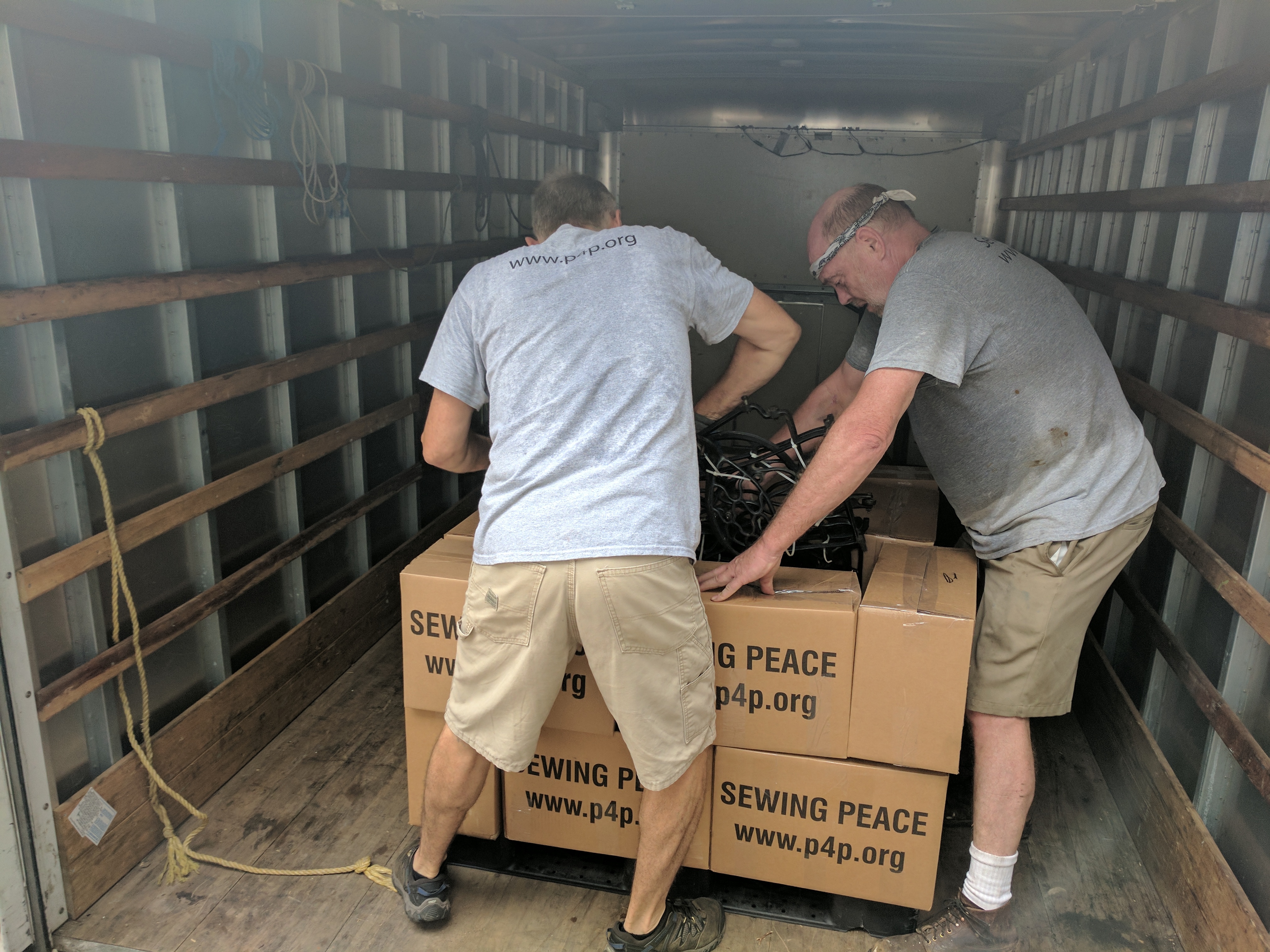
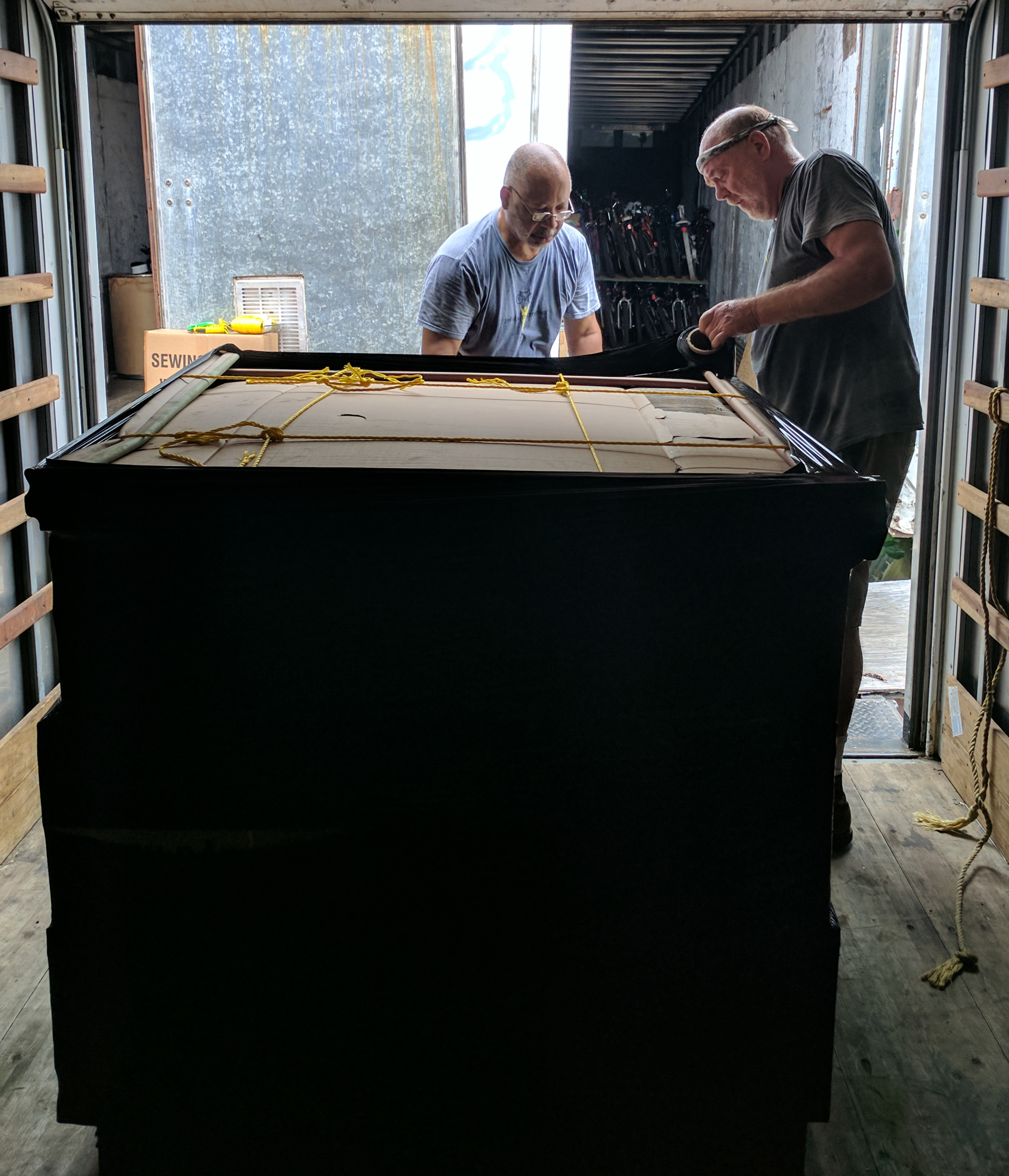
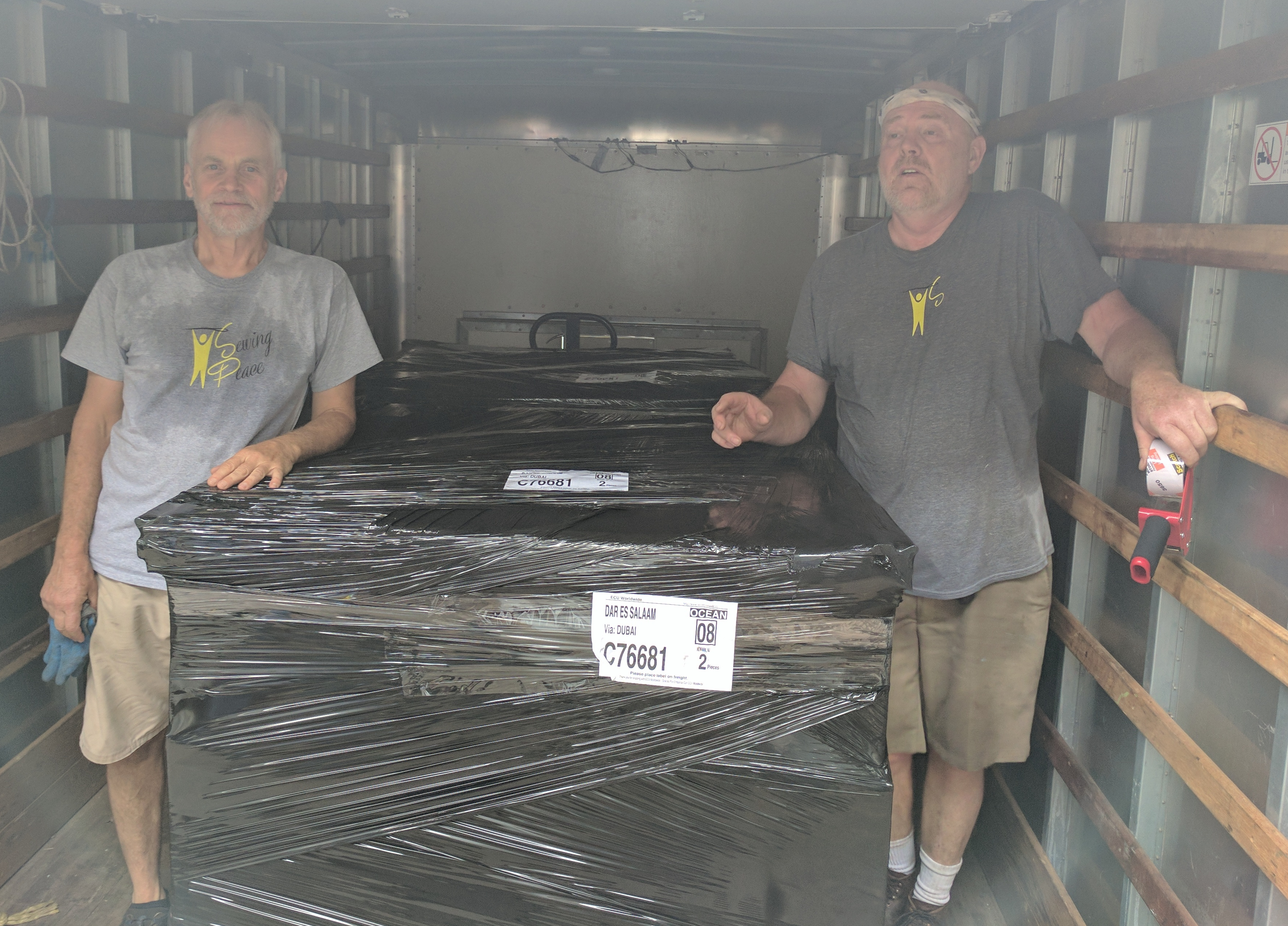
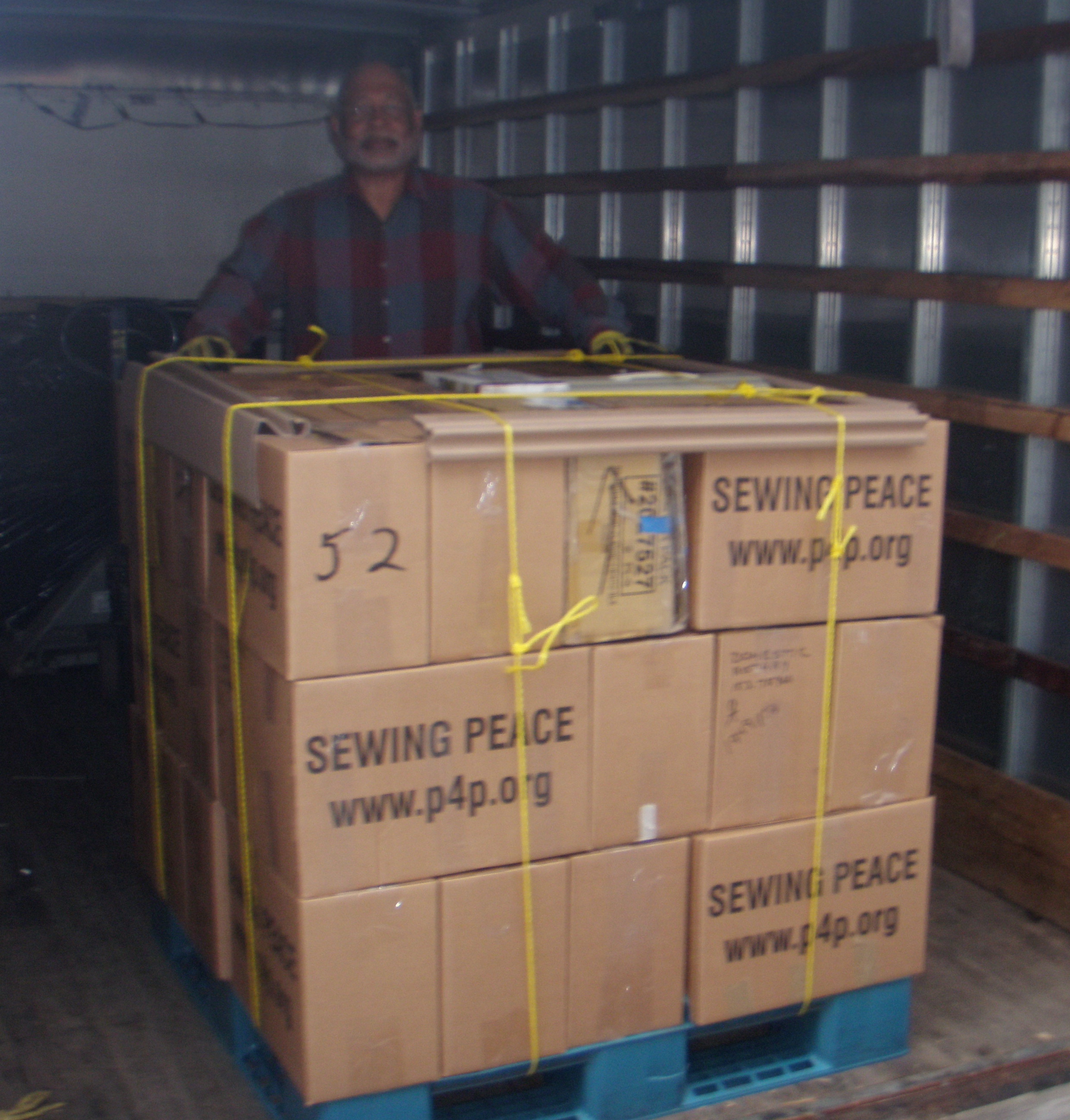
On Friday, we prepared the two pallets. We stacked the boxed machines on a pallet, leaving room for a couple of sets of the heavy treadle stands. We nestled the treadle stands inside the walls of boxed sewing machines, put a cardboard roof over the treadles, and added another layer of boxed machines. We added some cardboard padding, roped it up, then shrink-wrapped the whole thing into a neat 4-foot cube. We shipped a total of 68 machines in the two pallets.

Bon voyage, sewing machines. See you in Tanzania!

Eleventh Container to Albania

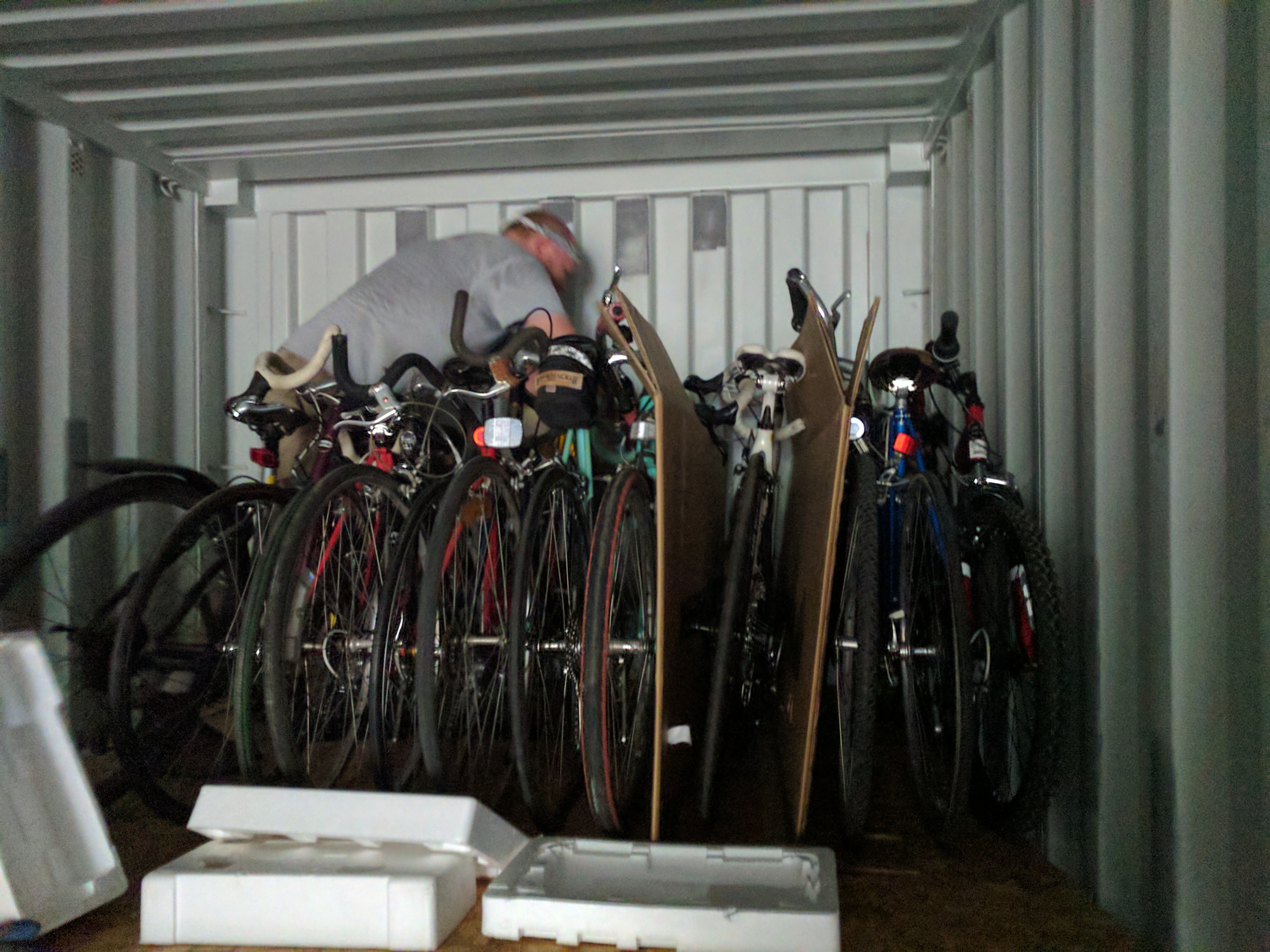
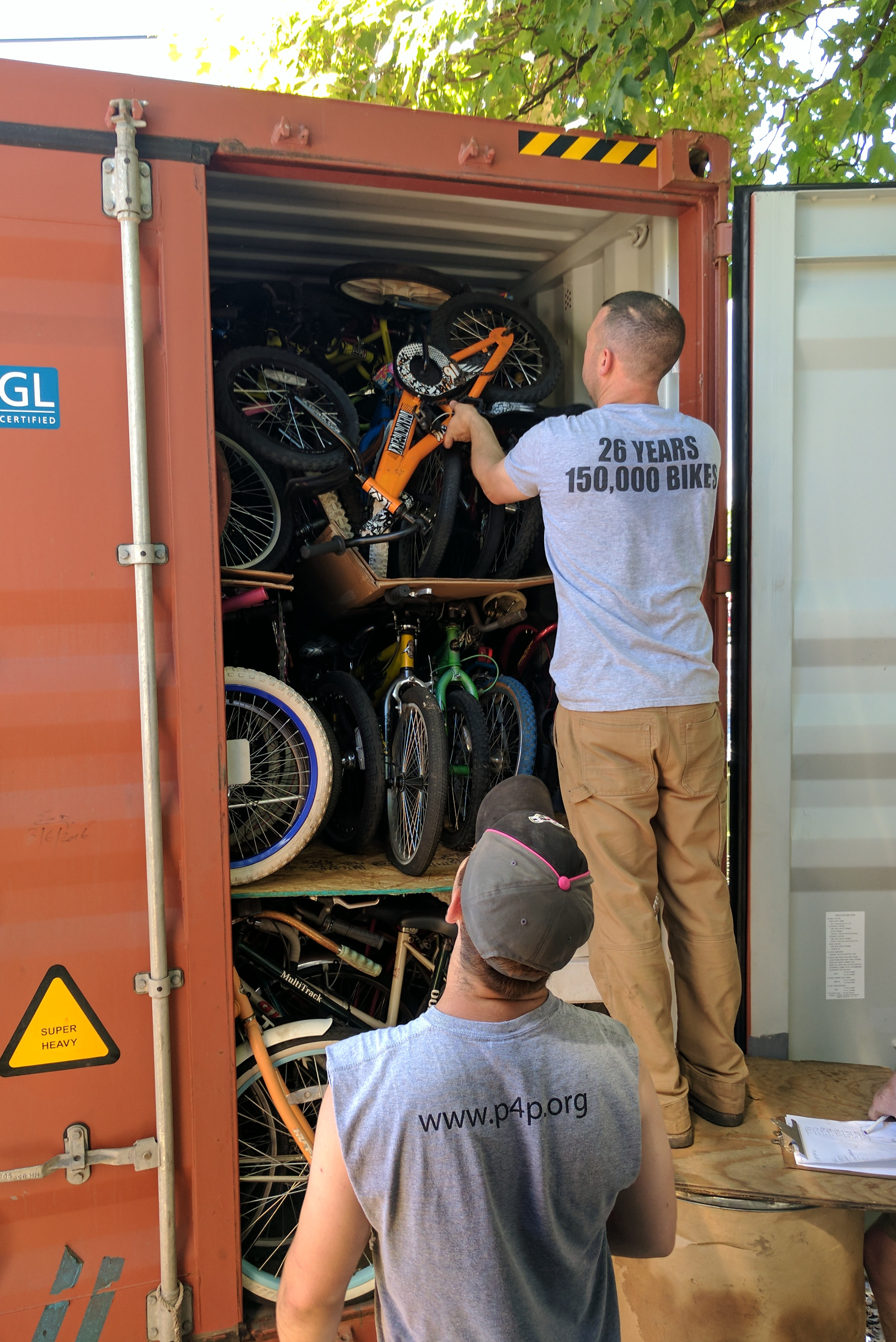
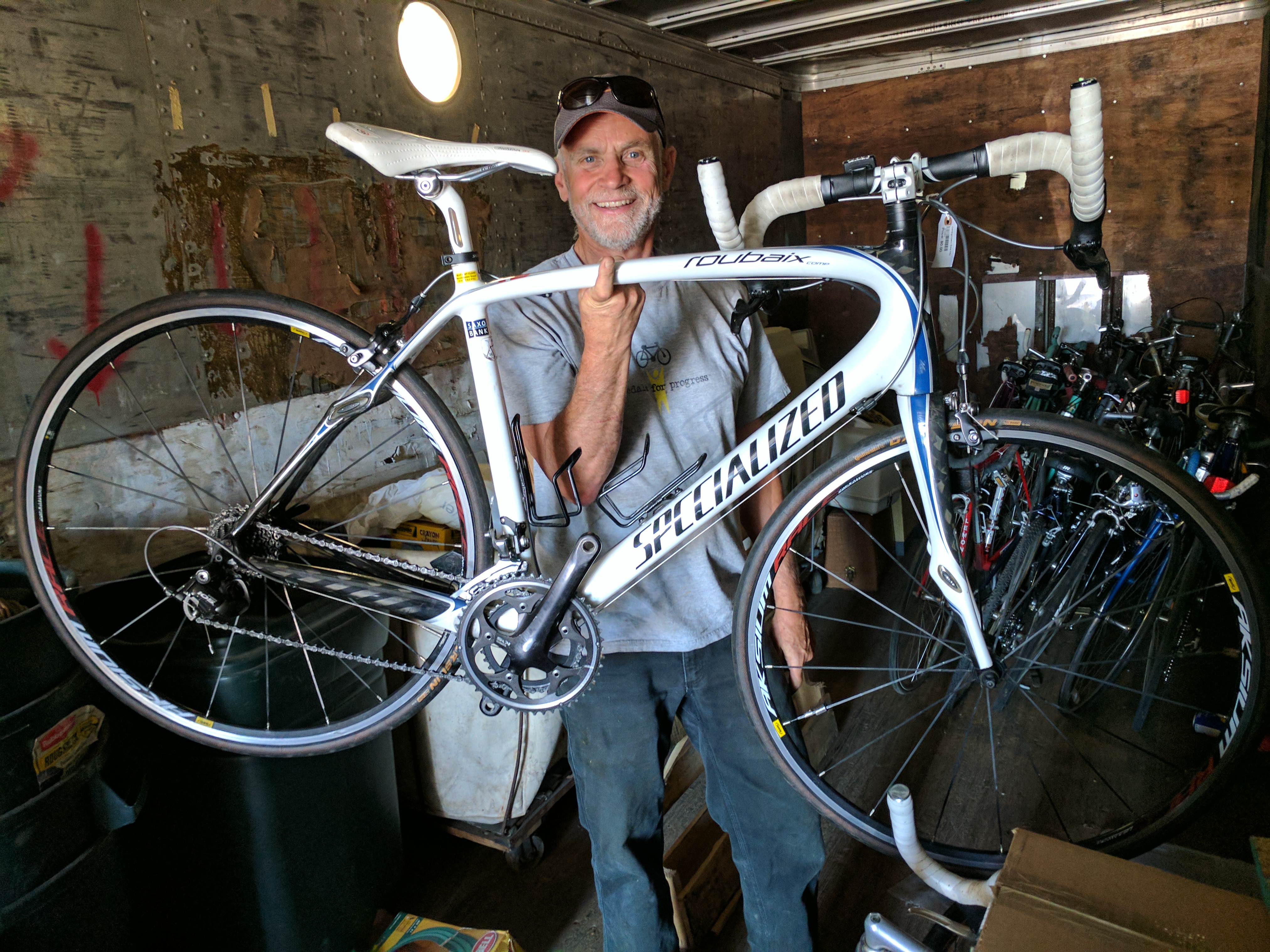
Also on Friday, we pre-loaded 53 adult bikes, 25 kids’ bikes, and some sewing machines into the container bound for Albania. The pre-load lets us take care of any special packing before the big push on Saturday. This time we used the pre-load to pack very carefully a handful of spectacular bikes, including that famous carbon-fiber Specialized Roubaix. In the photos you can see that it has its own personal cardboard stall. These bikes will go to people who love cycling and are willing to pay a high price for a special bike. Our partner in Albania, PASS/Ecovolis, will be extremely happy to get some high-end bikes they can sell to help support their programs.

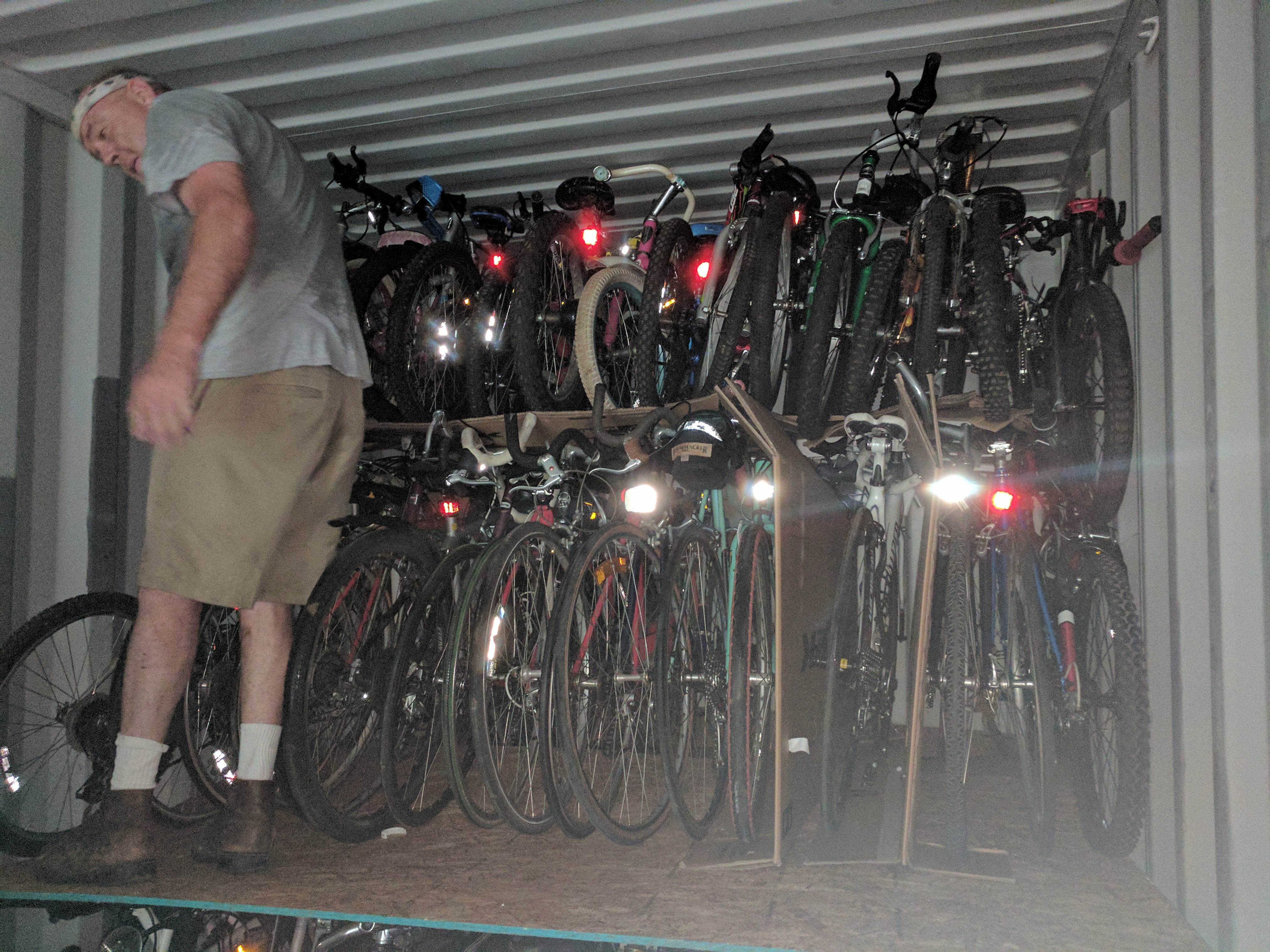
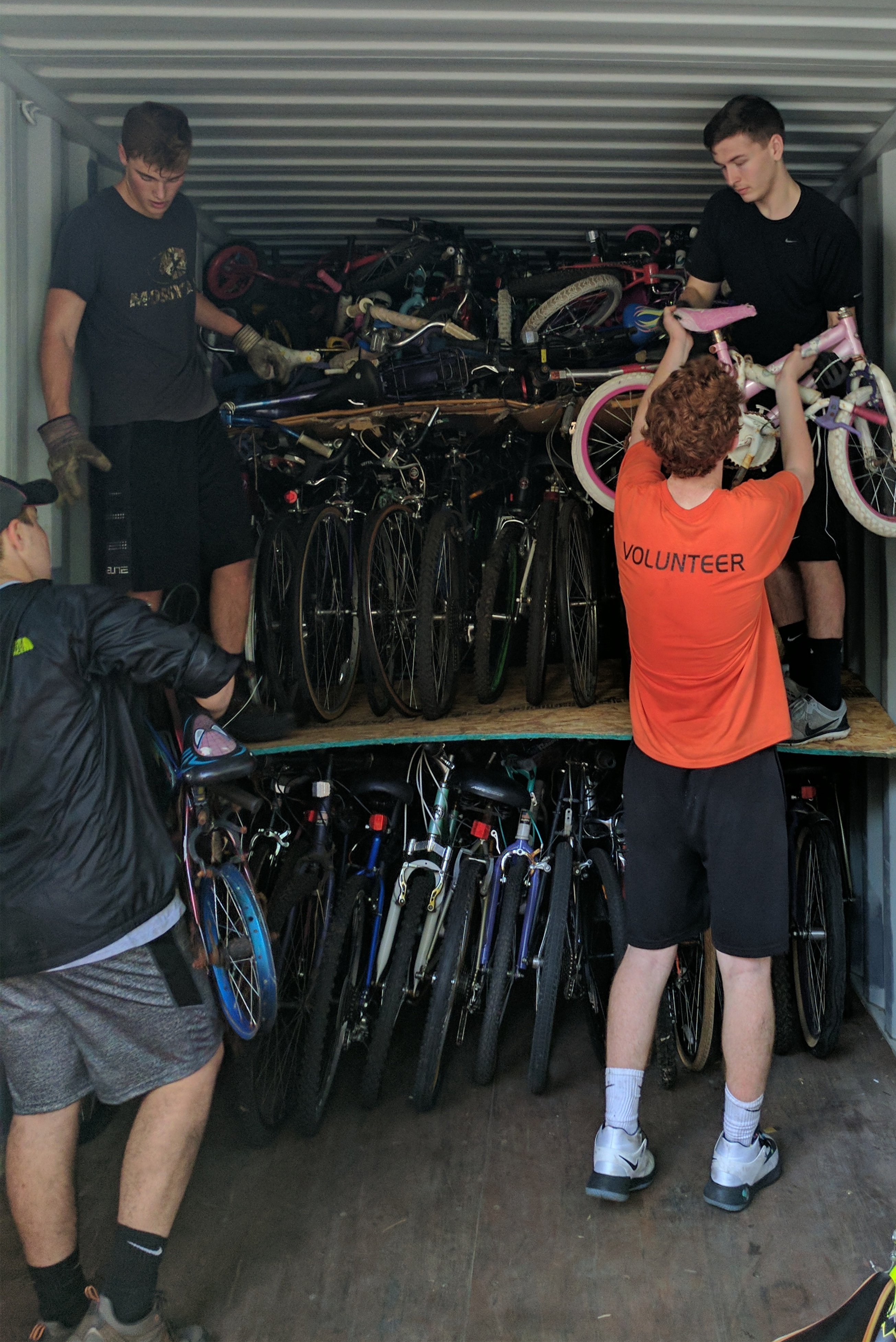
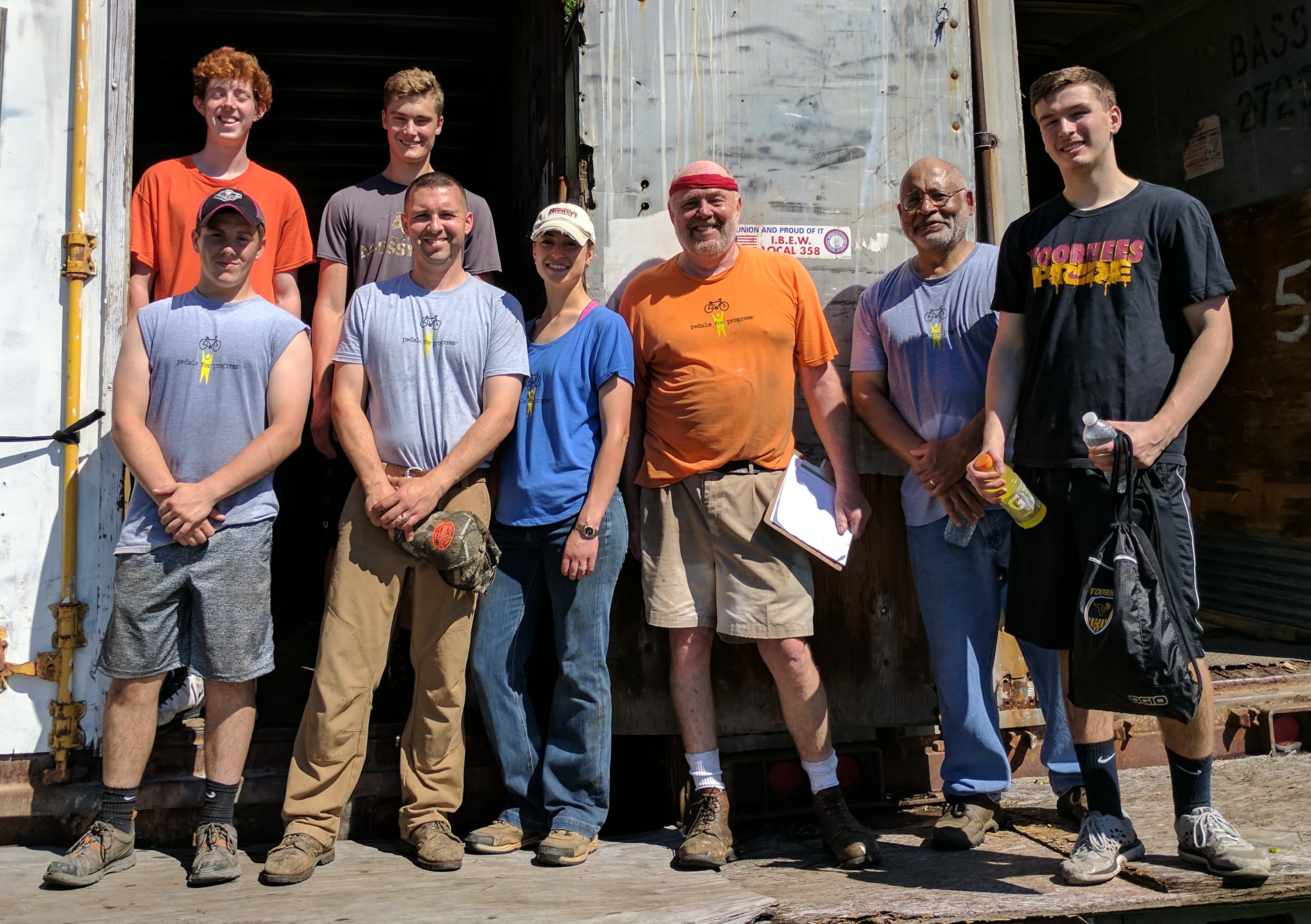
On Saturday, the real loading crew took over and did the hard work. They started at 7am to try to avoid the heat of the day, when the interior of the container attains advanced sauna status. Some sections of the container get three rows of bikes stacked on top of each other: two rows of adult bikes and one row of kids’ bikes. To pack the top row, you climb into a sweltering 3-foot niche with the broiling roof of the container blistering your flesh. Then you contort yourself into the most awkward position you can think of and take ridiculously heavy kids’ bikes from the person passing them up. Then you push them into position, using hands, feet, and any other body part that proves useful. The idea is always to get as many bikes as possible into the container—the shipping cost is fixed, so every bike adds to the bottom line.

When the container is almost full, we close one of the two container doors and jam in the last few dozen bikes, jig-saw like. Our partners are well aware of our packing methods, so they open the container doors gingerly, hoping not to be crushed by an avalance of bicycles.

The final count for the Albania container: 426 adult bikes, 100 kids’ bikes, 25 pairs of pedals, 9 saddles, 12 baskets, 25 helmets, 9 sets of training wheels, 2 bike racks, 4 wheels, 8 tires, and a few other miscellaneous bike parts and accessories, plus 15 sewing machines. That’s a full container!

Our Albania partner, PASS/Ecovolis, is one of our most active partners. They have a bike shop and a bike sharing program in Tirana, the capital of Albania. They also have projects in reforestation, childhood literacy and nutrition, and low-income housing.

As for sewing machines, Ened Mato, head of Ecovolis, tells us that they now have extra importance. Partly thanks to Ecovolis efforts in political persuasion, Tirana merchants now must charge a small fee for plastic shopping bags. Yet another PASS group, Trasta o Nona, manufactures fabric shopping bags, using Sewing Peace machines. The PASS shopping bags should sell much better with the new fee on plastic bags.


Flemington Collection

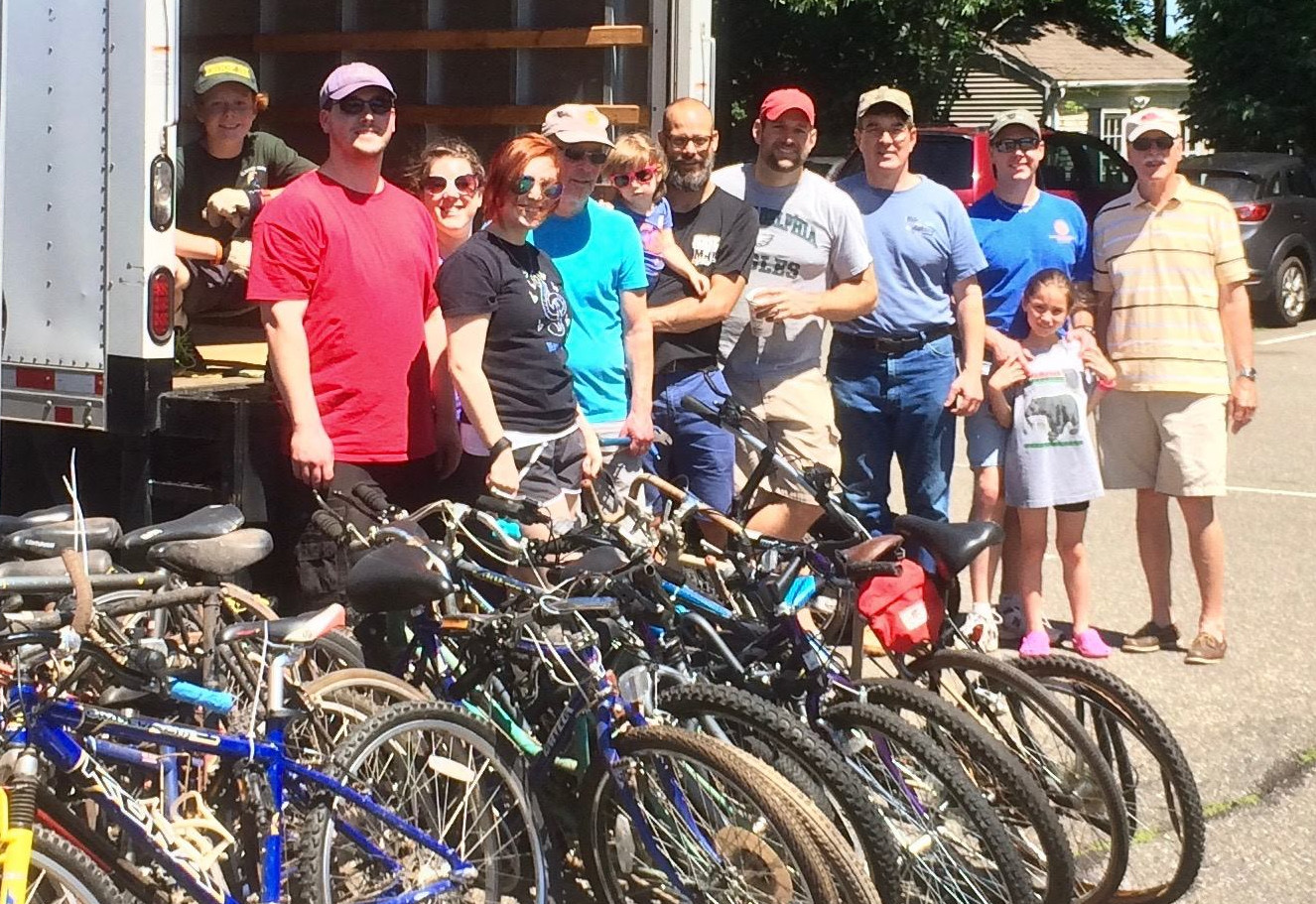
While the crew was loading the Albania container, Gary was running the final collection of the spring 2017 season. The Presbyterian Church of Flemington and the Flemington Rotary Club collected 42 bikes and 19 sewing machines.

Summer Break

So that was our big weekend: we shipped 68 sewing machines to Tanzania on Friday, finished loading 526 bikes and 15 sewing machines for Albania on Saturday, and also on Saturday collected 42 bikes and 19 sewing machines in Flemington. Well done all around.

The shipments to Tanzania and Albania emptied the trailers of most bikes and sewing machines, but there are a few left as a start on our next shipments, which we will make later in the year.

Our collections resume in September. Get in touch if you’d like to host one. Have a great summer.

InStitch Summer 2017


Report from Tanzania

Summer 2017 InStitch

Introduction
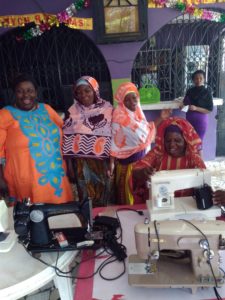
The Honorable Sophia Mwakagenda is a Member of the Parliament of Tanzania. From 1 April 2016 to 20 March 2017 the Honorable Mwakagenda visited different constituencies of the Longido and Ngorongoro districts in the Arusha region, and the districts of Rungwe, Kyela, Mbarali, and Mbeya in the Mbeya region. This visit was a continuation of visits countrywide in order to listen to the people and implement some of her programs through her NGO She Can Foundation.

The visits in Mbeya and Arusha regions were coordinated by the Office of Members of Parliament located in Mbeya city.

Honorable Mwakagenda was accompanied by a team of 4 researchers and assistants: Edwin Mwaitebele, Emmanuel Ngwetta, Mpegwa Mwakang’ata, and Frank Kayumba.

The Purpose of the Visit
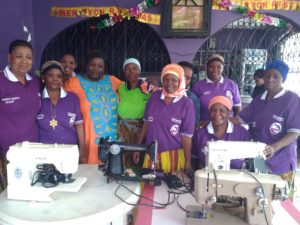
The purpose of the visit was to help women’s entrepreneur groups by giving them means of production, like sewing machines, to improve their productivity in their local settings.

Specific Objectives

  • To meet women’s social and economic groups in different areas to hand over support and equipment including sewing machines
  • To provide some knowledge and skills to these groups


Activities
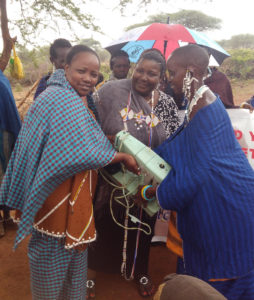
The team met six women’s social and economic groups from seven constituencies of Arusha and Mbeya regions with the aim of sharing with them knowledge and skills on entrepreneurship for them to improve their work. The MPs handed over sewing machines during this visit. In Mbeya region and Arusha region, which is Masaai, the MPs handed over a total of 61 sewing machines.

The Honorable Mwakagenda gave four sewing machines to women’s entrepreneur groups in Mbeya urban constituencies.

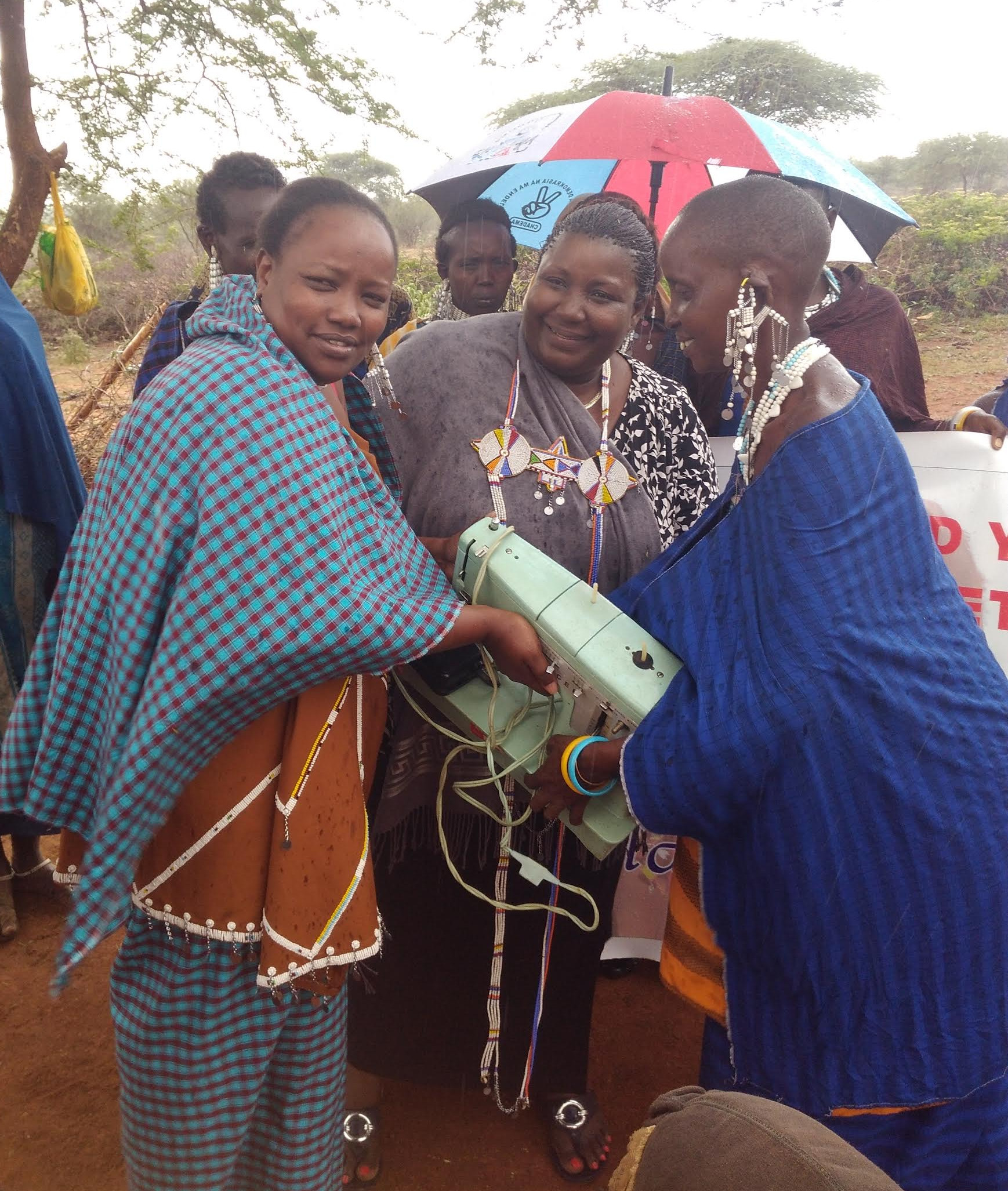
In her visit of 17 and 18 March to the Longido district of Arusha region, Honorable Mwakagenda gave a sewing machine to a 21-year-old woman known as Grace from the Ngarenaibo village. The machine gives Grace employment and should improve her family’s economic situation.

Numbers of Sewing Machines Given

From 1 April 2016 to 23 March 2017, Honorable Sophia Mwakagenda gave 73 sewing machines as follows in Mbeya and Arusha regions.

REGION (District) NUMBER OF MACHINES

MBEYA (Kyela, Rungwe, Mbarali, and Mbeya) 36
ARUSHA (Longido and Ngorongoro) 37

TOTAL 73

Other Activities

Honorable Sophia Mwakagenda had an opportunity to visit Ngorongoro Crater, which is an international tourist attraction in Ngorongoro district and talked with the leadership concerning their challenges in their day to day work.

Honorable Mwakagenda also visited her fellow MP Honorable Cecilia Pareso in Karatu district to console her on her brother’s death, which happened few days ago.

Reflections on the Visits

Honorable Mwakagenda and her team got a good reception from the leadership and citizenry in general.

The level of awareness of the people, particularly women, in attending, listening and participating to the Member of Parliament meetings was very high.

These visits give people hope: the visits show love and togetherness in society regardless of location, tribe, background, status, and colour.


Sewing in Kenya

Summer 2017 InStitch

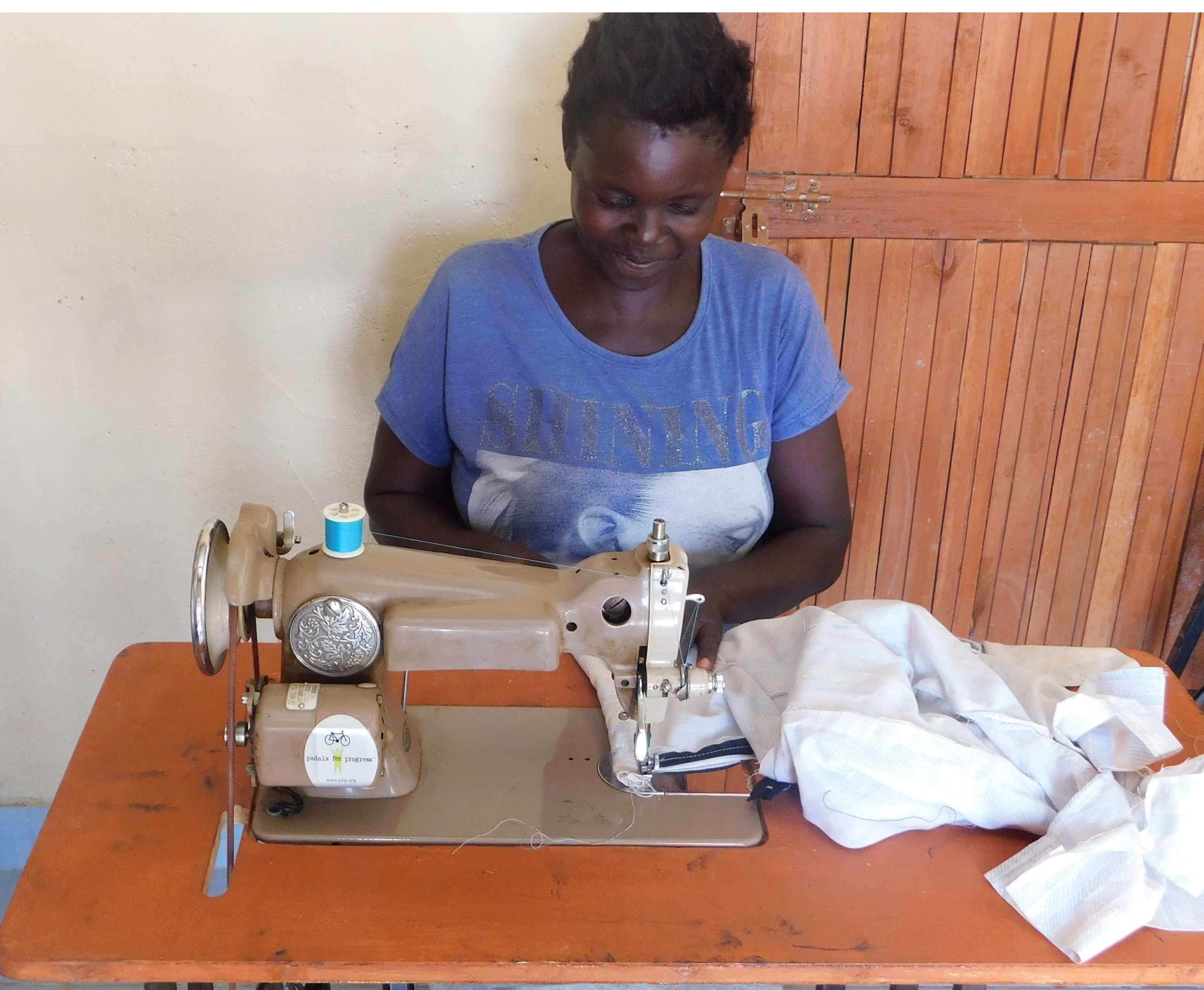
Cherehani Africa provides sewing machines to women in rural Kenya to enable them to start and run their own independent tailoring businesses.  Lillian Onyango lives and works in Madiany market, Siaya County. Lillian has four children, three of whom go to school. Lillian learned dress-making skills at Ruma Training Institute in 2010 but has been unable to afford to purchase her own sewing machine to enable her to start her own tailoring business. For the last seven years Lilian has been leasing a sewing machine to enable her to generate income and provide for her children.
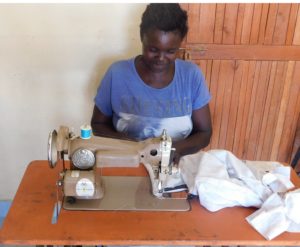
She pays a monthly leasing fee of $5, and this fee reduced her profits and chances of ever owning her own machine. When Cherehani Africa met Lilian and told her about our partnership with Sewing Peace that will enable her and many more women in rural Siaya to acquire sewing machines, she was overwhelmed with joy. For her, the sewing machine she has received from Sewing Peace is the first production tool she owns in her own name. Lilian made a down payment of $40 for the sewing machine and committed to completing the deficit of $20 in two months. Lilian no longer has to lease a sewing machine and is able to take home more money to support her family. Through the partnership of Cherehani Africa and Sewing Peace, Lillian no longer has to worry about leasing a tool she depends on for her survival. All her energy and savings are now directed at completing the payment for the sewing machine. “Thank you Sewing Peace for enabling me own a sewing machine. I will work very hard to ensure that you can extend your support to many more women like me in Kenya,” says Lilian.

The total cost for the machine is $60, which most beneficiaries pay off in six monthly installments of $10. All the machines that we received were in merchantable condition and we have not had to repair any before issuing. We broadly put the machines into two categories: those that could be converted to manual ($60) and those that are strictly electrical ($80). The ones that could be converted to manual have been widely issued as most beneficiaries work in stations without electricity. The electric ones have moved slower because they are more suitable for urban centers.

Best Regards,

Robert Mboya


Kyrgyzstan Sewing Update

Summer 2017 InStitch

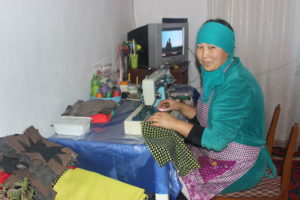
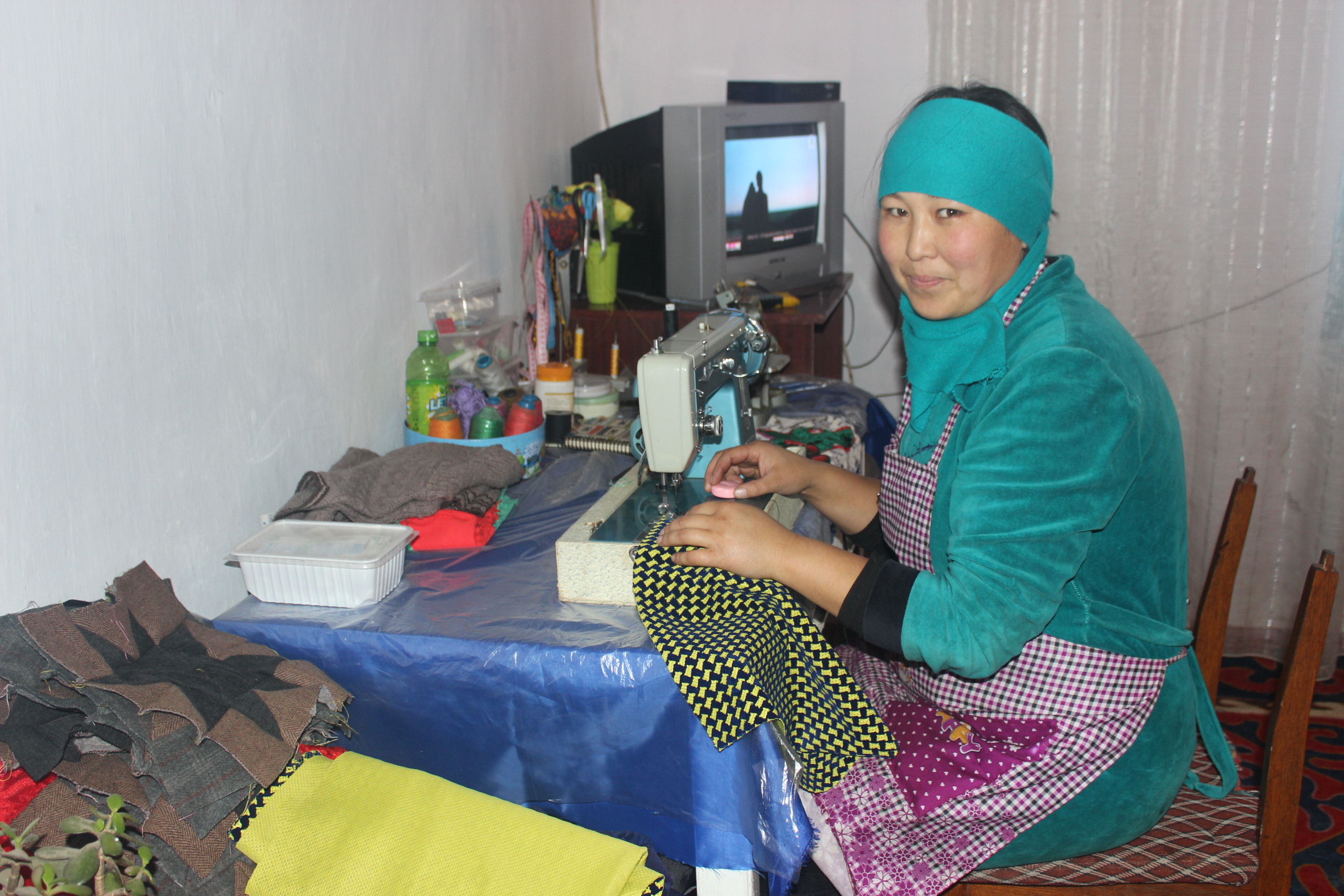
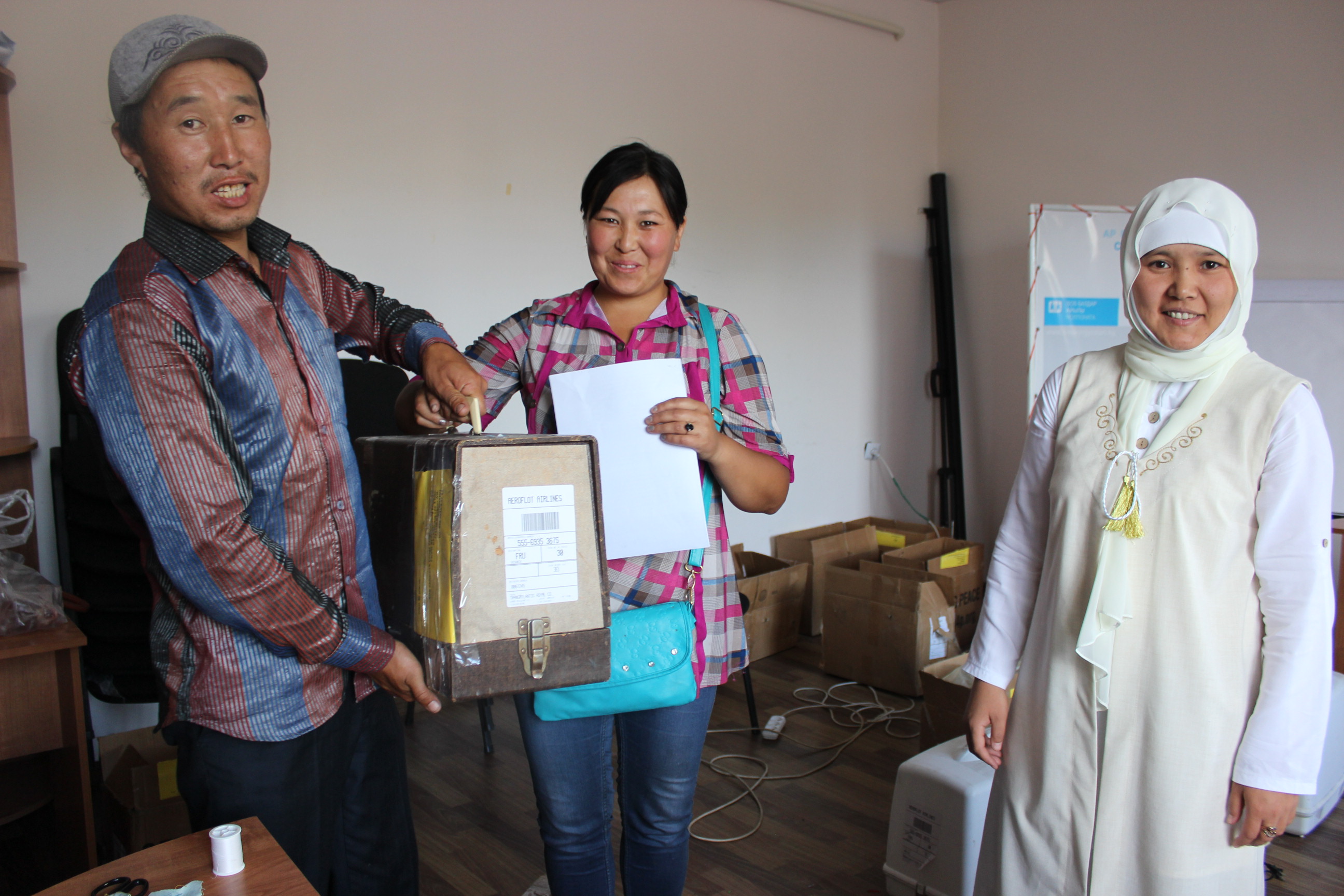
Of the 30 sewing machines received, 23 have been repaired. These machines have greatly improved the lives of our beneficiaries, helping give low-income families in our region a way to earn valuable income for their families. Because many of our beneficiaries are single parents, our beneficiaries use them to run businesses out of their homes, allowing them to care for their children while working. In order to make our work sustainable, we are always looking for ways to support our beneficiaries in finding long-term solutions to issues that they are experiencing. Your donation of sewing machines has helped us do just that. Thanks for your support!

Family Narratives
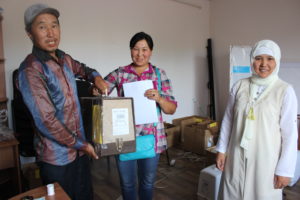
“When we first applied for assistance from the Family Strengthening Project (FSP) my family was in a very difficult situation. Our family had practically no income, and we had extreme difficulty feeding our children. Thanks to FSP and their partnership with Sewing Peace, I had the opportunity to take sewing courses and receive state certification and started a sewing business with three other families in January 2017. Our business has received two sewing machines, and we are already taking orders and sewing products for an upcoming wedding.
We are very thankful for the generous donation life-changing support from Sewing Peace.”
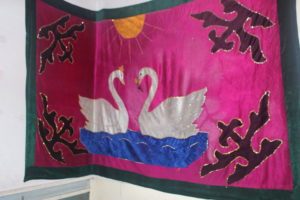


“I am the mother of five children, and did not have enough income to care for them well. I have been an FSP beneficiary for a year, and they have provided me with necessary material and psychological support. But I was still in need of a job to provide long-term, steady income for my family. Because of the donation from Sewing Peace, I was given a sewing machine to start a business from my home. Already, I have received and fulfilled many orders using this machine.

Aside from providing work for me, this sewing machine has allowed me to sew necessary items for my family. Because of this donation, I am better able to care for my family. Thank you for your donation and for how you supported my family through a very difficult time.”


The Sewing Machine

Summer 2017 InStitch


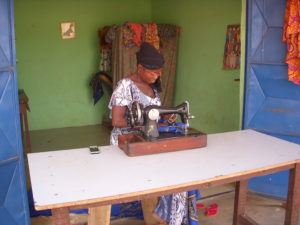
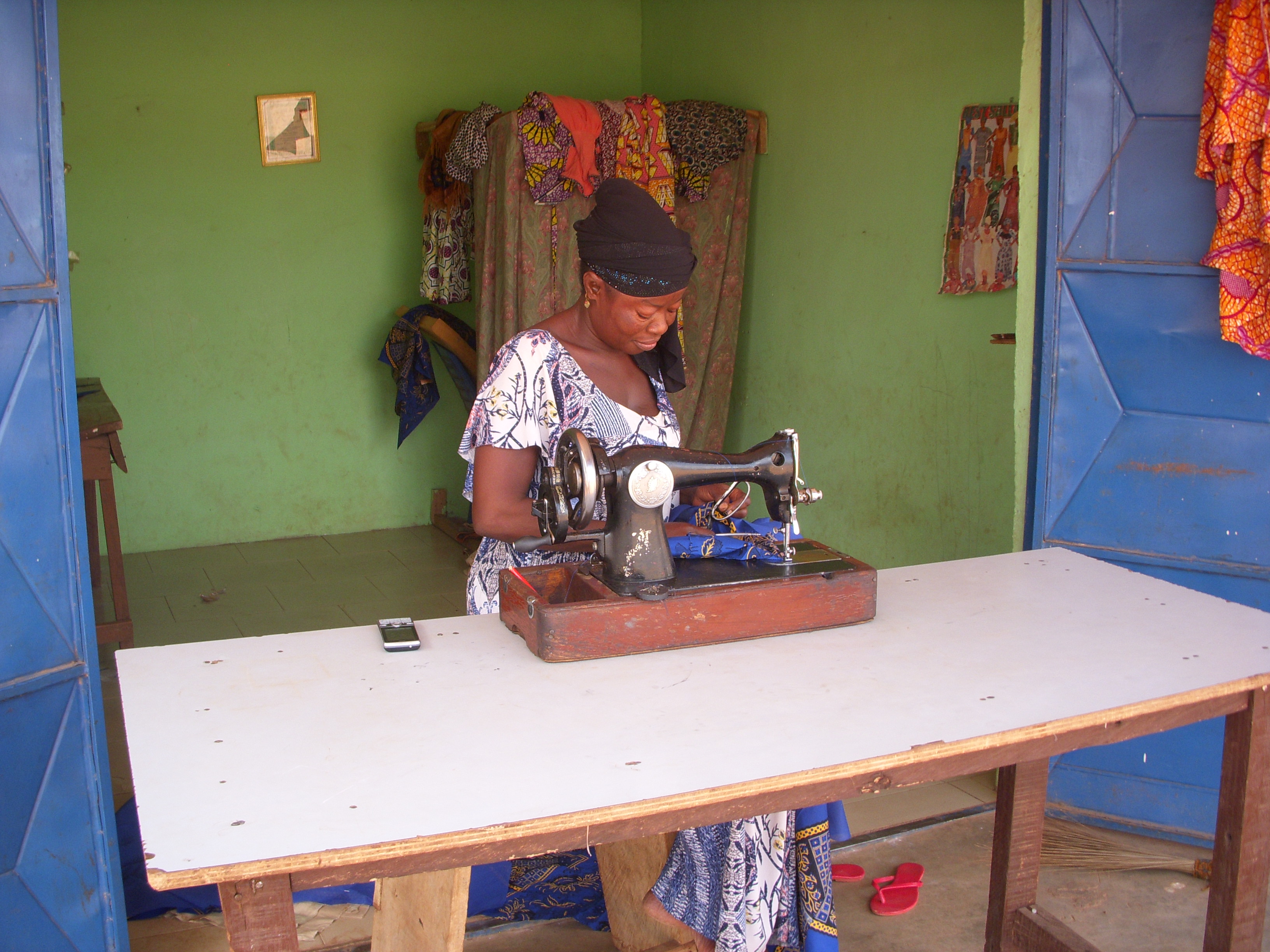
Sewing may generally be described as an art whereby stitches and seams are used to join two or more fabrics together.  Depending on their creativity and imagination, seamstresses and tailors design and sew clothing so that people will look extremely beautiful in it when they wear it.

Since sewing machines seem expensive to young people from relatively needy families, they find it difficult to get one on their own when they want to engage or enroll into such a vocation or profession. Fortunately, this problem has been curbed in some areas in Ghana due to help from WEBike.

The machine is bought at a rather cheap price. This enables young people to learn the vocation and establish their own businesses easily, and then to train other people in that field and engage the employment of other younger generations who are interested in sewing and designing. This has helped to reduce marginally the unemployment rate.

A sewing job also keeps young and energetic people away from dangerous and sometimes criminal behavior. They prefer the vocation to such negative vices.

Economically, it has also helped them to take care of themselves and families as well, especially in the area of education from basic to tertiary.

We are so grateful to the WEBike organization for their help and support.

Liberia: New Partner, May 2017

Sewing Peace is proud to announce that we are adding an additional program. The Tailoring 4 Life Project of Education Care Africa, based in Monrovia, Liberia, is our new partner. The machines will be sailing out of Port Newark on the ACL Atlantic Star on the 6th of June, 2017. The shipment is scheduled to arrive in Monrovia via Antwerp on the 9th of August.

We used a new configuration in our packing. We had several treadle and hand-crank manual sewing machines that should be welcome in parts of the country with unreliable electricity, so we stacked the portable electric machines around the sides of the pallet and put the manuals inside. Liberia is getting four pre-1915 treadles, two lovely Singer hand-crank machines from around 1915, and 64 electrics.

The Tailoring 4 Life Project has three main goals:

  1. Hire experienced tailors to produce designer clothing for sale and to provide tailoring services to the community.
  2. For women who wish to learn tailoring, train them in a six-month program after which they can rent-to-buy a sewing machine.
  3. For women who do not wish to learn tailoring, train them in retail sales.

Welcome, Education Care Africa!

Report from Tanzania, Summer 2017

Summer 2017 InStitch

Introduction

The Honorable Sophia Mwakagenda is a Member of the Parliament of Tanzania. From 1 April 2016 to 20 March 2017 the Honorable Mwakagenda visited different constituencies of the Longido and Ngorongoro districts in the Arusha region, and the districts of Rungwe, Kyela, Mbarali, and Mbeya in the Mbeya region. This visit was a continuation of visits countrywide in order to listen to the people and implement some of her programs through her NGO She Can Foundation.

The visits in Mbeya and Arusha regions were coordinated by the Office of Members of Parliament located in Mbeya city.

Honorable Mwakagenda was accompanied by a team of 4 researchers and assistants: Edwin Mwaitebele, Emmanuel Ngwetta, Mpegwa Mwakang’ata, and Frank Kayumba.

The Purpose of the Visit

The purpose of the visit was to help women’s entrepreneur groups by giving them means of production, like sewing machines, to improve their productivity in their local settings.

Specific Objectives

  • To meet women’s social and economic groups in different areas to hand over support and equipment including sewing machines
  • To provide some knowledge and skills to these groups

Activities


The team met six women’s social and economic groups from seven constituencies of Arusha and Mbeya regions with the aim of sharing with them knowledge and skills on entrepreneurship for them to improve their work. The MPs handed over sewing machines during this visit. In Mbeya region and Arusha region, which is Masaai, the MPs handed over a total of 61 sewing machines.

The Honorable Mwakagenda gave four sewing machines to women’s entrepreneur groups in Mbeya urban constituencies.

In her visit of 17 and 18 March to the Longido district of Arusha region, MP Mwakagenda gave a sewing machine to a 21-year-old woman known as Grace from the Ngarenaibo village. The machine gives Grace employment and should improve her family’s economic situation.

Numbers of Sewing Machines Given

From 1 April 2016 to 23 March 2017, MP Mwakagenda gave 73 sewing machines as follows in Mbeya and Arusha regions.

REGION (District) NUMBER OF MACHINES

MBEYA (Kyela, Rungwe, Mbarali, and Mbeya) 36
ARUSHA (Longido and Ngorongoro) 37

TOTAL 73

Other Activities

Honorable Sophia Mwakagenda had an opportunity to visit Ngorongoro Crater, which is an international tourist attraction in Ngorongoro district and talked with the leadership concerning their challenges in their day to day work.

Honorable Mwakagenda also visited her fellow MP Honorable Cecilia Pareso in Karatu district to console her on her brother’s death, which happened few days ago.

Reflections on the Visits

MP Mwakagenda and her team got a good reception from the leadership and citizenry in general.

The level of awareness of the people, particularly women, in attending, listening and participating to the Member of Parliament meetings was very high.

These visits give people hope: the visits show love and togetherness in society regardless of location, tribe, background, status, and colour.

Sewing in Kenya

Summer 2017 InStitch

Cherehani Africa provides sewing machines to women in rural Kenya to enable them to start and run their own independent tailoring businesses.  Lillian Onyango lives and works in Madiany market, Siaya County. Lillian has four children, three of whom go to school. Lillian learned dress-making skills at Ruma Training Institute in 2010 but has been unable to afford to purchase her own sewing machine to enable her to start her own tailoring business. For the last seven years Lilian has been leasing a sewing machine to enable her to generate income and provide for her children.

She pays a monthly leasing fee of $5, and this fee reduced her profits and chances of ever owning her own machine. When Cherehani Africa met Lilian and told her about our partnership with Sewing Peace that will enable her and many more women in rural Siaya to acquire sewing machines, she was overwhelmed with joy. For her, the sewing machine she has received from Sewing Peace is the first production tool she owns in her own name. Lilian made a down payment of $40 for the sewing machine and committed to completing the deficit of $20 in two months. Lilian no longer has to lease a sewing machine and is able to take home more money to support her family. Through the partnership of Cherehani Africa and Sewing Peace, Lillian no longer has to worry about leasing a tool she depends on for her survival. All her energy and savings are now directed at completing the payment for the sewing machine. “Thank you Sewing Peace for enabling me to own a sewing machine. I will work very hard to ensure that you can extend your support to many more women like me in Kenya,” says Lilian.

Hello David,

The total cost for the machine is $60, which most beneficiaries pay off in six monthly installments of $10. All the machines that we received were in merchantable condition and we have not had to repair any before issuing. We broadly put the machines into two categories: those that could be converted to manual ($60) and those that are strictly electrical ($80). The ones that could be converted to manual have been widely issued as most beneficiaries work in stations without electricity. The electric ones have moved slower because they are more suitable for urban centers.

Best Regards,

Robert Mboya

Kyrgyzstan Sewing Update

Summer 2017 InStitch

Of the 30 sewing machines received, 23 have been repaired. These machines have greatly improved the lives of our beneficiaries, helping give low-income families in our region a way to earn valuable income for their families. Because many of our beneficiaries are single parents, our beneficiaries use them to run businesses out of their homes, allowing them to care for their children while working. In order to make our work sustainable, we are always looking for ways to support our beneficiaries in finding long-term solutions to issues that they are experiencing. Your donation of sewing machines has helped us do just that. Thanks for your support!

Family Narratives

“When we first applied for assistance from the Family Strengthening Project (FSP) my family was in a very difficult situation. Our family had practically no income, and we had extreme difficulty feeding our children. Thanks to FSP and their partnership with Sewing Peace, I had the opportunity to take sewing courses and receive state certification and started a sewing business with three other families in January 2017. Our business has received two sewing machines, and we are already taking orders and sewing products for an upcoming wedding.
We are very thankful for the generous donation life-changing support from Sewing Peace.”


“I am the mother of five children, and did not have enough income to care for them well. I have been an FSP beneficiary for a year, and they have provided me with necessary material and psychological support. But I was still in need of a job to provide long-term, steady income for my family. Because of the donation from Sewing Peace, I was given a sewing machine to start a business from my home. Already, I have received and fulfilled many orders using this machine.

Aside from providing work for me, this sewing machine has allowed me to sew necessary items for my family. Because of this donation, I am better able to care for my family. Thank you for your donation and for how you supported my family through a very difficult time.”

The Sewing Machine

Summer 2017 InStitch


Sewing may generally be described as an art whereby stitches and seams are used to join two or more fabrics together.  Depending on their creativity and imagination, seamstresses and tailors design and sew clothing so that people will look extremely beautiful in it when they wear it.

Since sewing machines seem expensive to young people from relatively needy families, they find it difficult to get one on their own when they want to engage or enroll into such a vocation or profession. Fortunately, this problem has been curbed in some areas in Ghana due to help from WEBike.

The machine is bought at a rather cheap price. This enables young people to learn the vocation and establish their own businesses easily, and then to train other people in that field and engage the employment of other younger generations who are interested in sewing and designing. This has helped to reduce marginally the unemployment rate.

A sewing job also keeps young and energetic people away from dangerous and sometimes criminal behavior. They prefer the vocation to such negative vices.

Economically, it has also helped them to take care of themselves and families as well, especially in the area of education from basic to tertiary.

We are so grateful to the WEBike organization for their help and support.
Albania Update, March, 2017

Dear David,

I wish you and your organization the best. We have been engaged in several important campaigns.

After four years, supported by money we earned by selling shopping bags we made with P4P sewing machines, we won an important battle against plastic garbage. YES! Now even people in Albania are paying a modest fee for plastic bags. This has created an even larger market for our bags. Another mission accomplished together: PASS & P4P!

Building bike frames in Albania

The project of the Albanian Bicycle is taking life. So far we have produced 50 bicycle frames, 100% Albanian.These bikes fill different roles than the excellent bicycles we get from P4P. The Albanian bikes we are building are cargo bikes, taxi bikes, coffee bikes, etc. For each bike sold we are still planting 10 trees. ☺

We are also very interested in solar panels. We are highly active in environmental issues and have implemented several projects involving solar energy. We would like to continue our mission to promote clean energies.

LibrAria

We opened a children’s library we call LibrAria in the Grand Park of Tirana. About 5000 children per month visit us there. With the generous help of a local publishing house, we offer children’s books for no charge. Besides books, we also offer musical instruments – guitars and percussion – that the kids can play in the park. On Mondays we have a flutist who gives free lessons.

albania2017aprKidsBookstoreIMG_1888We invented games that give the kids a better appreciation of nature. For example, on the Island of Little Robinson Crusoe we asked the children to think about how they would survive, how they could sustain themselves, if they had to live outside. Another time we started the Odyssey island project and the children helped build a small boat to get to the island. A third time we created the Island of Indian Tents. We always have colors and paints that the kids use in the projects.

On Saturday evenings we bring in a piano and invite adults to listen to the music and enjoy a glass of wine. We’ve also had some fantastic music from Trio Bonae, who play classical music for violin, cello, and contrabass.

So we’re outside in the park with the children, their parents, and the lake, books, trees, tents, and games. We feel so good about this project.

THANK YOU for your hard work and for everything P4P has done for Albania and for our organization. We wish you only the best in the future!

Sincerely,

Ened Mato

[Check out this one-minute video of a dance party with PASS making fabric bags using P4P sewing machines.]